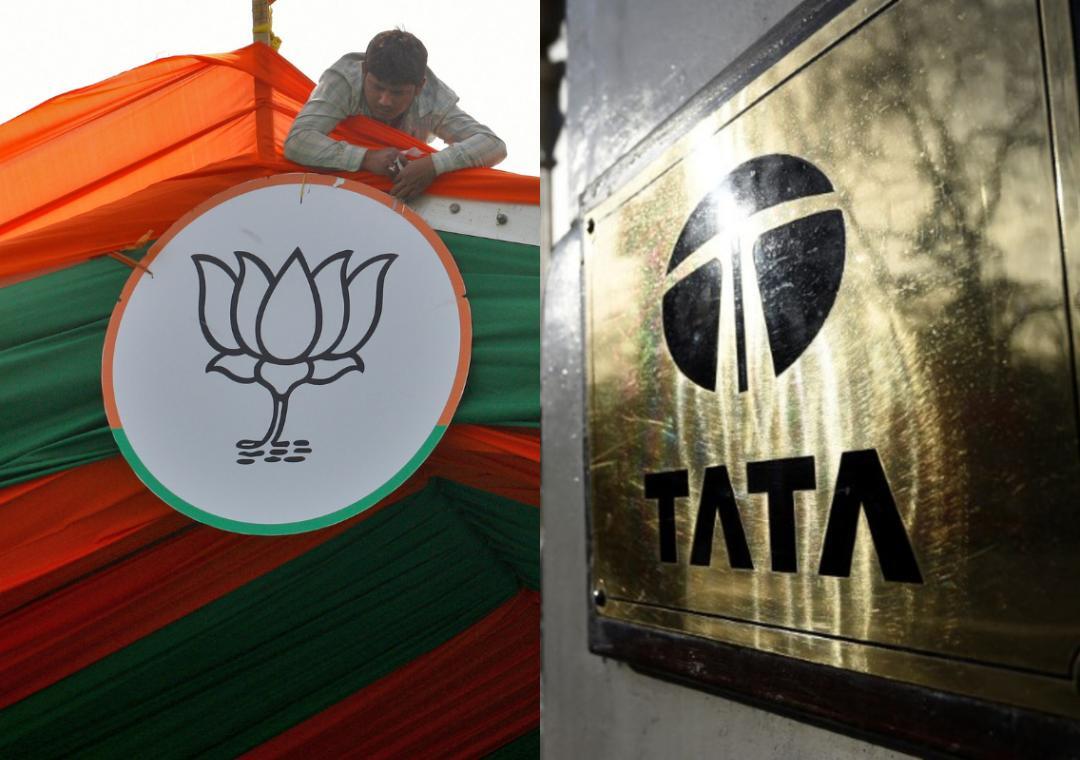
Tata Group donates ₹758 crore to BJP, weeks after approval for semiconductor units: Report
The Tata Group, one of India’s largest and most influential conglomerates, has been in the news recently for its significant donations to the Bharatiya Janata Party (BJP). According to reports, the Tata Group donated a staggering ₹758 crore to the BJP in April 2024, just weeks after the company received substantial subsidies for two of its semiconductor units. This donation, made just days before the 2024 Lok Sabha elections, has raised eyebrows and sparked debate about the nature of corporate-political relationships in India.
The donations, which accounted for nearly 83% of the group’s total contributions, were sourced from 15 different Tata companies. In contrast, the Indian National Congress, the main opposition party, received a relatively paltry 8.4% of the group’s donations. This significant disparity has led to allegations of favoritism and undue influence, with many questioning the timing and motivations behind the Tata Group’s generous donation to the BJP.
The subsidies in question, totaling ₹44,000 crore, were approved for two of the Tata Group’s semiconductor units. This massive investment is part of the Indian government’s efforts to boost the country’s semiconductor industry and reduce its reliance on foreign imports. The move is expected to create thousands of jobs and stimulate economic growth, but the proximity of the donation to the subsidy approval has raised concerns about the relationship between the government and big business.
The Tata Group’s donation to the BJP is not an isolated incident. Corporate donations to political parties are a common practice in India, with many companies seeking to curry favor with the ruling party in the hopes of securing favorable treatment and lucrative contracts. However, the scale and timing of the Tata Group’s donation have sparked outrage and calls for greater transparency and accountability in the country’s electoral system.
The issue of corporate donations to political parties is a complex one, with proponents arguing that it is a necessary evil in a country where election campaigns are increasingly expensive and resource-intensive. However, critics argue that such donations create an uneven playing field, where companies with deep pockets can exert undue influence over the political process and secure advantages that are not available to smaller players or individual citizens.
In the case of the Tata Group’s donation to the BJP, the proximity of the subsidy approval and the donation has raised suspicions of quid pro quo. While there is no concrete evidence to suggest that the donation was a direct result of the subsidy approval, the timing of the two events is certainly suspicious. The fact that the donation was made just days before the 2024 Lok Sabha elections, when the BJP was seeking to retain power, has also led to allegations of electoral manipulation.
The implications of the Tata Group’s donation to the BJP are far-reaching and have significant implications for the country’s democratic system. If companies are able to exert such significant influence over the political process, it raises questions about the integrity of the electoral system and the ability of smaller parties and individual candidates to compete on a level playing field.
Furthermore, the donation has also raised concerns about the concentration of economic power in the hands of a few large conglomerates. The Tata Group is one of India’s largest and most influential companies, with interests spanning everything from steel and automobiles to hospitality and telecommunications. The fact that a single company can exert such significant influence over the political process is a worrying sign, and highlights the need for greater regulation and oversight of corporate donations to political parties.
In conclusion, the Tata Group’s donation of ₹758 crore to the BJP, just weeks after the approval of subsidies for its semiconductor units, has raised significant concerns about the nature of corporate-political relationships in India. The donation, which accounted for nearly 83% of the group’s total contributions, has sparked allegations of favoritism and undue influence, and has raised questions about the integrity of the electoral system. As India continues to grapple with the challenges of economic development and democratic governance, it is essential that the country’s political and business leaders prioritize transparency, accountability, and fairness in all their dealings.
About the Author