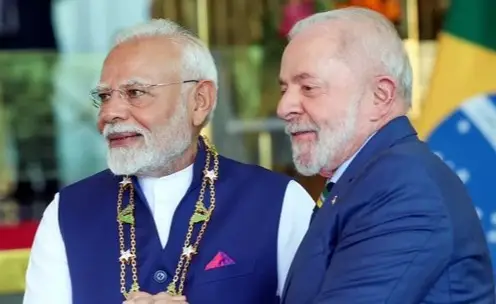
Look forward to welcome Brazil’s Prez Lula da Silva to India: PM Modi
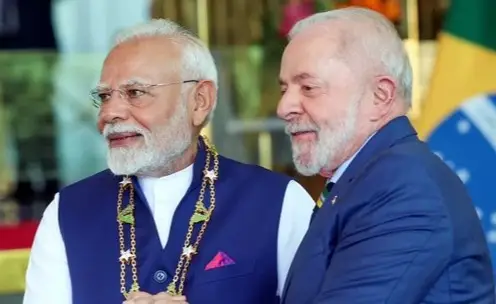
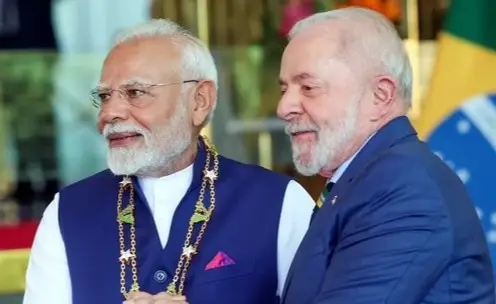
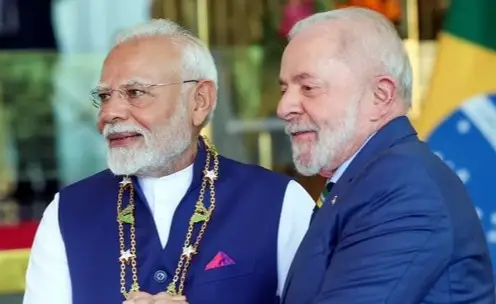
In a significant development, Prime Minister Narendra Modi spoke to Brazil’s President Luiz Inácio Lula da Silva on Thursday, expressing his eagerness to welcome the Brazilian leader to India. The conversation between the two leaders highlights the strong momentum in the India-Brazil Strategic Partnership, which has been gaining traction in recent years. As both countries navigate complex global geopolitics, their bilateral relationship is poised to play a crucial role in advancing the shared interests of the Global South.
During their conversation, PM Modi and President Lula da Silva reviewed the strong momentum in the India-Brazil Strategic Partnership, which has been characterized by increasing cooperation in areas such as trade, investment, defense, and culture. The two leaders acknowledged the significance of their partnership in promoting peace, stability, and prosperity in their respective regions and beyond. PM Modi emphasized that their close cooperation is vital for advancing the shared interests of the Global South, a term that refers to the economic and political alignment of countries in the Southern Hemisphere, including India, Brazil, and other emerging economies.
The India-Brazil Strategic Partnership has been gaining momentum since its inception in 2006. The two countries have been working together on various initiatives, including the India-Brazil-South Africa (IBSA) Dialogue Forum, which aims to promote cooperation among the three countries in areas such as trade, investment, and sustainable development. They have also been collaborating on regional and global issues, including climate change, terrorism, and reform of the United Nations.
One of the key areas of cooperation between India and Brazil is trade. Both countries have been seeking to expand their trade ties, with a focus on increasing bilateral trade in goods and services. However, their trade relationships with the United States have been facing challenges in recent times. Both India and Brazil are facing tariff-related tensions with the US, which has imposed tariffs on certain imports from these countries. The US has also been critical of India’s and Brazil’s trade policies, which it sees as protectionist.
Despite these challenges, India and Brazil have been working together to promote their trade interests and to counter the protectionist tendencies of other countries. They have been advocating for a rules-based international trading system, which promotes free and fair trade among nations. Their cooperation on trade issues is likely to continue, with a focus on promoting their shared interests and advancing the cause of the Global South.
The invitation extended by PM Modi to President Lula da Silva to visit India is a significant development in the context of their bilateral relationship. The visit is likely to provide an opportunity for the two leaders to discuss a range of issues, including trade, investment, defense, and culture. They are also likely to explore new areas of cooperation, including renewable energy, agriculture, and healthcare.
The India-Brazil Strategic Partnership has the potential to play a significant role in promoting peace, stability, and prosperity in the region. As two of the largest democracies in the world, India and Brazil have a shared commitment to promoting democratic values and human rights. They have also been working together to promote sustainable development, with a focus on reducing poverty, inequality, and environmental degradation.
In conclusion, the conversation between PM Modi and President Lula da Silva highlights the strong momentum in the India-Brazil Strategic Partnership. As both countries navigate complex global geopolitics, their bilateral relationship is poised to play a crucial role in advancing the shared interests of the Global South. The invitation extended by PM Modi to President Lula da Silva to visit India is a significant development, which is likely to provide an opportunity for the two leaders to discuss a range of issues and to explore new areas of cooperation.
About the Author