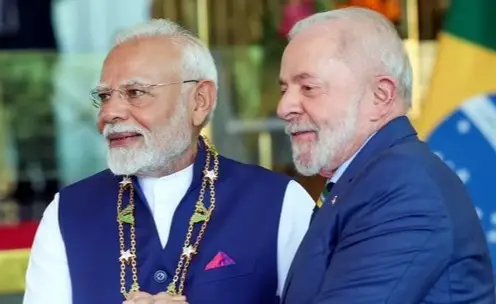
Look forward to welcome Brazil’s Prez Lula da Silva to India: PM Modi
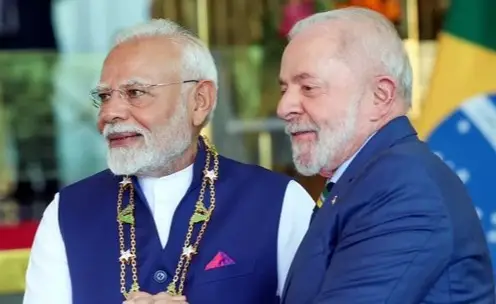
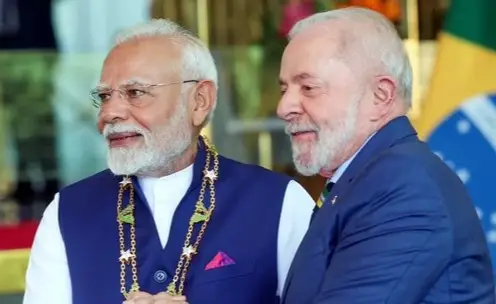
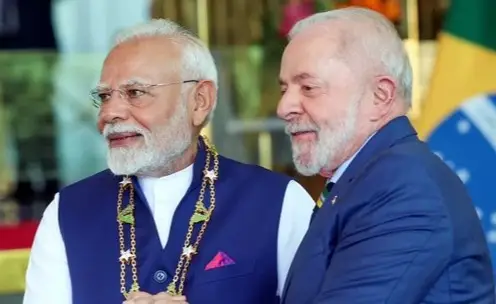
In a significant development, Prime Minister Narendra Modi spoke to Brazil’s President Luiz Inácio Lula da Silva on Thursday, expressing his eagerness to welcome the Brazilian leader to India. The conversation between the two leaders is a testament to the strong and growing bilateral relationship between India and Brazil. As Modi tweeted after the call, “We reviewed the strong momentum in the India-Brazil Strategic Partnership…Our close cooperation is vital for advancing the shared interests of the Global South.”
The India-Brazil Strategic Partnership has indeed gained significant momentum in recent years, with both countries cooperating closely on a range of issues, including trade, investment, defense, and climate change. The partnership is built on the foundation of shared values and interests, including a commitment to democracy, human rights, and the rule of law. As two of the largest democracies in the world, India and Brazil have a natural affinity, and their relationship has the potential to play a significant role in shaping the global agenda.
One of the key areas of cooperation between India and Brazil is trade. Both countries have significant trade relationships with each other, with India being one of Brazil’s largest trading partners in Asia. The two countries have been working to increase trade and investment flows, and have set a target of reaching $15 billion in bilateral trade by 2025. However, both India and Brazil are facing tariff-related tensions with the US, which has imposed tariffs on certain imports from both countries. This has created a challenging environment for trade, and both Modi and Lula da Silva have been vocal about the need for a more equitable and rules-based trading system.
Despite these challenges, the India-Brazil relationship remains strong, and both countries are committed to deepening their cooperation. As Modi noted during the call, the close cooperation between India and Brazil is vital for advancing the shared interests of the Global South. This refers to the grouping of countries in the global south, which includes countries in Africa, Asia, and Latin America. The Global South is home to a significant proportion of the world’s population, and its countries are increasingly playing a major role in shaping the global agenda.
The India-Brazil partnership is also significant in the context of the BRICS grouping, which includes Brazil, Russia, India, China, and South Africa. The BRICS countries are among the largest and most populous countries in the world, and their cooperation has the potential to shape the global economy and politics. As two of the founding members of the BRICS grouping, India and Brazil have a special responsibility to drive the agenda of the grouping and promote the interests of the Global South.
In addition to trade and investment, India and Brazil are also cooperating closely on defense and security issues. Both countries have a long history of cooperation in this area, and have been working together to promote peace and stability in their respective regions. The two countries have also been cooperating on issues such as counter-terrorism, cybersecurity, and maritime security, and have been working together to promote the rule of law and human rights.
The conversation between Modi and Lula da Silva also comes at a time when both countries are facing significant challenges at home. In India, the government is grappling with the challenges of economic growth, job creation, and social inequality. In Brazil, the government is facing challenges related to corruption, crime, and economic stagnation. Despite these challenges, both countries remain committed to deepening their cooperation and promoting the interests of the Global South.
In conclusion, the conversation between Prime Minister Narendra Modi and President Lula da Silva is a significant development in the India-Brazil relationship. The two leaders have reaffirmed their commitment to deepening their cooperation and promoting the interests of the Global South. As India and Brazil look to the future, they are likely to play an increasingly important role in shaping the global agenda, and their partnership has the potential to drive growth, prosperity, and stability in the years to come.
About the Author