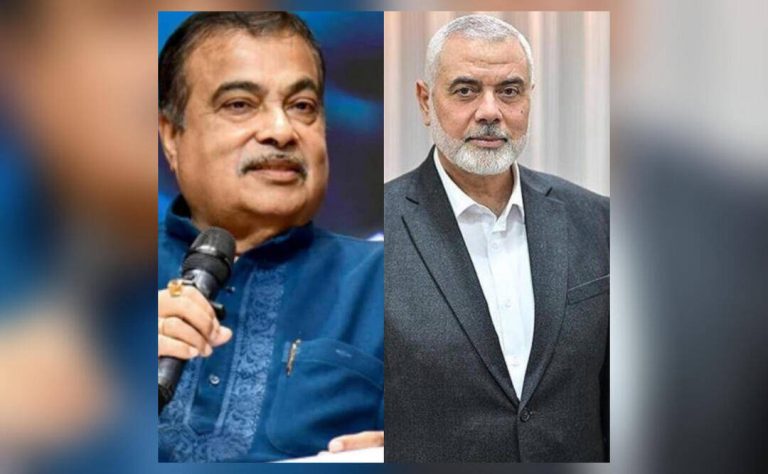
Nitin Gadkari says he met Hamas leader Ismail Haniyeh hours before his murder in Iran
In a shocking revelation, Union Minister Nitin Gadkari disclosed that he had met with Hamas political chief Ismail Haniyeh in Tehran, just hours before the latter’s assassination in 2024. The meeting took place when both Gadkari and Haniyeh were in Iran to attend the inauguration of Masoud Pezeshkian. This unexpected turn of events has sent shockwaves across the globe, with many trying to piece together the circumstances surrounding the assassination.
Gadkari, who is known for his diplomatic endeavors, revealed that he had returned to his hotel after attending the inauguration ceremony. However, his evening took an unexpected turn when the Indian ambassador informed him that they would have to leave the country immediately due to the assassination of Ismail Haniyeh. This sudden development not only highlights the volatile nature of global politics but also underscores the complexities of international diplomacy.
The assassination of Ismail Haniyeh, a prominent figure in the Palestinian Islamist movement Hamas, has significant implications for the Middle East and global politics. As the political chief of Hamas, Haniyeh played a crucial role in shaping the organization’s stance on various issues, including its relations with Israel and other countries in the region. His death is likely to create a power vacuum within Hamas, which could have far-reaching consequences for the region.
Gadkari’s meeting with Haniyeh, although brief, assumes significance in the context of India’s diplomatic efforts in the Middle East. India has traditionally maintained good relations with both Israel and Palestine, and Gadkari’s meeting with Haniyeh reflects the country’s efforts to engage with all stakeholders in the region. However, the timing of the meeting, just hours before Haniyeh’s assassination, has raised eyebrows and sparked speculation about the circumstances surrounding the event.
The Iranian government has blamed Israel’s Mossad intelligence agency for the assassination, which has further escalated tensions between the two countries. The IRGC (Islamic Revolutionary Guard Corps) has vowed to avenge Haniyeh’s death, which could lead to a significant escalation of violence in the region. The international community is watching the situation closely, with many calling for restraint and diplomacy to prevent further bloodshed.
The assassination of Ismail Haniyeh also highlights the complexities of international diplomacy, where even the slightest miscalculation can have far-reaching consequences. The fact that Gadkari met with Haniyeh just hours before his assassination underscores the unpredictable nature of global politics, where even the most well-intentioned efforts can go awry.
As the situation continues to unfold, India is likely to maintain a cautious approach, given its strategic interests in the Middle East. The country has significant economic and diplomatic stakes in the region, and any escalation of violence could have negative consequences for India’s interests. Gadkari’s meeting with Haniyeh, although brief, reflects India’s efforts to engage with all stakeholders in the region, and the country is likely to continue its diplomatic efforts to promote peace and stability in the Middle East.
In conclusion, the assassination of Ismail Haniyeh is a significant development that has far-reaching implications for global politics. Nitin Gadkari’s meeting with Haniyeh, just hours before his assassination, highlights the complexities of international diplomacy and the unpredictable nature of global events. As the situation continues to unfold, India is likely to maintain a cautious approach, given its strategic interests in the Middle East.
About the Author