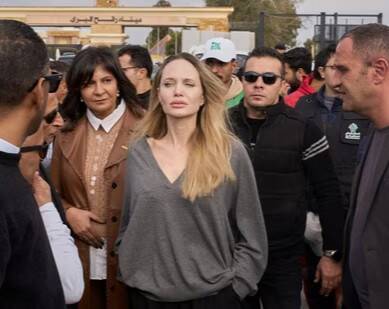
Angelina Jolie Visits Gaza’s Rafah Crossing amid Israeli Suspension
The Gaza Strip, a region that has been plagued by conflict and humanitarian crises for decades, has recently received a high-profile visitor. Hollywood actress and ex-UN special envoy Angelina Jolie visited the Rafah Crossing in Gaza on Friday, bringing attention to the plight of the Palestinian people. The visit comes at a time when Israel has announced the suspension of aid organizations working in the Gaza Strip, unless they renew their registrations. This move has sparked concerns about the already precarious humanitarian situation in the region.
According to a CNN report, Angelina Jolie’s visit to the Rafah Crossing was a poignant reminder of the struggles faced by the people of Gaza. During her visit, she witnessed firsthand the effects of the Israeli suspension of aid organizations. “I walked through a large warehouse that was full of items that were denied entry, most of them medical,” she said. This statement highlights the severity of the situation, where essential medical supplies are being denied entry, exacerbating the suffering of the people.
The Rafah Crossing is a critical entry point for goods and humanitarian aid into the Gaza Strip. However, the Israeli authorities have imposed strict restrictions on the crossing, severely limiting the flow of essential supplies. The suspension of aid organizations working in the region has further compounded the problem, leaving many Palestinians without access to basic necessities like food, water, and medical care.
Angelina Jolie’s visit to the Rafah Crossing is a testament to her long-standing commitment to humanitarian causes. As a former UN special envoy, she has worked tirelessly to bring attention to the plight of refugees and displaced persons around the world. Her visit to Gaza is a powerful statement about the need for international attention and action to address the humanitarian crisis in the region.
The Israeli authorities’ decision to suspend aid organizations working in the Gaza Strip has been widely criticized by human rights groups and international organizations. The move is seen as a further attempt to strangle the already fragile economy of Gaza, and to restrict the flow of humanitarian aid to the region. The suspension has also raised concerns about the safety and well-being of the Palestinian population, who are already struggling to survive in a region plagued by poverty, unemployment, and violence.
The Gaza Strip has been under an Israeli blockade since 2007, which has had a devastating impact on the region’s economy and infrastructure. The blockade has restricted the flow of goods and people in and out of the region, leading to widespread poverty, unemployment, and humanitarian crises. The situation has been further exacerbated by repeated conflicts between Israel and Palestinian militant groups, which have resulted in significant damage to infrastructure and loss of life.
In this context, Angelina Jolie’s visit to the Rafah Crossing is a beacon of hope for the people of Gaza. Her presence highlights the need for international attention and action to address the humanitarian crisis in the region. It also underscores the importance of supporting aid organizations working in the Gaza Strip, who are providing essential services to the Palestinian population.
The international community has a critical role to play in addressing the humanitarian crisis in the Gaza Strip. This includes providing financial and logistical support to aid organizations working in the region, as well as advocating for an end to the Israeli blockade and the suspension of aid organizations. It also requires a commitment to finding a lasting solution to the conflict, one that recognizes the rights and dignity of the Palestinian people.
In conclusion, Angelina Jolie’s visit to the Rafah Crossing in Gaza is a powerful reminder of the humanitarian crisis in the region. The Israeli suspension of aid organizations working in the Gaza Strip has exacerbated an already precarious situation, leaving many Palestinians without access to basic necessities like food, water, and medical care. As the international community, we have a moral obligation to act, to support aid organizations working in the region, and to advocate for an end to the Israeli blockade and the suspension of aid organizations. We must also recognize the rights and dignity of the Palestinian people, and work towards a lasting solution to the conflict.
About the Author