Khawaja Asif’s ‘Pak won’t need IMF in 6 months’ claim runs into a $10.6-bn wall: Report
In a recent statement, Pakistan’s Defence Minister Khawaja Asif sparked controversy by claiming that the country would no longer require the assistance of the International Monetary Fund (IMF) within the next six months. This assertion was made in an effort to alleviate concerns regarding Pakistan’s economic stability and potential collapse. However, a closer examination of the country’s financial obligations reveals that Asif’s claim may be overly optimistic, if not entirely unrealistic.
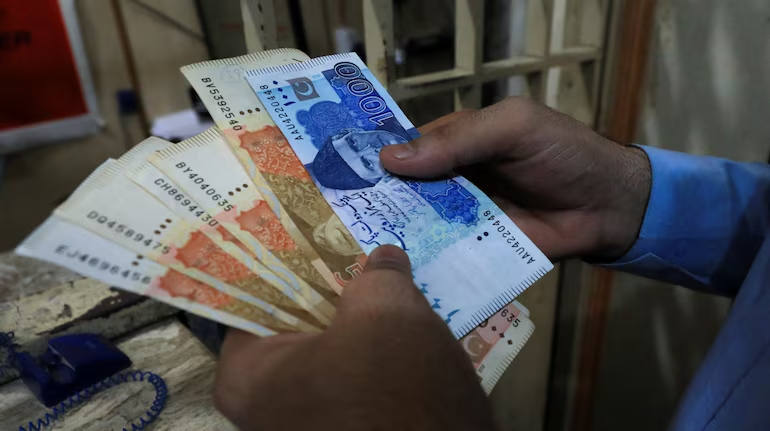
According to a report by Moneycontrol, Pakistan’s ability to forgo IMF assistance is hindered by a significant obstacle: a staggering debt of $10.6 billion owed to the IMF alone. This substantial financial burden poses a major challenge to Asif’s claim, as it is unlikely that Pakistan can single-handedly overcome its economic woes without external support.
Despite Pakistan’s successful conversion of its Operation Sindoor-linked propaganda into defence deals worth billions, these agreements are unlikely to be sufficient to rescue the country from economic ruin. The defence deals, while significant in terms of their financial value, do not address the underlying structural issues that have contributed to Pakistan’s economic instability.
Pakistan’s economic struggles are well-documented, with the country facing a range of challenges including a large trade deficit, dwindling foreign exchange reserves, and a significant reliance on external borrowing. The IMF has played a crucial role in providing financial support to Pakistan in recent years, with the country having received numerous loans and credit facilities to help stabilize its economy.
Asif’s claim that Pakistan will no longer require IMF assistance within six months is therefore puzzling, given the country’s significant debt obligations and ongoing economic challenges. While the defence minister’s statement may have been intended to boost confidence in Pakistan’s economic prospects, it is unlikely to alleviate concerns among investors and international observers.
In fact, Asif’s claim has been met with skepticism by many experts, who point out that Pakistan’s economic situation is far more complex and nuanced than a simple assertion of self-sufficiency. The country’s economic woes are deeply ingrained, and will require a comprehensive and sustained effort to address.
Furthermore, the IMF’s support is not limited to providing financial assistance; the organization also plays a crucial role in promoting economic reform and stability in countries that receive its support. Pakistan’s relationship with the IMF is therefore not simply a matter of receiving loans, but also involves a range of economic and policy reforms that are designed to promote long-term stability and growth.
In light of these factors, it is clear that Asif’s claim that Pakistan will no longer require IMF assistance within six months is unlikely to materialize. The country’s significant debt obligations, combined with its ongoing economic challenges, mean that external support will likely be required for the foreseeable future.
As the Pakistani government seeks to navigate its complex economic landscape, it is essential that policymakers adopt a realistic and pragmatic approach to addressing the country’s challenges. This will involve working closely with international partners, including the IMF, to develop and implement effective economic reforms that promote stability and growth.
In conclusion, Khawaja Asif’s claim that Pakistan will not require IMF assistance within six months is a bold assertion that runs into a significant obstacle: a $10.6 billion debt owed to the IMF alone. While the country has achieved success in converting its Operation Sindoor-linked propaganda into defence deals, these agreements are unlikely to be sufficient to rescue Pakistan from economic ruin. As the country navigates its complex economic landscape, it is essential that policymakers adopt a realistic and pragmatic approach to addressing its challenges, and work closely with international partners to promote stability and growth.
About the Author