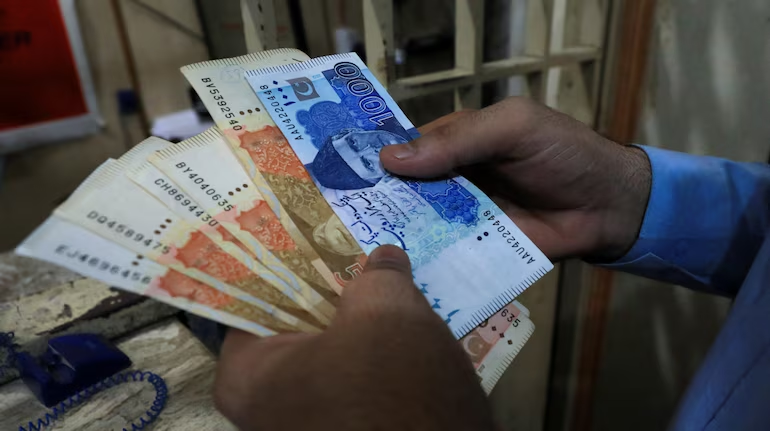
Khawaja Asif’s ‘Pak won’t need IMF in 6 months’ claim runs into a $10.6-bn wall: Report
In a recent statement, Pakistan’s Defence Minister Khawaja Asif claimed that the country would not need the International Monetary Fund (IMF) in six months to save it from economic collapse. However, this claim has run into a significant obstacle, with Pakistan owing a staggering $10.6 billion to the IMF alone. According to a report by Moneycontrol, this massive debt poses a significant challenge to Pakistan’s economic stability, and it remains to be seen whether the country can manage to overcome this hurdle.
The claim made by Khawaja Asif was seen as a bold statement, given the current economic situation in Pakistan. The country has been struggling with a severe economic crisis, characterized by high inflation, a large trade deficit, and a dwindling foreign exchange reserve. In this context, the idea that Pakistan would not need the IMF’s assistance in six months seems overly optimistic, to say the least.
One of the main reasons behind Pakistan’s economic woes is its massive external debt. The country owes a significant amount of money to various international lenders, including the IMF. The $10.6 billion debt owed to the IMF is a substantial burden, and it is unlikely that Pakistan can repay this amount in the near future. Moreover, the country’s economic situation is not expected to improve significantly in the next six months, which makes it even more challenging to imagine a scenario where Pakistan would not need the IMF’s assistance.
Despite the challenges, Pakistan has managed to secure some significant defence deals in recent times. The country has been able to convert its Operation Sindoor-linked propaganda into defence deals worth billions of dollars. However, while these deals may provide some temporary relief, they are unlikely to be enough to single-handedly save Pakistan from economic ruin. The country’s economic problems are deeply entrenched, and it will require a much more comprehensive approach to address them.
The defence deals secured by Pakistan are likely to provide some short-term benefits, such as an influx of foreign exchange and an improvement in the country’s balance of payments. However, these benefits are unlikely to be sufficient to offset the massive debt owed to the IMF. Moreover, the deals may also have some negative consequences, such as an increase in the country’s military expenditure, which could further exacerbate the economic crisis.
In addition to the defence deals, Pakistan will need to implement a range of other measures to address its economic challenges. This could include policies to boost exports, reduce imports, and increase foreign investment. The country will also need to take steps to improve its business environment, such as simplifying regulatory procedures and reducing corruption. Furthermore, Pakistan will need to implement fiscal reforms to reduce its budget deficit and improve its tax collection.
The IMF has been providing financial assistance to Pakistan for several years, and the country has been subject to various conditions and restrictions as part of these programmes. While the IMF’s assistance has helped to stabilize Pakistan’s economy, it has also been criticized for imposing harsh conditions that have exacerbated the country’s economic problems. In this context, Khawaja Asif’s claim that Pakistan would not need the IMF’s assistance in six months is seen as a welcome development, as it suggests that the country is trying to reduce its dependence on external lenders.
However, as the report by Moneycontrol suggests, Pakistan’s claim is unlikely to materialize in the near future. The country’s economic challenges are too deep-seated, and it will require a much more comprehensive approach to address them. While the defence deals secured by Pakistan may provide some temporary relief, they are unlikely to be enough to save the country from economic ruin. As such, it is likely that Pakistan will continue to rely on the IMF’s assistance for the foreseeable future.
In conclusion, Khawaja Asif’s claim that Pakistan would not need the IMF’s assistance in six months is an overly optimistic statement that runs into a significant obstacle. The country’s massive debt owed to the IMF, combined with its deep-seated economic challenges, makes it unlikely that Pakistan can manage to overcome its economic woes in the near future. While the defence deals secured by Pakistan may provide some temporary benefits, they are unlikely to be enough to single-handedly save the country from economic ruin. As such, it is likely that Pakistan will continue to rely on the IMF’s assistance for the foreseeable future.
About the Author