Khawaja Asif’s ‘Pak won’t need IMF in 6 months’ claim runs into a $10.6-bn wall: Report
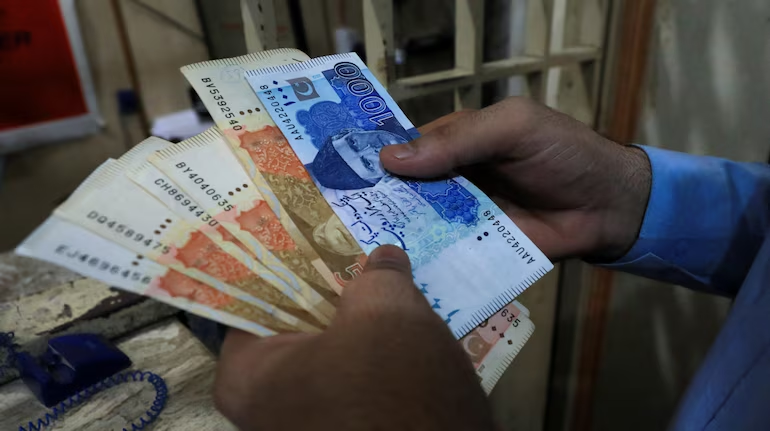
Pakistan’s Defense Minister Khawaja Asif has been making headlines with his claim that the country will not need the International Monetary Fund (IMF) in six months to save it from economic collapse. However, a recent report by Moneycontrol suggests that this claim may be nothing more than a pipe dream. According to the report, Pakistan’s economic woes run deeper than Asif’s optimistic predictions, with a staggering $10.6 billion owed to the IMF alone.
The report highlights the stark reality of Pakistan’s economic situation, which is far from the rosy picture painted by Asif. Despite managing to secure defense deals worth billions, including those linked to Operation Sindoor, the country’s economic fundamentals remain weak. The defense deals, while significant, are unlikely to single-handedly save Pakistan from economic ruin.
Asif’s claim that Pakistan will not need the IMF in six months is based on the assumption that the country’s economy will experience a significant turnaround in the near future. However, with a debt burden of $10.6 billion to the IMF, it is unlikely that Pakistan will be able to wean itself off the international lender’s support anytime soon.
The IMF has been a crucial lifeline for Pakistan’s economy, providing the country with much-needed financial support to avoid default. However, the Fund’s support comes with strings attached, including strict conditions on economic reforms and fiscal discipline. Pakistan has struggled to meet these conditions, which has led to a delay in the disbursement of IMF funds.
The $10.6 billion owed to the IMF is just the tip of the iceberg. Pakistan’s total external debt stands at over $100 billion, with the country facing significant challenges in servicing its debt obligations. The country’s foreign exchange reserves are also dwindling, making it difficult to meet its import bill and maintain a stable exchange rate.
Despite these challenges, Asif remains optimistic about Pakistan’s economic prospects. He has pointed to the country’s success in securing defense deals, including those linked to Operation Sindoor, as evidence of its growing economic clout. However, these deals are unlikely to have a significant impact on Pakistan’s economic fundamentals, at least in the short term.
Operation Sindoor, a military operation launched by Pakistan to counter Indian influence in the region, has been linked to several defense deals worth billions. While these deals are significant, they are unlikely to generate enough revenue to offset Pakistan’s massive debt burden. Moreover, the deals are also likely to come with significant upfront costs, including the purchase of military equipment and the deployment of troops.
In addition to its debt burden, Pakistan also faces significant economic challenges, including a large fiscal deficit and a struggling economy. The country’s economy has been growing at a slow pace, with the IMF projecting a growth rate of just 2% for the current fiscal year. The country’s inflation rate is also high, with prices rising by over 10% in the past year.
The economic challenges facing Pakistan are complex and multifaceted. While Asif’s claim that the country will not need the IMF in six months may be well-intentioned, it is unlikely to materialize anytime soon. The country’s debt burden, combined with its weak economic fundamentals, makes it unlikely that Pakistan will be able to wean itself off the IMF’s support in the near future.
In conclusion, Khawaja Asif’s claim that Pakistan will not need the IMF in six months is unlikely to come true. The country’s economic challenges are significant, and its debt burden is substantial. While defense deals, including those linked to Operation Sindoor, are significant, they are unlikely to single-handedly save Pakistan from economic ruin. The country needs to take a more nuanced approach to addressing its economic challenges, including implementing significant economic reforms and reducing its debt burden.
About the Author