Khawaja Asif’s ‘Pak won’t need IMF in 6 months’ claim runs into a $10.6-bn wall: Report
In a recent statement, Khawaja Asif, a prominent Pakistani politician, claimed that Pakistan will not need the International Monetary Fund (IMF) in six months to save it from economic collapse. However, this claim has run into a significant obstacle, with a whopping $10.6 billion owed to the IMF alone. According to a report by Moneycontrol, this massive debt has raised serious doubts about the feasibility of Asif’s assertion.
The Pakistani government has been struggling to manage its finances, with a severe balance of payments crisis and a dwindling foreign exchange reserve. The country’s economy has been on the brink of collapse, with many experts warning of an imminent default. In this context, Asif’s claim that Pakistan will be able to survive without IMF assistance in six months seems overly optimistic, if not downright unrealistic.
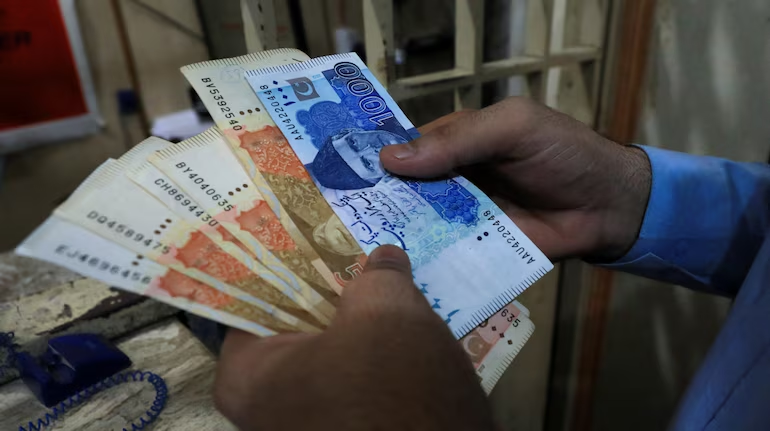
One of the main reasons behind Pakistan’s economic woes is its massive debt burden. The country owes a staggering $10.6 billion to the IMF, which is a significant portion of its total external debt. This debt has been accumulated over the years, with successive governments relying heavily on foreign borrowing to finance their budget deficits. The problem is that Pakistan’s economy is not generating enough revenue to service this debt, let alone repay it.
Despite the challenges, Pakistan has managed to secure some significant defence deals in recent times. The country has been able to convert its Operation Sindoor-linked propaganda into defence deals worth billions of dollars. However, these deals are unlikely to be enough to single-handedly save Pakistan from economic ruin. The country’s economic problems run deep, and a comprehensive solution is needed to address them.
The $10.6 billion owed to the IMF is just the tip of the iceberg. Pakistan’s total external debt is much higher, with estimates suggesting that it could be as high as $100 billion. The country’s debt-to-GDP ratio is also very high, which makes it difficult for the government to service its debt obligations. In this context, Asif’s claim that Pakistan will not need IMF assistance in six months seems like a pipe dream.
The IMF has been a lifeline for Pakistan’s economy in the past, providing the country with much-needed financial assistance to avoid default. However, the IMF’s help comes with conditions, which can be difficult for the Pakistani government to swallow. The fund requires Pakistan to implement significant economic reforms, including increasing taxes, reducing subsidies, and improving governance. These reforms are essential to put Pakistan’s economy on a sustainable path, but they can be painful in the short term.
The Pakistani government has been reluctant to implement these reforms, which has made it difficult for the country to secure IMF assistance. The government has been trying to find alternative sources of funding, including from friendly countries like China and Saudi Arabia. However, these alternatives are not enough to replace the IMF’s assistance, and Pakistan will likely need to return to the fund for help.
In conclusion, Khawaja Asif’s claim that Pakistan will not need IMF assistance in six months is unlikely to materialize. The country’s massive debt burden, including the $10.6 billion owed to the IMF, is a significant obstacle that cannot be ignored. While Pakistan has managed to secure some significant defence deals, these are unlikely to be enough to save the country from economic ruin. The Pakistani government needs to take a comprehensive approach to address the country’s economic problems, including implementing significant economic reforms and seeking assistance from the IMF.
The situation is complex, and there are no easy solutions. However, one thing is clear: Pakistan needs to take drastic measures to address its economic problems, and it needs to do so quickly. The country’s economy is on the brink of collapse, and any further delay will only make things worse. Asif’s claim may have been well-intentioned, but it is not based in reality. Pakistan needs a realistic plan to address its economic problems, and it needs to start implementing it now.
About the Author