Khawaja Asif’s ‘Pak won’t need IMF in 6 months’ claim runs into a $10.6-bn wall: Report
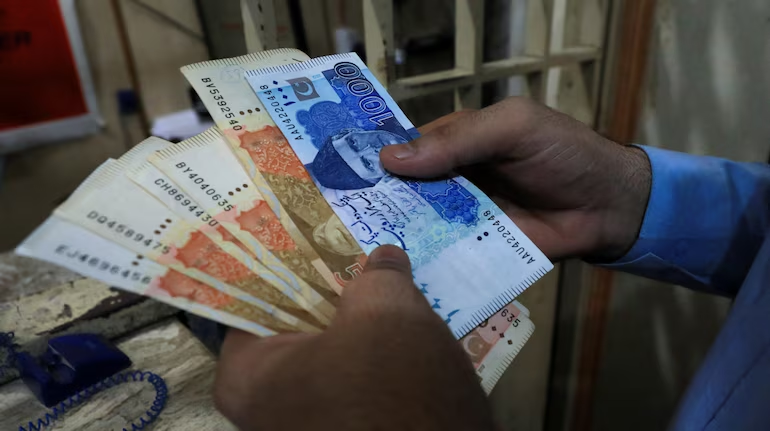
In a recent statement, Khawaja Asif, a prominent Pakistani politician, claimed that Pakistan would not need the International Monetary Fund (IMF) in six months to save it from economic collapse. However, this claim has hit a roadblock, and a significant one at that. According to a report by Moneycontrol, Pakistan’s debts to the IMF alone stand at a staggering $10.6 billion, making it a daunting task for the country to wean itself off the international lender’s support in such a short span.
The claim made by Khawaja Asif was likely an attempt to boost investor confidence and reassure the public that Pakistan’s economy was on the path to recovery. However, the sheer magnitude of the country’s debt obligations tells a different story. The $10.6 billion owed to the IMF is just the tip of the iceberg, as Pakistan’s total external debt stands at a whopping $113 billion. This massive debt burden has been a major contributor to the country’s economic woes, and it will require more than just rhetoric to overcome.
It is worth noting that Pakistan has had some success in recent times in converting its Operation Sindoor-linked propaganda into defence deals worth billions. These deals, while significant, are unlikely to single-handedly save Pakistan from economic ruin. The country’s economy is facing a multitude of challenges, including a large trade deficit, a dwindling foreign exchange reserve, and a struggling industrial sector. While the defence deals may provide a temporary boost to the economy, they are not a long-term solution to the country’s economic problems.
The IMF has been a crucial lifeline for Pakistan’s economy in recent years, providing the country with much-needed loans to help it navigate its economic challenges. However, the IMF’s support comes with conditions, including the implementation of economic reforms aimed at reducing the country’s debt burden and promoting economic growth. Pakistan has struggled to implement these reforms, and as a result, its relationship with the IMF has been tumultuous at best.
The claim made by Khawaja Asif that Pakistan won’t need the IMF in six months is, therefore, a highly ambitious one. It will require a significant improvement in the country’s economic fundamentals, including a reduction in its debt burden, an increase in its foreign exchange reserves, and a boost to its industrial sector. While these are all achievable goals, they will require a sustained effort from the government and other stakeholders over a period of time.
In the short term, Pakistan will likely continue to rely on the IMF for support. The country’s economy is simply not strong enough to withstand the shocks that would come with a sudden withdrawal of IMF support. The IMF’s loans have helped Pakistan to avoid a balance of payments crisis, and their withdrawal would likely lead to a significant depreciation of the Pakistani rupee, inflation, and a decline in economic activity.
In conclusion, Khawaja Asif’s claim that Pakistan won’t need the IMF in six months is a bold one, but it is unlikely to materialize. The country’s debt burden, particularly its obligations to the IMF, is a significant obstacle that will need to be addressed. While Pakistan has had some success in securing defence deals, these are not a substitute for the economic reforms that are needed to put the country’s economy on a sustainable path. The IMF will likely continue to play a crucial role in supporting Pakistan’s economy in the short term, and it will be important for the government to work with the IMF to implement the economic reforms that are needed to promote economic growth and reduce the country’s debt burden.
About the Author