Khawaja Asif’s ‘Pak won’t need IMF in 6 months’ claim runs into a $10.6-bn wall: Report
In a recent statement, Khawaja Asif, a prominent Pakistani politician, claimed that Pakistan would not need the International Monetary Fund (IMF) in six months to save it from economic collapse. However, this claim has run into a significant wall worth $10.6 billion, according to a report by Moneycontrol. The report highlights the enormous challenge that Pakistan faces in meeting its external debt obligations, particularly to the IMF.
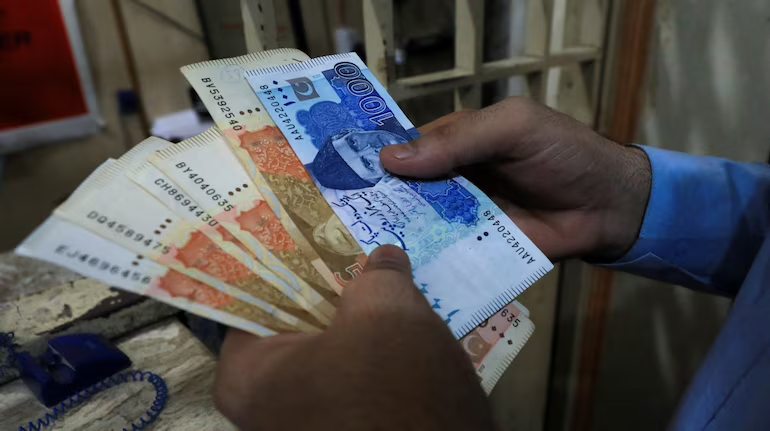
Pakistan has been struggling with a severe economic crisis, characterized by a large trade deficit, depleting foreign exchange reserves, and a heavy debt burden. The country has been relying on the IMF to bail it out, with a $6 billion loan program agreed upon in 2019. However, the program has been suspended due to Pakistan’s failure to meet certain conditions, including increasing taxes and reducing subsidies.
Despite these challenges, Khawaja Asif’s claim that Pakistan would not need the IMF in six months seems overly optimistic. The report by Moneycontrol suggests that Pakistan’s external debt obligations are too large to be met without external assistance. The country owes $10.6 billion to the IMF alone, which is a significant portion of its total external debt.
Meanwhile, Pakistan has been successful in converting its Operation Sindoor-linked propaganda into defense deals worth billions. Operation Sindoor is a propaganda campaign launched by Pakistan to promote its military capabilities and attract foreign investment. The campaign has been successful in securing defense deals with several countries, including China and Turkey. However, these deals are unlikely to single-handedly save Pakistan from economic ruin.
The report by Moneycontrol highlights the limitations of these defense deals in addressing Pakistan’s economic challenges. While the deals may provide some short-term benefits, they are unlikely to generate sufficient revenue to meet Pakistan’s external debt obligations. The country needs a more comprehensive economic strategy that addresses its underlying structural issues, including a large trade deficit and a heavy debt burden.
Furthermore, the report suggests that Pakistan’s economic challenges are not just limited to its external debt obligations. The country is also facing significant internal challenges, including a large fiscal deficit and a struggling economy. The government’s efforts to increase taxes and reduce subsidies have been met with resistance from various stakeholders, including businesses and consumers.
In this context, Khawaja Asif’s claim that Pakistan would not need the IMF in six months seems unrealistic. The country needs a more nuanced approach to addressing its economic challenges, one that takes into account its external debt obligations, internal structural issues, and the need for a comprehensive economic strategy.
The report by Moneycontrol provides a sobering assessment of Pakistan’s economic challenges and the limitations of its current approach. While the country has been successful in securing defense deals and promoting its military capabilities, these efforts are unlikely to be sufficient to address its economic challenges. Pakistan needs a more comprehensive economic strategy that addresses its underlying structural issues and provides a roadmap for sustainable economic growth.
In conclusion, Khawaja Asif’s claim that Pakistan would not need the IMF in six months has run into a significant wall worth $10.6 billion. The country’s external debt obligations, internal structural issues, and the need for a comprehensive economic strategy all suggest that Pakistan’s economic challenges are more complex and deeper-seated than initially thought. While the country has made some progress in promoting its military capabilities and securing defense deals, these efforts are unlikely to be sufficient to address its economic challenges. A more nuanced approach is needed, one that takes into account Pakistan’s external debt obligations, internal structural issues, and the need for a comprehensive economic strategy.
About the Author