Khawaja Asif’s ‘Pak won’t need IMF in 6 months’ claim runs into a $10.6-bn wall: Report
Recently, Khawaja Asif, a prominent figure in Pakistan, made a bold claim that the country will not need the International Monetary Fund (IMF) in six months to save it from economic collapse. This statement was met with a mixture of surprise and skepticism, and a recent report by Moneycontrol has shed some light on the validity of this claim. According to the report, Pakistan’s economic situation is more complex than Asif’s statement suggests, and the country’s financial woes are far from over.
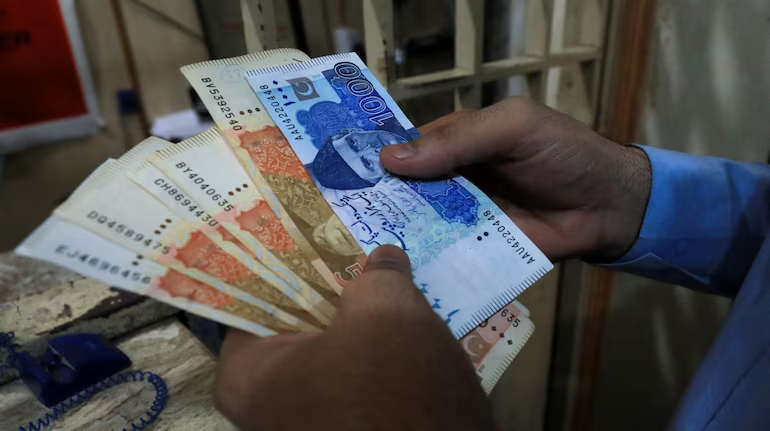
The report highlights that Pakistan has managed to secure defense deals worth billions of dollars, thanks in part to its successful propaganda campaign linked to Operation Sindoor. However, these deals alone will not be enough to save the country from economic ruin. The main obstacle to Pakistan’s economic recovery is the massive debt it owes to the IMF, which stands at a staggering $10.6 billion. This debt is a significant burden on the country’s economy, and it is unlikely that Pakistan will be able to pay it off in the near future.
The IMF has been a crucial lifeline for Pakistan’s economy in recent years, providing the country with much-needed financial assistance to avoid default. However, the IMF’s support comes with conditions, and Pakistan has struggled to meet these conditions in the past. The country’s economy has been plagued by corruption, mismanagement, and a lack of structural reforms, which have hindered its ability to implement the IMF’s recommendations.
Asif’s claim that Pakistan will not need the IMF in six months is therefore highly questionable. The country’s economic situation is far more complex than a simple statement can capture, and it will take more than just defense deals to turn the economy around. The report by Moneycontrol suggests that Pakistan will need to implement significant structural reforms and address its underlying economic issues if it hopes to reduce its reliance on the IMF.
One of the main challenges facing Pakistan’s economy is its large trade deficit. The country imports more than it exports, which puts pressure on its foreign exchange reserves and makes it difficult to pay off its debts. To address this issue, Pakistan will need to increase its exports and reduce its imports, which will require significant investments in industries such as manufacturing and agriculture.
Another challenge facing Pakistan’s economy is its low tax-to-GDP ratio. The country has a large informal economy, which means that many businesses and individuals do not pay taxes. To increase its revenue, Pakistan will need to implement policies that encourage businesses and individuals to pay their taxes, such as reducing tax rates and improving tax administration.
In addition to these structural reforms, Pakistan will also need to address its energy crisis. The country has a severe shortage of electricity, which hinders economic growth and makes it difficult for businesses to operate. To address this issue, Pakistan will need to invest in new energy sources, such as renewable energy, and improve the efficiency of its existing energy infrastructure.
In conclusion, Khawaja Asif’s claim that Pakistan will not need the IMF in six months is overly optimistic. The country’s economic situation is complex, and it will take more than just defense deals to turn the economy around. Pakistan will need to implement significant structural reforms, address its underlying economic issues, and invest in key sectors such as manufacturing, agriculture, and energy. Until then, the country will likely remain reliant on the IMF to avoid economic collapse.
The report by Moneycontrol highlights the significant challenges facing Pakistan’s economy and the need for the country to implement meaningful reforms to reduce its reliance on the IMF. As the country navigates its economic crisis, it is essential to have a realistic understanding of the challenges ahead and the steps that need to be taken to address them.
About the Author