Khawaja Asif’s ‘Pak won’t need IMF in 6 months’ claim runs into a $10.6-bn wall: Report
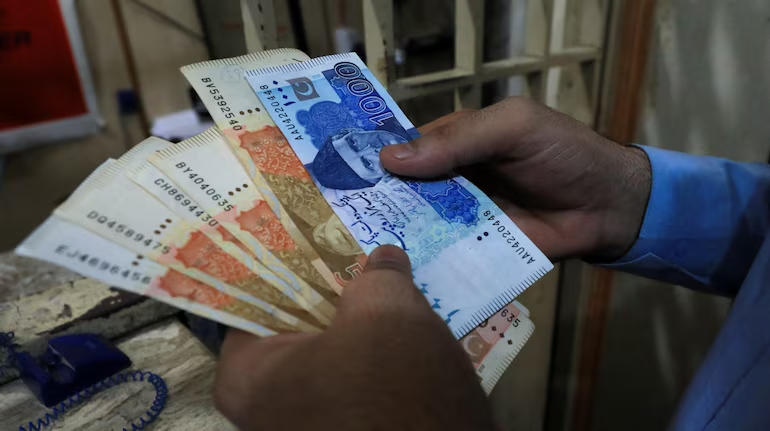
In a recent statement, Pakistan’s Defence Minister Khawaja Asif sparked controversy by claiming that the country would not need the International Monetary Fund (IMF) in six months to save it from economic collapse. However, this claim has run into a significant obstacle, with a staggering $10.6 billion wall standing in the way. According to a report by Moneycontrol, Pakistan’s economic woes are far from over, and the country’s defence deals, although substantial, will not be enough to single-handedly save it from economic ruin.
The report highlights that Pakistan has managed to convert its Operation Sindoor-linked propaganda into defence deals worth billions. However, these deals, although significant, are not sufficient to address the country’s underlying economic issues. The primary concern for Pakistan is its massive debt, which includes a whopping $10.6 billion owed to the IMF alone. This debt, combined with other economic challenges, poses a significant threat to the country’s financial stability.
Khawaja Asif’s claim that Pakistan will not need the IMF in six months is, therefore, questionable. The country’s economy is facing numerous challenges, including a large trade deficit, low foreign exchange reserves, and a significant budget deficit. These issues, if not addressed, could lead to a severe economic crisis, making it difficult for Pakistan to recover without external assistance.
The IMF has been a crucial lifeline for Pakistan, providing the country with financial support to help stabilize its economy. However, the relationship between Pakistan and the IMF has been strained in recent years, with the country struggling to meet the IMF’s conditions for loan disbursement. The IMF has been pushing Pakistan to implement economic reforms, including increasing taxes, reducing subsidies, and improving governance.
Despite these challenges, Pakistan has made some progress in recent months. The country has implemented some economic reforms, and its exports have shown signs of growth. However, these positive developments are not enough to offset the country’s significant economic challenges. The $10.6 billion debt owed to the IMF is a stark reminder of the country’s economic vulnerabilities.
In addition to its debt, Pakistan is also facing significant economic headwinds. The country’s trade deficit has been widening, and its foreign exchange reserves are under pressure. The Pakistani rupee has also been depreciating, making imports more expensive and contributing to inflation. These challenges, combined with the country’s significant debt, make it difficult for Pakistan to achieve economic stability without external support.
The report by Moneycontrol highlights the complexities of Pakistan’s economic situation and the challenges the country faces in achieving economic stability. While Khawaja Asif’s claim that Pakistan will not need the IMF in six months may be optimistic, it is essential to recognize the country’s significant economic challenges. The $10.6 billion wall standing in the way of Pakistan’s economic recovery is a stark reminder of the country’s vulnerabilities and the need for sustained economic reforms.
In conclusion, Khawaja Asif’s claim that Pakistan will not need the IMF in six months is questionable, given the country’s significant economic challenges. The $10.6 billion debt owed to the IMF alone is a substantial obstacle, and the country’s economic headwinds, including a large trade deficit and low foreign exchange reserves, make it difficult for Pakistan to achieve economic stability without external support. While Pakistan has made some progress in recent months, it is essential to recognize the country’s economic vulnerabilities and the need for sustained economic reforms.
About the Author