Khawaja Asif’s ‘Pak won’t need IMF in 6 months’ claim runs into a $10.6-bn wall: Report
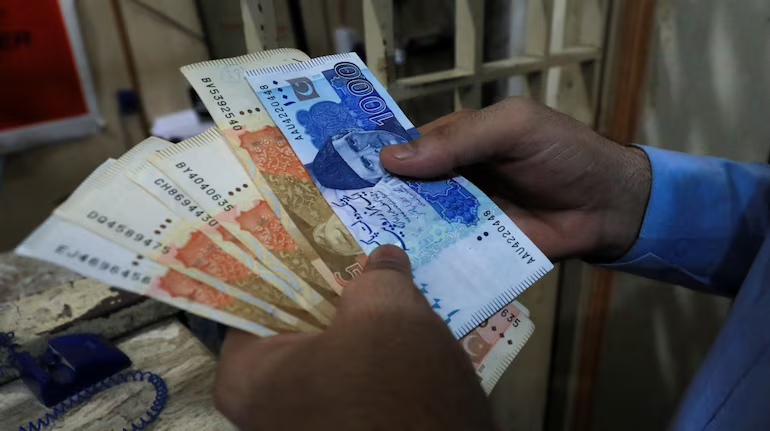
In a recent statement, Pakistan’s Defence Minister Khawaja Asif claimed that the country would not need the International Monetary Fund (IMF) in six months to save it from economic collapse. However, this claim has run into a significant hurdle, with Pakistan owing a whopping $10.6 billion to the IMF alone. According to a report by Moneycontrol, this debt poses a significant challenge to Pakistan’s economic stability, and it remains to be seen how the country plans to overcome this obstacle.
Pakistan’s economy has been facing significant challenges in recent times, with a large trade deficit, dwindling foreign exchange reserves, and a heavy reliance on external borrowing. The country has been struggling to meet its debt obligations, and the IMF has been a crucial lifeline in helping Pakistan stay afloat. However, Khawaja Asif’s claim that Pakistan would not need the IMF in six months suggests that the country is confident of turning its economy around and becoming self-sufficient.
One of the ways Pakistan has been trying to boost its economy is through defence deals. The country has managed to convert its Operation Sindoor-linked propaganda into defence deals worth billions. Operation Sindoor is a military operation launched by Pakistan to counter Indian influence in the region, and it has been successful in attracting significant investment from countries such as China and Saudi Arabia. However, while these deals are certainly a positive development for Pakistan’s economy, they are unlikely to be enough to single-handedly save the country from economic ruin.
The $10.6 billion that Pakistan owes to the IMF is a significant amount, and it will require a concerted effort from the government to pay off this debt. The IMF has been providing financial assistance to Pakistan for several years now, and the country has been struggling to meet its debt obligations. The IMF has imposed strict conditions on Pakistan in exchange for its financial assistance, including measures to increase tax revenue, reduce corruption, and improve governance.
Despite these challenges, Pakistan’s government remains optimistic about the country’s economic prospects. Khawaja Asif’s claim that Pakistan would not need the IMF in six months suggests that the government is confident of turning the economy around and becoming self-sufficient. However, this claim has been met with skepticism by many analysts, who point out that Pakistan’s economic challenges are deep-seated and will require a sustained effort to overcome.
One of the main challenges facing Pakistan’s economy is its large trade deficit. The country imports significantly more than it exports, and this has resulted in a significant depletion of its foreign exchange reserves. To overcome this challenge, Pakistan will need to increase its exports and reduce its imports. This will require a concerted effort from the government to boost the country’s manufacturing sector and increase its competitiveness in the global market.
Another challenge facing Pakistan’s economy is its heavy reliance on external borrowing. The country has been relying heavily on loans from the IMF and other international lenders to meet its debt obligations, and this has resulted in a significant increase in its external debt. To overcome this challenge, Pakistan will need to reduce its reliance on external borrowing and increase its domestic revenue. This will require a sustained effort from the government to increase tax revenue, reduce corruption, and improve governance.
In conclusion, Khawaja Asif’s claim that Pakistan would not need the IMF in six months is an ambitious one, and it remains to be seen how the country plans to achieve this goal. With a debt of $10.6 billion to the IMF alone, Pakistan’s economic challenges are significant, and it will require a concerted effort from the government to overcome them. While defence deals and other economic initiatives are certainly a positive development, they are unlikely to be enough to single-handedly save Pakistan from economic ruin. The government will need to take a sustained and multi-faceted approach to address the country’s economic challenges and put it on a path to sustainable growth and development.
To achieve this goal, Pakistan will need to increase its exports, reduce its imports, and boost its manufacturing sector. The government will also need to reduce its reliance on external borrowing and increase its domestic revenue. This will require a concerted effort from the government to increase tax revenue, reduce corruption, and improve governance. With the right policies and a sustained effort, Pakistan can overcome its economic challenges and achieve sustainable growth and development.
For now, however, the $10.6 billion wall that Pakistan faces in the form of its debt to the IMF remains a significant obstacle. The country will need to find a way to overcome this obstacle if it is to achieve its goal of becoming self-sufficient and not needing the IMF in six months. Only time will tell if Pakistan is able to achieve this goal, but for now, the challenges facing the country’s economy are significant, and it will require a concerted effort from the government to overcome them.
About the Author