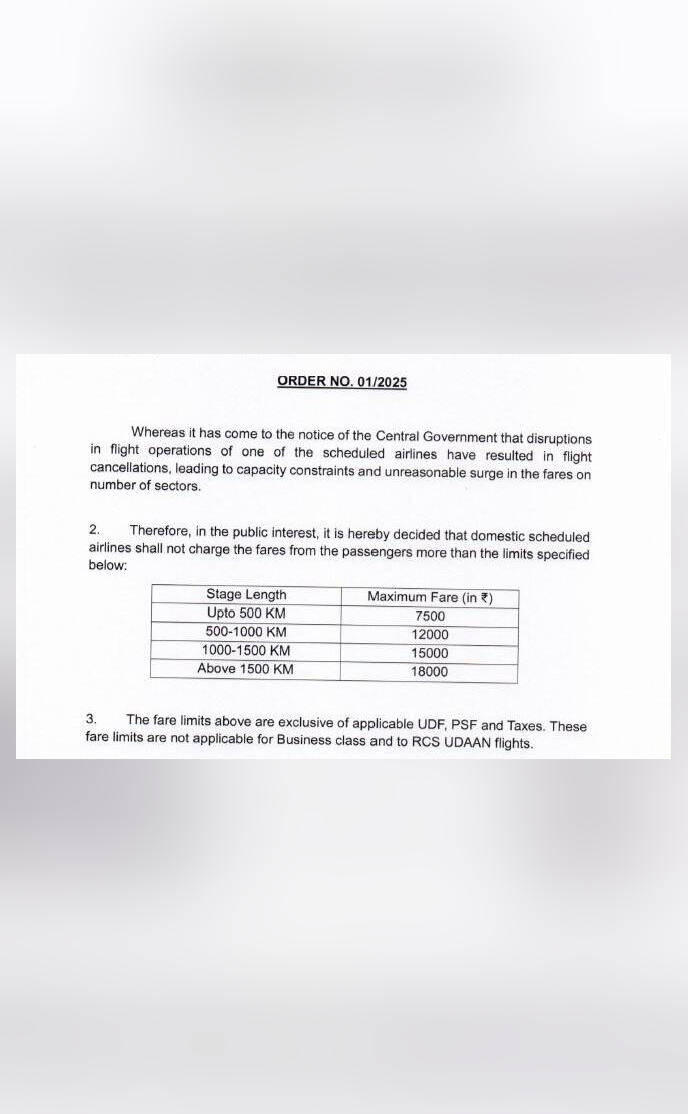
Govt announces maximum fares that airlines can charge amid IndiGo chaos
The Civil Aviation Ministry has taken a significant step to regulate the surge in airfares following the recent mass flight cancellations by IndiGo, one of India’s largest airlines. In an effort to protect passengers from exorbitant prices, the ministry has imposed temporary fare ceilings across various routes. This move is expected to bring relief to travelers who have been facing high fares due to the sudden shortage of flights.
According to the new regulations, airlines are now restricted from charging more than a certain amount for flights of different distances. For flights that cover a distance of up to 500 kilometers, airlines can charge a maximum fare of ₹7,500. This includes popular routes such as Delhi to Chandigarh, Mumbai to Pune, and Bangalore to Hyderabad, among others.
For flights that cover a distance between 500 kilometers and 1,000 kilometers, the maximum fare that airlines can charge has been capped at ₹12,000. This range includes routes like Delhi to Mumbai, Chennai to Bangalore, and Kolkata to Guwahati, among others.
The most significant restriction, however, applies to flights that cover distances above 1,500 kilometers. For these long-haul flights, airlines are not allowed to charge more than ₹18,000. This includes routes like Delhi to Bangalore, Mumbai to Chennai, and Kolkata to Delhi, among others.
These fare ceilings are expected to remain in place until the situation returns to normal, and the airlines are able to resume their regular operations. The move is seen as a necessary step to prevent airlines from taking advantage of the situation and charging exorbitant fares from passengers.
The decision to impose fare ceilings comes after IndiGo, which is India’s largest airline by market share, canceled hundreds of flights over the past few days. The airline cited technical issues and crew constraints as the reason for the cancellations, which left thousands of passengers stranded.
The sudden cancellation of flights led to a surge in demand for tickets on other airlines, resulting in a sharp increase in fares. Many passengers took to social media to express their frustration and disappointment, with some even reporting that they were being charged as much as ₹50,000 or more for a one-way ticket.
The government’s decision to intervene and regulate airfares is seen as a positive step towards protecting the interests of passengers. The fare ceilings will not only prevent airlines from charging exorbitant fares but also ensure that passengers are not exploited during times of crisis.
It is worth noting that the fare ceilings are not a permanent solution and are intended to be a temporary measure to address the current situation. The government is expected to review the situation and revise the fare ceilings as necessary.
In the meantime, passengers are advised to check with their airlines for the latest information on fares and flight schedules. They can also explore alternative options, such as booking flights with other airlines or traveling by train or bus, if possible.
The government’s move to regulate airfares is a significant step towards ensuring that the aviation industry remains competitive and passenger-friendly. It is expected to have a positive impact on the industry as a whole and will likely lead to better services and more affordable fares for passengers in the long run.
In conclusion, the Civil Aviation Ministry’s decision to impose fare ceilings on airlines is a welcome move that will bring relief to passengers who have been facing high fares due to the recent flight cancellations. The move is expected to regulate the surge in airfares and prevent airlines from taking advantage of the situation. We hope that the situation will return to normal soon, and the airlines will be able to resume their regular operations without any disruptions.
News Source: https://x.com/NDTVProfitIndia/status/1997255961241919681
About the Author