Govt announces maximum fares that airlines can charge amid IndiGo chaos
The Civil Aviation Ministry has taken a significant step to regulate the airline industry, particularly in the wake of the recent chaos caused by mass flight cancellations by IndiGo. In a move to curb surge pricing, the ministry has imposed temporary fare ceilings across various routes. This decision is expected to bring relief to passengers who have been facing exorbitant fares due to the shortage of flights.
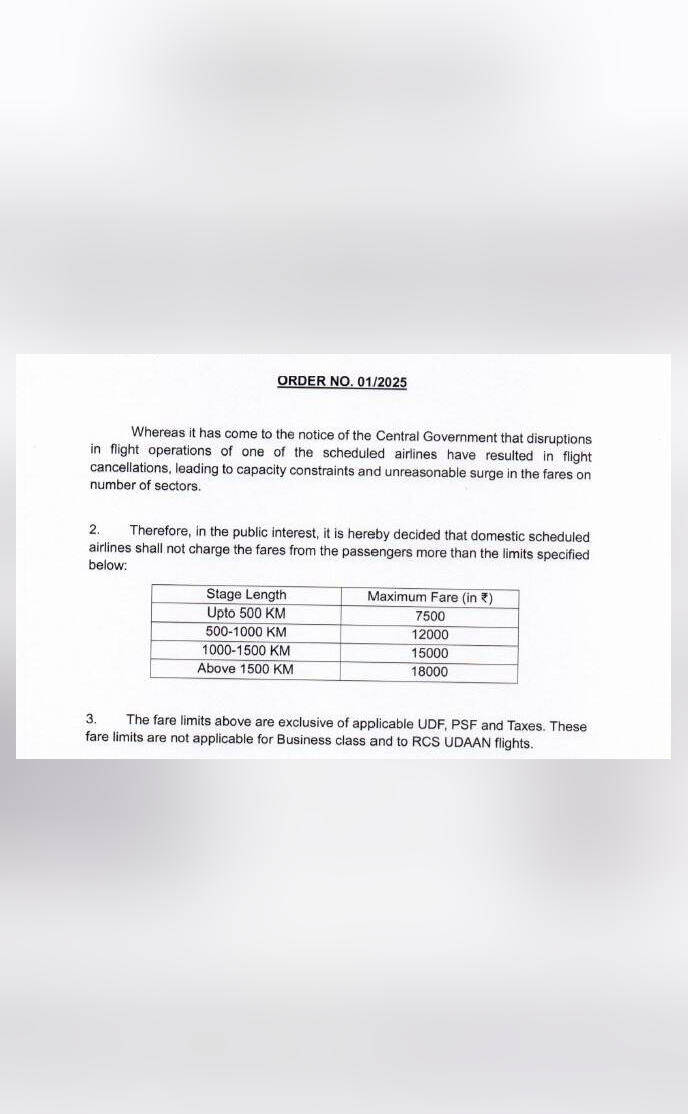
As per the new regulations, airlines are now restricted from charging more than a certain amount for flights of different distances. For flights that cover a distance of up to 500km, airlines can charge a maximum fare of ₹7,500. This will apply to several short-haul flights that connect major cities to nearby towns and metropolitan areas. For instance, flights from Delhi to Chandigarh, or Mumbai to Pune, will now have a maximum fare cap of ₹7,500.
For flights that cover a distance between 500km and 1,000km, a maximum fare of ₹12,000 can be charged. This will apply to several medium-haul flights that connect major cities to other parts of the country. For example, flights from Delhi to Bangalore, or Mumbai to Hyderabad, will now have a maximum fare cap of ₹12,000.
Lastly, for flights that cover a distance of above 1,500km, a maximum fare of ₹18,000 can be charged. This will apply to several long-haul flights that connect major cities to distant parts of the country. For instance, flights from Delhi to Chennai, or Mumbai to Kolkata, will now have a maximum fare cap of ₹18,000.
This move by the Civil Aviation Ministry is expected to bring some semblance of order to the airline industry, which has been plagued by surge pricing in recent times. The ministry has been receiving numerous complaints from passengers about exorbitant fares, particularly on routes where there is limited connectivity.
The recent chaos caused by IndiGo’s mass flight cancellations has further exacerbated the problem. With many flights cancelled, passengers were left with no choice but to book flights on other airlines, often at much higher prices. The ministry’s decision to impose fare ceilings is expected to prevent such situations in the future.
It is worth noting that the fare ceilings are temporary and will be in place until the airline industry stabilizes. The ministry will review the situation and adjust the fare ceilings as necessary. In the meantime, passengers can breathe a sigh of relief, knowing that they will not be charged exorbitant fares for their flights.
The decision to impose fare ceilings has been welcomed by passenger associations and consumer groups. They have been advocating for greater regulation of the airline industry, particularly when it comes to pricing. With the ministry’s decision, passengers can now expect to pay more reasonable fares for their flights.
However, the airline industry has expressed some concerns about the fare ceilings. They argue that the ceilings are too low and will not allow them to cover their costs. They also argue that the ceilings will lead to a shortage of flights, as airlines will not be able to operate profitably.
Despite these concerns, the ministry has made it clear that the fare ceilings are non-negotiable. They have stated that the ceilings are necessary to protect passengers from exorbitant fares and to prevent the airline industry from taking advantage of them.
In conclusion, the Civil Aviation Ministry’s decision to impose fare ceilings is a welcome move. It will bring some much-needed regulation to the airline industry and prevent passengers from being charged exorbitant fares. While the airline industry may have some concerns about the fare ceilings, they are necessary to protect passengers and to ensure that the industry operates in a fair and transparent manner.
Source: https://x.com/NDTVProfitIndia/status/1997255961241919681
About the Author