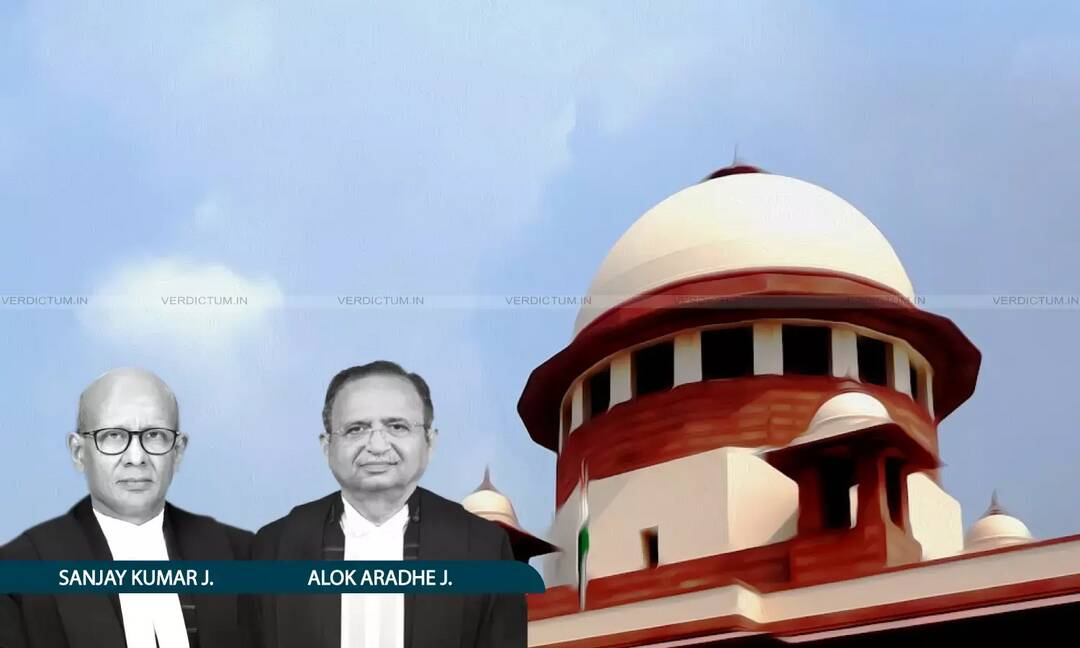
Substitution of Sole Arbitator Warranted Once Mandate Ends: SC
The Supreme Court of India has recently made a significant ruling regarding the substitution of a sole arbitrator in arbitration proceedings. The Court has held that the substitution of a sole arbitrator is warranted when their mandate ceases to exist. This decision has far-reaching implications for arbitration proceedings in India and provides clarity on the role of the arbitrator and the court’s power to intervene in such proceedings.
The Court explained that on the expiry of the initial or extended period, the arbitrator cannot proceed, and their mandate terminates, subject to a court order passed in a proceeding under Section 29A(4) of the Arbitration and Conciliation Act. This means that once the arbitrator’s mandate ends, they can no longer continue with the arbitration proceedings, and a new arbitrator must be appointed to take their place.
The ruling was made in the case of Mohan Lal Fatehpuria v. MS Bharat Textiles & Ors. (2025 INSC 1409), where the Court was faced with the question of whether the substitution of a sole arbitrator was warranted once their mandate had ceased to exist. The Court’s decision provides a clear answer to this question and sets out the circumstances in which a sole arbitrator’s mandate may be terminated.
The Arbitration and Conciliation Act, 1996, provides the framework for arbitration proceedings in India. The Act sets out the procedures for the appointment of arbitrators, the conduct of arbitration proceedings, and the powers of the arbitrator. Section 29A of the Act deals with the time limit for making an arbitral award and provides that the arbitral award shall be made within a period of 12 months from the date of completion of the pleadings. The section also provides for the extension of this period by a further six months, subject to the parties’ agreement.
However, the Act does not explicitly provide for the termination of an arbitrator’s mandate. The Court’s ruling in the present case fills this gap and provides clarity on the circumstances in which an arbitrator’s mandate may be terminated. The Court’s decision is based on the principle that an arbitrator’s mandate is limited to the period specified in the agreement or the law, and once this period expires, the arbitrator can no longer continue with the arbitration proceedings.
The implications of the Court’s decision are significant. It means that parties to an arbitration agreement must be aware of the time limits for the completion of the arbitration proceedings and must take steps to ensure that the arbitrator’s mandate is extended or a new arbitrator is appointed before the expiry of the initial or extended period. Failure to do so may result in the arbitration proceedings coming to a standstill, and the parties may be required to start the process all over again.
The Court’s decision also highlights the importance of the role of the court in arbitration proceedings. While the Arbitration and Conciliation Act provides for the autonomy of the arbitrator, the Court’s decision shows that the court has the power to intervene in arbitration proceedings in certain circumstances, such as when the arbitrator’s mandate has ceased to exist.
In conclusion, the Supreme Court’s ruling in the case of Mohan Lal Fatehpuria v. MS Bharat Textiles & Ors. (2025 INSC 1409) provides clarity on the substitution of a sole arbitrator when their mandate ceases to exist. The decision highlights the importance of being aware of the time limits for the completion of arbitration proceedings and the need to take steps to ensure that the arbitrator’s mandate is extended or a new arbitrator is appointed before the expiry of the initial or extended period. The decision also underscores the role of the court in arbitration proceedings and provides a clear answer to the question of whether the substitution of a sole arbitrator is warranted once their mandate has ceased to exist.
About the Author