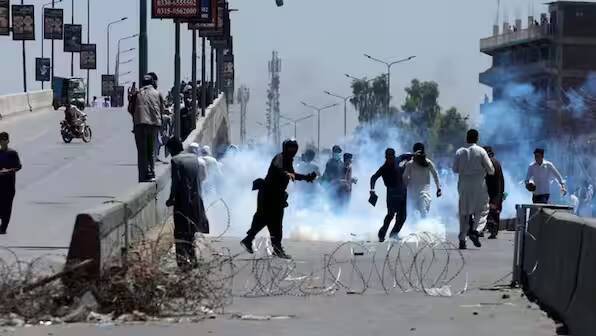
Violent protest breaks out in Pak over demand of separate ‘Sindhu Desh’
In a shocking turn of events, a protest demanding a separate ‘Sindhu Desh’ turned violent in Pakistan’s Karachi, leaving a trail of destruction and chaos in its wake. The protest, which was organized by the Jiye Sindh Muttahida Mahaz (JSSM), a Sindhi nationalist group, saw thousands of Sindhis take to the streets, raising slogans of ‘Azadi’ (freedom) and ‘Pakistan Murdabad’ (death to Pakistan). The protest, which was initially peaceful, took a turn for the worse when the authorities redirected the rally’s path, angering the protesters and forcing them to throw stones at the police.
The incident is a stark reminder of the deep-seated tensions and divisions that exist within Pakistan, a country that has long struggled to reconcile its diverse ethnic and linguistic identities. The demand for a separate ‘Sindhu Desh’ is not a new one, and has been a longstanding issue in the region. However, the recent outbreak of violence has brought the issue back into the spotlight, highlighting the need for the Pakistani government to address the grievances of the Sindhi people and work towards a more inclusive and equitable society.
The JSSM, which is leading the charge for a separate ‘Sindhu Desh’, is a Sindhi nationalist group that has been active in the region for several years. The group’s demands are centered around the idea of creating a separate homeland for the Sindhi people, who have long felt marginalized and oppressed by the Pakistani state. The group’s leaders argue that the Sindhi people have been denied their basic rights and freedoms, and that the only way to achieve true freedom and self-determination is through the creation of a separate state.
The protest in Karachi is not an isolated incident, and is part of a larger movement that is sweeping across the region. In recent months, there have been several protests and demonstrations in Sindh, all of which have been centered around the demand for a separate ‘Sindhu Desh’. The movement has gained significant momentum, with thousands of Sindhis taking to the streets to demand their rights and freedoms.
The Pakistani government has responded to the protests with a mix of force and diplomacy. While the government has attempted to negotiate with the JSSM and other Sindhi nationalist groups, it has also used force to suppress the protests and maintain law and order. The use of force has only served to fuel the flames of discontent, and has pushed the Sindhi people further away from the Pakistani state.
The demand for a separate ‘Sindhu Desh’ is not just a matter of Sindhi nationalism, but also has significant implications for the broader region. The creation of a separate state would have far-reaching consequences, not just for Pakistan, but also for the surrounding countries. It would also raise questions about the future of the region, and the potential for further fragmentation and conflict.
In conclusion, the violent protest in Karachi is a stark reminder of the deep-seated tensions and divisions that exist within Pakistan. The demand for a separate ‘Sindhu Desh’ is a complex issue that requires a nuanced and thoughtful approach. The Pakistani government must work towards addressing the grievances of the Sindhi people, and must take concrete steps to promote inclusivity and equity in the region. Only through dialogue and negotiation can the government hope to resolve the issue and promote a more peaceful and stable society.
The incident has also raised questions about the future of Pakistan, and the potential for further fragmentation and conflict. As the country continues to grapple with the challenges of extremism, terrorism, and ethnic nationalism, it is clear that the demand for a separate ‘Sindhu Desh’ is just one part of a much larger and more complex puzzle. The Pakistani government must work towards promoting a more inclusive and equitable society, one that recognizes the rights and freedoms of all its citizens, regardless of their ethnic or linguistic background.
The international community must also take note of the situation, and must work towards promoting a peaceful and stable resolution to the conflict. The creation of a separate state would have far-reaching consequences, not just for Pakistan, but also for the surrounding countries. It is therefore imperative that the international community works towards promoting dialogue and negotiation, and must support the Pakistani government in its efforts to promote inclusivity and equity in the region.
In the end, the demand for a separate ‘Sindhu Desh’ is a complex issue that requires a nuanced and thoughtful approach. The Pakistani government must work towards addressing the grievances of the Sindhi people, and must take concrete steps to promote inclusivity and equity in the region. Only through dialogue and negotiation can the government hope to resolve the issue and promote a more peaceful and stable society.
About the Author