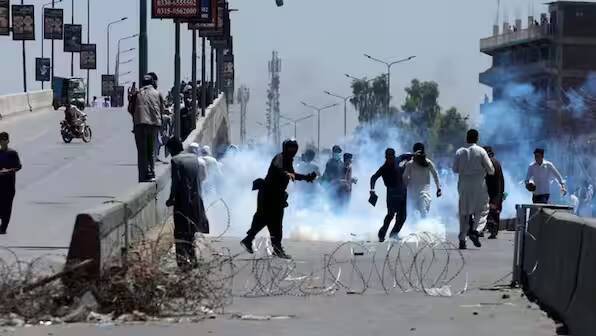
Violent protest breaks out in Pak over demand of separate ‘Sindhu Desh’
In a disturbing turn of events, a protest demanding a separate ‘Sindhu Desh’ turned violent in Pakistan’s Karachi, leaving a trail of destruction and chaos in its wake. The protest, which was organized by the Jiye Sindh Muttahida Mahaz (JSSM), a Sindhi nationalist group, saw thousands of Sindhis gathering in the city to raise their voices for independence from Pakistan. The situation took a turn for the worse when stone pelting and clashes with police were reported, leaving many injured and arrested.
The protesters, who were demanding a separate homeland for the Sindhi people, raised slogans of ‘Azadi’ (freedom) and ‘Pakistan Murdabad’ (death to Pakistan), which were met with a heavy-handed response from the authorities. According to reports, the police had redirected the rally’s path, which made the protesters angry, forcing them to throw stones at the police. The situation quickly escalated, with the police responding with tear gas and baton charges to disperse the crowd.
The demand for a separate ‘Sindhu Desh’ is not a new one, and has been a long-standing issue in Pakistan. The Sindhi people have historically felt marginalized and oppressed by the Pakistani government, which they claim has exploited their resources and ignored their concerns. The JSSM, which is leading the charge for a separate Sindhu Desh, claims that the Sindhi people have been subjected to decades of oppression and discrimination, and that independence is the only way to ensure their rights and freedoms.
The protest in Karachi is just the latest in a series of demonstrations and rallies that have been held across Sindh in recent months. The movement for a separate Sindhu Desh has been gaining momentum, with many Sindhis feeling that they have no other option but to demand independence from Pakistan. The Pakistani government, on the other hand, has been quick to crack down on the protesters, labeling them as separatists and terrorists.
The situation in Sindh is not an isolated one, and is part of a larger trend of separatist movements that are sweeping across Pakistan. In recent years, the country has seen a surge in separatist movements, with groups in Balochistan, Khyber Pakhtunkhwa, and Punjab all demanding greater autonomy or independence from the federal government. The Pakistani government has responded to these movements with force, leading to widespread human rights abuses and violence.
The demand for a separate Sindhu Desh is also closely tied to the issue of resources and economic development. Sindh is one of the most resource-rich provinces in Pakistan, with vast reserves of oil, gas, and coal. However, the Sindhi people feel that they have not benefited from these resources, and that the Pakistani government has exploited them for its own gain. The JSSM and other Sindhi nationalist groups claim that a separate Sindhu Desh would allow the Sindhi people to control their own resources and develop their own economy.
The international community has been slow to respond to the situation in Sindh, with many countries avoiding criticism of the Pakistani government’s handling of the separatist movement. However, human rights groups have been vocal in their condemnation of the government’s actions, calling for an end to the violence and repression of the Sindhi people.
In conclusion, the violent protest in Karachi is just the latest example of the deep-seated tensions and frustrations that are simmering in Sindh. The demand for a separate Sindhu Desh is a complex and contentious issue, with roots in decades of oppression and marginalization. While the Pakistani government may be able to crack down on the protesters in the short term, it is unlikely to be able to silence the Sindhi people’s demands for independence and self-determination in the long term.
As the situation in Sindh continues to unfold, it is essential that the international community pays close attention to the developments and ensures that the human rights of the Sindhi people are protected. The Pakistani government must also take steps to address the grievances of the Sindhi people and work towards a peaceful and negotiated solution to the conflict.
About the Author