Ancient Chinese text helps to know more about Earth’s rotation
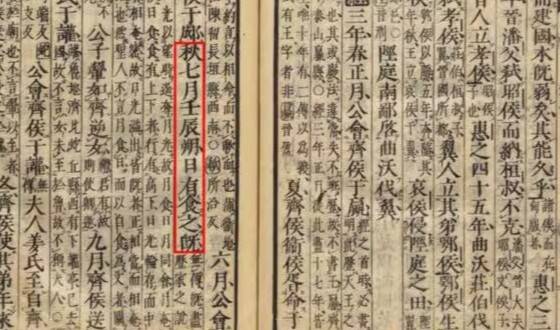
The study of the Earth’s rotation has been a subject of fascination for centuries, with scientists and astronomers continually seeking to understand the intricacies of our planet’s movement. Recently, a team of researchers made a groundbreaking discovery by analyzing an ancient Chinese text that described a solar eclipse in 709 BCE. This finding has provided new insights into the Earth’s rotation speed, revealing that our planet rotates slower now than it did 2,700 years ago.
The research, published in The Astrophysical Journal Letters, focused on an ancient Chinese text that documented a solar eclipse that occurred on April 21, 709 BCE. The text described the eclipse as a total solar eclipse, which sparked the interest of the researchers. They decided to investigate further, using the ancient text to calculate how the Sun would have appeared from the city of Qufu, where the eclipse was observed.
By studying the ancient text and using computer simulations, the researchers were able to recreate the eclipse and determine how the Sun would have appeared from Qufu. However, their findings revealed that the total eclipse would not have been visible from Qufu, as the city was approximately eight kilometers off the path of totality. This discrepancy led the researchers to conclude that the Earth’s rotation has slowed down over the past 2,700 years.
The discovery is significant, as it provides new data on the Earth’s rotation speed. The researchers found that the length of a day on Earth has increased by about 1.8 milliseconds over the past 2,700 years. This may seem like a small change, but it has significant implications for our understanding of the Earth’s rotation and its impact on our planet’s climate and geological processes.
The study also highlights the importance of ancient texts in understanding our planet’s history. The ancient Chinese text that was used in this study is a testament to the advanced astronomical knowledge of ancient civilizations. The text, which was written over 2,700 years ago, provides a unique window into the past, allowing us to study the Earth’s rotation and other celestial phenomena in a way that would not be possible using modern data alone.
The researchers used a combination of historical records, astronomical simulations, and geological data to reconstruct the eclipse and determine the Earth’s rotation speed. They analyzed the ancient text, which described the eclipse as a total solar eclipse, and used computer simulations to recreate the event. They also used geological data to determine the location of Qufu and the surrounding region, which helped them to pinpoint the exact location of the eclipse.
The study’s findings have significant implications for our understanding of the Earth’s rotation and its impact on our planet’s climate and geological processes. The slowing down of the Earth’s rotation has been linked to changes in the planet’s climate, including the formation of ice ages and the alteration of ocean currents. The discovery also highlights the importance of continued monitoring of the Earth’s rotation, as changes in the planet’s rotation speed can have significant impacts on our planet’s ecosystems and climate.
In addition to providing new insights into the Earth’s rotation, the study also demonstrates the importance of interdisciplinary research. The researchers used a combination of astronomy, geology, and history to reconstruct the eclipse and determine the Earth’s rotation speed. This approach highlights the value of collaboration between different fields of study, as it allows researchers to approach complex problems from multiple angles and gain a deeper understanding of the underlying phenomena.
The discovery of the Earth’s slowing rotation is also a reminder of the dynamic nature of our planet. The Earth’s rotation is not a constant, but rather a complex process that is influenced by a variety of factors, including the planet’s slightly ellipsoidal shape, the movement of the tectonic plates, and the gravitational pull of the Moon. The study’s findings highlight the importance of continued monitoring of the Earth’s rotation, as changes in the planet’s rotation speed can have significant impacts on our planet’s ecosystems and climate.
In conclusion, the study of the ancient Chinese text has provided new insights into the Earth’s rotation speed, revealing that our planet rotates slower now than it did 2,700 years ago. The discovery is a testament to the power of interdisciplinary research and the importance of analyzing ancient texts to understand our planet’s history. The study’s findings have significant implications for our understanding of the Earth’s rotation and its impact on our planet’s climate and geological processes, and highlight the need for continued monitoring of the Earth’s rotation.
The study’s findings are a significant contribution to our understanding of the Earth’s rotation, and demonstrate the value of using ancient texts to study the Earth’s history. The discovery is a reminder of the dynamic nature of our planet, and the importance of continued research into the Earth’s rotation and its impact on our planet’s ecosystems and climate.
About the Author