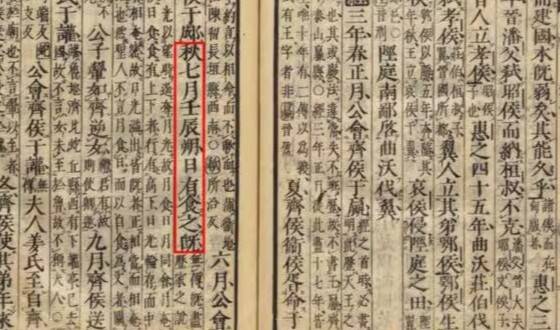
Ancient Chinese text helps to know more about Earth’s rotation
The study of Earth’s rotation has been a fascinating topic for scientists and researchers for centuries. Understanding the intricacies of our planet’s movement is crucial in grasping the complexities of the universe. Recently, a team of researchers has made a groundbreaking discovery that sheds new light on Earth’s rotation speed, thanks to an ancient Chinese text describing a solar eclipse in 709 BCE. This finding, published in The Astrophysical Journal Letters, has significant implications for our understanding of the Earth’s rotation and its evolution over time.
The ancient Chinese text in question describes a solar eclipse that occurred on April 21, 709 BCE, which was observed by astronomers in the city of Qufu, in what is now Shandong Province, China. The text provides a detailed account of the eclipse, including the time of day and the extent of the Sun’s coverage by the Moon. By analyzing this text, researchers were able to calculate how the Sun would have appeared from Qufu city during the eclipse.
Using sophisticated computer simulations, the researchers recreated the celestial alignment of the Sun, Moon, and Earth on that day, taking into account the Earth’s slightly ellipsoidal shape and the Moon’s orbital eccentricity. They found that, contrary to the ancient text’s description, the total eclipse would not have been visible from Qufu city. In fact, the city would have been located about eight kilometers off the path of totality, which is the area where the eclipse is visible in its entirety.
This discrepancy between the ancient text’s description and the simulated eclipse path led the researchers to a surprising conclusion. They realized that the Earth’s rotation speed must have slowed down over the past 2,700 years, resulting in a longer day. This means that the length of a day on Earth has increased by about 1.8 milliseconds over the past 2,700 years.
The researchers’ findings have significant implications for our understanding of the Earth’s rotation and its evolution over time. The slowing down of the Earth’s rotation is a well-known phenomenon, caused by the tidal interactions between the Earth and the Moon. However, the new data provides a more precise estimate of the rate at which the Earth’s rotation is slowing down.
The study also highlights the importance of ancient astronomical records in understanding the history of the Earth’s rotation. By analyzing these records, researchers can gain valuable insights into the Earth’s past and its evolution over time. The ancient Chinese text used in this study is just one example of the many astronomical records that have been left behind by ancient civilizations.
The discovery of the Earth’s slowing rotation has significant implications for various fields of science, including astronomy, geology, and climatology. For instance, changes in the Earth’s rotation speed can affect the planet’s climate, as they can influence the distribution of heat around the globe. Additionally, the slowing down of the Earth’s rotation can also impact the stability of the Earth’s axis, which can have significant effects on the planet’s climate and geological activity.
In conclusion, the study of ancient Chinese texts has provided new clues about the Earth’s rotation speed, revealing that the planet’s rotation has slowed down over the past 2,700 years. This discovery has significant implications for our understanding of the Earth’s rotation and its evolution over time, and highlights the importance of ancient astronomical records in understanding the history of our planet. As scientists continue to study the Earth’s rotation and its effects on our planet, we can expect to gain a deeper understanding of the complex and fascinating mechanisms that govern our world.
About the Author