First Detailed Look at Tsunami Captured from Space by NASA
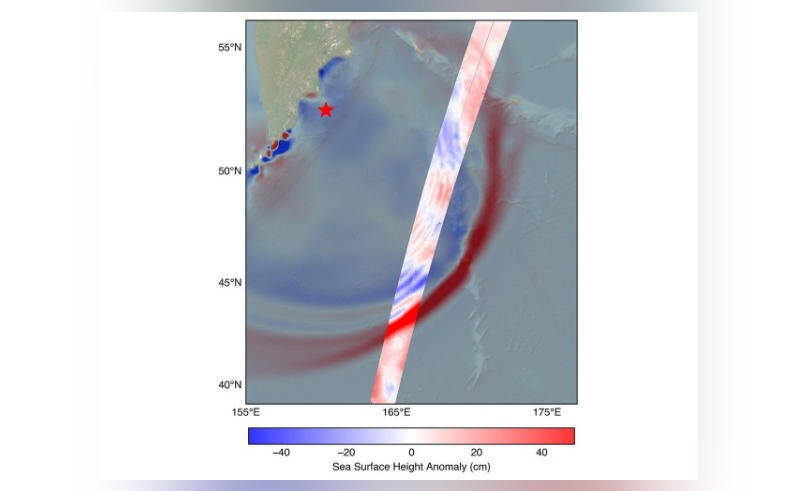
The field of space exploration and Earth observation has taken a significant leap forward with the recent capture of a tsunami’s detailed image from space. NASA and the French space agency, CNES’s (Centre National d’Etudes Spatiales), SWOT (Surface Water and Ocean Topography) satellite has successfully tracked the waves generated by an 8.8 magnitude earthquake off Russia’s Kamchatka peninsula on July 30. This groundbreaking achievement provides new insights into the behavior of tsunamis, challenging our earlier understanding of these massive ocean waves.
The SWOT satellite, launched in December 2022, is designed to study the Earth’s oceans, lakes, and rivers, providing unprecedented data on the planet’s water bodies. Equipped with advanced radar and lidar instruments, the satellite can measure the height of the ocean surface with incredible accuracy, allowing scientists to track even the slightest changes in the water level. This capability has enabled researchers to capture the first detailed look at a tsunami from space, revealing fascinating details about the wave’s behavior.
The tsunami in question was triggered by a massive earthquake that struck off the coast of Russia’s Kamchatka peninsula on July 30. The earthquake, measuring 8.8 on the Richter scale, generated a series of waves that traveled across the Pacific Ocean. The SWOT satellite, orbiting the Earth at an altitude of around 900 kilometers, was able to detect these waves and track their movement. The data collected by the satellite revealed a complex pattern of wave behavior, with the tsunami splitting into multiple waves.
Contrary to the earlier belief that tsunamis maintain a single, uniform form, the SWOT satellite’s data showed that the tsunami split into multiple waves, with a large leading wave followed by smaller ones. This discovery challenges our current understanding of tsunami behavior and has significant implications for tsunami forecasting and warning systems. The fact that tsunamis can break into multiple waves, each with its own characteristics, makes it more difficult to predict their behavior and potential impact on coastal communities.
The SWOT satellite’s data also provided valuable insights into the wave’s dynamics, including its speed, direction, and amplitude. The satellite’s radar and lidar instruments were able to measure the wave’s height and shape, allowing scientists to study its behavior in unprecedented detail. This information can be used to improve tsunami forecasting models, enabling more accurate predictions of wave arrival times, wave heights, and coastal inundation.
The capture of this tsunami from space is a significant achievement, not only for NASA and CNES but also for the scientific community as a whole. The data collected by the SWOT satellite will help researchers better understand the complex behavior of tsunamis, ultimately leading to improved forecasting and warning systems. This, in turn, can save countless lives and reduce the economic impact of these devastating events.
The SWOT satellite’s mission is a prime example of the importance of international collaboration in space exploration and Earth observation. The partnership between NASA and CNES has enabled the development of a state-of-the-art satellite that is providing groundbreaking data on our planet’s water bodies. The satellite’s data will be made available to researchers and scientists around the world, facilitating a better understanding of our planet and its complex systems.
In conclusion, the first detailed look at a tsunami captured from space by NASA and CNES’s SWOT satellite is a significant milestone in the field of Earth observation. The data collected by the satellite has challenged our earlier understanding of tsunami behavior, revealing a complex pattern of wave behavior that can be used to improve forecasting and warning systems. As we continue to explore and study our planet from space, we can expect to uncover even more secrets about the Earth’s oceans and the complex systems that shape our world.
About the Author