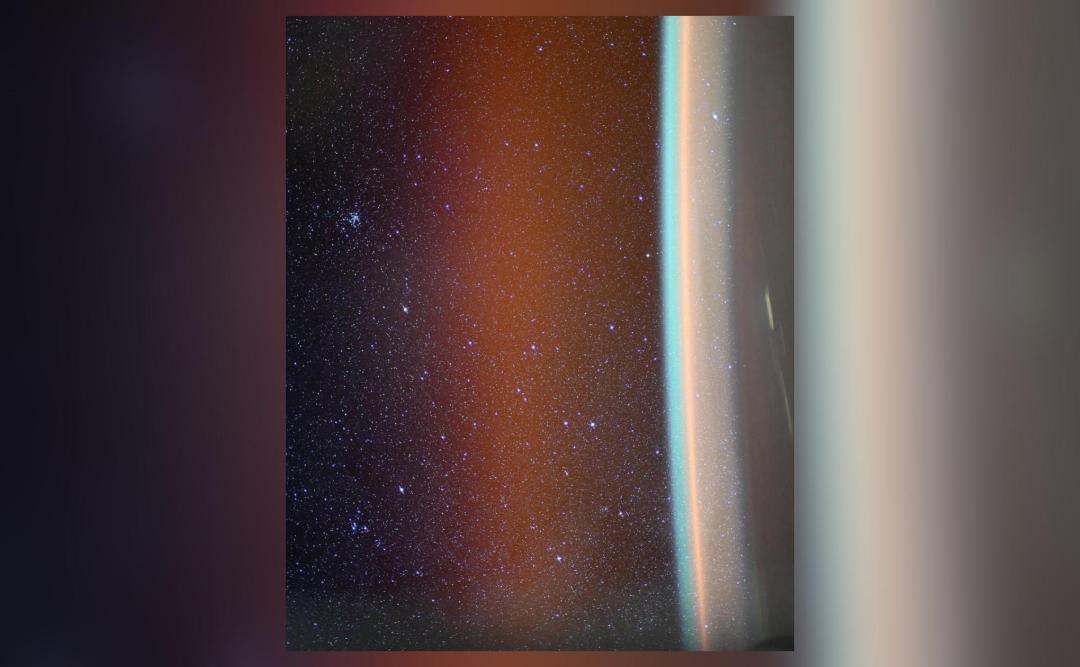
Pic shows colours of Earth’s atmosphere as seen from space
The Earth’s atmosphere is a complex and fascinating system that surrounds our planet, protecting us from the harsh conditions of space. Recently, an image captured from the International Space Station (ISS) has given us a stunning glimpse into the vibrant colors of our atmosphere as seen from space. The image, shared by NASA astronaut Don Pettit, showcases the breathtaking beauty of the Earth’s atmospheric layers, with multiple vibrant layers of green atomic oxygen, orange hydroxyl radicals, and red airglow excited from solar activity.
The image, which has been making waves on social media, is a testament to the incredible beauty of our planet. The different layers of the atmosphere are clearly visible, with the green atomic oxygen layer glowing brightly, followed by the orange hydroxyl radicals, and finally the red airglow. The airglow, which is a result of solar activity, is particularly striking, with its deep red hue adding a sense of depth and dimension to the image.
But what exactly is airglow, and how does it occur? Airglow is a phenomenon that occurs when atoms and molecules in the upper atmosphere, excited by sunlight, emit light in order to shed their excess energy. This process is similar to the way that a neon sign works, where electricity excites the atoms in the sign, causing them to emit light. In the case of airglow, the energy source is the sun, and the atoms and molecules in the upper atmosphere are excited by the sun’s radiation.
The airglow phenomenon is not unique to Earth, and can be observed on other planets and moons in our solar system. However, the Earth’s atmosphere is particularly well-suited to producing airglow, due to its unique combination of atmospheric gases and solar radiation. The airglow can be seen in a range of colors, including green, blue, and red, depending on the energy level of the excited atoms and molecules.
The image captured by Don Pettit is not only stunningly beautiful, but it also provides valuable insights into the Earth’s atmosphere and the processes that shape it. By studying the airglow and other atmospheric phenomena, scientists can gain a better understanding of the complex interactions between the Earth’s atmosphere, the sun, and the solar wind.
The ISS, from which the image was captured, is a unique platform for studying the Earth’s atmosphere and the effects of space weather. The station’s orbit takes it above the Earth’s atmosphere, providing a unique perspective on the planet and its surroundings. The ISS is equipped with a range of scientific instruments, including cameras, spectrometers, and other sensors, which allow scientists to study the Earth’s atmosphere in unprecedented detail.
The image of the Earth’s atmosphere, with its vibrant colors and intricate layers, is a powerful reminder of the beauty and complexity of our planet. It is a testament to the incredible work of scientists and astronauts like Don Pettit, who are dedicated to exploring and understanding the Earth and its place in the universe.
In conclusion, the image captured from the ISS is a stunning example of the beauty and complexity of the Earth’s atmosphere. The vibrant colors and intricate layers of the atmosphere are a testament to the incredible processes that shape our planet, and the airglow phenomenon is a fascinating example of the complex interactions between the Earth’s atmosphere, the sun, and the solar wind. As we continue to explore and study the Earth and its surroundings, we are reminded of the incredible beauty and wonder of our planet, and the importance of preserving it for future generations.
Source: https://www.instagram.com/p/DRsbl4PEZJx/
About the Author