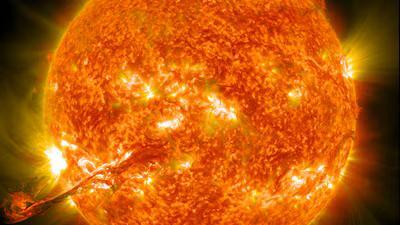
Aditya-L1 set to observe Sun’s maximum in 2026
The Sun, the star at the center of our solar system, is a dynamic and ever-changing entity. Its activity cycles, which last approximately 11 years, have a profound impact on the Earth’s magnetic field, atmosphere, and even our daily lives. As we approach the peak of the current solar cycle, scientists are eagerly anticipating the opportunity to study the Sun’s behavior in unprecedented detail. At the forefront of this effort is Aditya-L1, India’s first dedicated solar observatory, which is set to observe the Sun’s maximum activity in 2026.
The Sun’s solar maximum, also known as the solar max, is the period of highest solar activity during its 11-year cycle. During this time, the Sun’s magnetic field is at its strongest, leading to an increase in solar storms, coronal mass ejections, and rapid changes in magnetic activity. These events can have a significant impact on the Earth’s magnetic field, causing disruptions to communication systems, power grids, and even satellite operations.
Aditya-L1, which was launched in September 2022, is specifically designed to study the Sun’s corona, the outer atmosphere of the Sun. The spacecraft is equipped with a range of instruments, including a coronagraph, a solar wind monitor, and a magnetometer, which will allow scientists to study the Sun’s magnetic field, solar wind, and coronal mass ejections in unprecedented detail.
The data collected by Aditya-L1 during the solar maximum will provide valuable insights into the Sun’s behavior and the impact of its activity on the Earth’s magnetic field and atmosphere. Scientists expect to observe heightened solar storms, frequent coronal mass ejections, and rapid changes in magnetic activity, which will help them better understand the complex dynamics of the Sun’s corona.
One of the key objectives of the Aditya-L1 mission is to study the Sun’s magnetic field and its role in shaping the corona. The spacecraft will use its magnetometer to measure the strength and direction of the magnetic field, which will help scientists understand how the field is structured and how it changes over time. This information will be crucial in predicting solar storms and coronal mass ejections, which can have a significant impact on the Earth’s magnetic field and atmosphere.
Another important aspect of the Aditya-L1 mission is the study of coronal mass ejections (CMEs). CMEs are large clouds of plasma that are ejected from the Sun’s corona and can travel through space, interacting with the Earth’s magnetic field and causing disruptions to communication systems and power grids. Aditya-L1 will use its coronagraph to study CMEs in unprecedented detail, allowing scientists to better understand their structure, composition, and behavior.
The Aditya-L1 mission is also expected to provide valuable insights into the Sun’s solar wind, which is a stream of charged particles that flows away from the Sun and interacts with the Earth’s magnetic field. The spacecraft will use its solar wind monitor to measure the speed, density, and temperature of the solar wind, which will help scientists understand how the wind is structured and how it changes over time.
As the Sun approaches its solar maximum in 2026, scientists are eagerly anticipating the opportunity to study its behavior in unprecedented detail. Aditya-L1, with its range of instruments and advanced technology, is poised to play a key role in this effort, providing valuable insights into the Sun’s corona, magnetic field, and solar wind. The data collected by the spacecraft will help scientists better understand the complex dynamics of the Sun’s corona and the impact of its activity on the Earth’s magnetic field and atmosphere.
In conclusion, the Aditya-L1 mission is a significant milestone in the study of the Sun and its impact on the Earth’s magnetic field and atmosphere. As the Sun approaches its solar maximum in 2026, scientists are eagerly anticipating the opportunity to study its behavior in unprecedented detail. With its range of instruments and advanced technology, Aditya-L1 is poised to provide valuable insights into the Sun’s corona, magnetic field, and solar wind, helping us better understand the complex dynamics of the Sun’s corona and the impact of its activity on our planet.
About the Author