Aditya-L1 set to observe Sun’s maximum in 2026
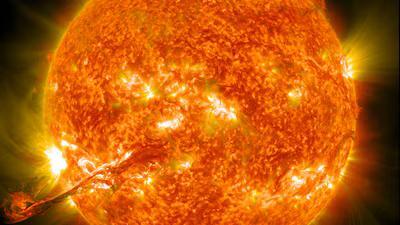
The year 2026 is expected to be a significant one for space weather enthusiasts and scientists alike, as the Sun is predicted to reach its solar maximum. This peak phase in the Sun’s 11-year cycle is characterized by heightened solar storms, frequent coronal mass ejections, and rapid magnetic activity changes. To closely monitor this phenomenon, India’s first dedicated solar observatory, Aditya-L1, is all set to play a crucial role. In this blog post, we will delve into the details of Aditya-L1 and its mission to observe the Sun’s maximum activity in 2026.
The Sun’s solar cycle, also known as the Schwabe cycle, is a periodic change in the Sun’s activity that occurs every 11 years. During this cycle, the Sun’s magnetic poles flip, shifting it from a quiet phase to an intense phase of activity. This shift is marked by an increase in sunspots, solar flares, and coronal mass ejections (CMEs). The solar maximum is the peak phase of this cycle, where the Sun’s activity is at its highest.
Aditya-L1, launched by the Indian Space Research Organisation (ISRO), is specifically designed to study the Sun’s corona, the outer atmosphere of the Sun. The spacecraft is equipped with a range of instruments that will help scientists understand the Sun’s dynamics, including its magnetic field, plasma, and radiation. With Aditya-L1, scientists will be able to closely monitor the Sun’s activity in real-time, providing valuable insights into space weather.
The solar maximum in 2026 is expected to be a significant event, with scientists predicting heightened solar storms and frequent CMEs. These events can have a significant impact on Earth’s magnetic field, causing geomagnetic storms that can disrupt communication systems, power grids, and navigation systems. By closely monitoring the Sun’s activity, scientists can provide early warnings for such events, helping to mitigate their impact on our daily lives.
Aditya-L1’s mission to observe the Sun’s maximum activity in 2026 is a significant one, as it will provide scientists with a unique opportunity to study the Sun’s dynamics in real-time. The spacecraft’s instruments will be able to capture high-resolution images of the Sun’s corona, as well as measure the Sun’s magnetic field and plasma. This data will help scientists to better understand the Sun’s behavior, including the mechanisms that drive solar storms and CMEs.
One of the key instruments on board Aditya-L1 is the Visible Emission Line Coronagraph (VELC), which will study the Sun’s corona in visible and ultraviolet wavelengths. The VELC will provide high-resolution images of the Sun’s corona, helping scientists to understand the dynamics of the Sun’s outer atmosphere. Another key instrument is the Solar Wind Monitor (SWM), which will measure the Sun’s solar wind and its variations.
The data collected by Aditya-L1 will be invaluable for scientists, as it will provide a unique insight into the Sun’s behavior during its solar maximum. The data will also help scientists to improve their understanding of space weather, which is critical for predicting and mitigating the impact of solar storms and CMEs on Earth.
In conclusion, Aditya-L1’s mission to observe the Sun’s maximum activity in 2026 is a significant one, as it will provide scientists with a unique opportunity to study the Sun’s dynamics in real-time. With its range of instruments, Aditya-L1 will be able to closely monitor the Sun’s activity, providing valuable insights into space weather. As the Sun reaches its solar maximum in 2026, Aditya-L1 will play a crucial role in helping scientists to better understand the Sun’s behavior, ultimately helping to mitigate the impact of solar storms and CMEs on our daily lives.
About the Author