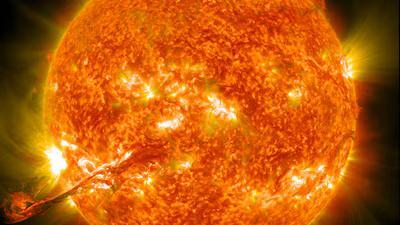
Aditya-L1 set to observe Sun’s maximum in 2026
The Sun, the star at the center of our solar system, is a dynamic and ever-changing entity. Its activity fluctuates over an 11-year cycle, with periods of high and low activity. The peak phase of this cycle is known as the solar maximum, during which the Sun’s magnetic field and solar activity are at their strongest. In 2026, the Sun is expected to reach its solar maximum, and India’s first dedicated solar observatory, Aditya-L1, will be ready to closely monitor this phenomenon.
The Aditya-L1 mission is a significant milestone in India’s space exploration program, marking the country’s first foray into the study of the Sun. The spacecraft, launched in 2022, is equipped with a range of instruments designed to study the Sun’s corona, chromosphere, and photosphere. The primary objective of the mission is to understand the Sun’s dynamics and its impact on the solar system, particularly on Earth’s magnetic field and upper atmosphere.
As the Sun approaches its solar maximum in 2026, scientists expect a significant increase in solar activity. This will manifest in the form of heightened solar storms, frequent coronal mass ejections, and rapid changes in magnetic activity. These events will provide valuable insights into space weather, which can have a significant impact on Earth’s communication systems, navigation, and even power grids.
The solar maximum is a critical phase in the Sun’s 11-year cycle, during which the magnetic poles flip, shifting the Sun from a period of quiet activity to one of intense activity. This process is known as the solar magnetic field reversal, and it is a complex and poorly understood phenomenon. By studying the Sun during this phase, scientists hope to gain a deeper understanding of the underlying mechanisms that drive the Sun’s activity and its impact on the solar system.
The Aditya-L1 spacecraft is equipped with a range of instruments designed to study the Sun’s corona, chromosphere, and photosphere. The Visible Emission Line Coronagraph (VELC) will study the Sun’s corona, while the Solar Ultraviolet Imaging Telescope (SUIT) will observe the Sun’s chromosphere and photosphere. The coronal properties and dynamics will be studied using the Solar Low Energy X-ray Spectrometer (SoLEXS) and the High Energy L1 Orbiting X-ray Spectrometer (HEL1OS).
These instruments will provide high-resolution images and spectra of the Sun’s atmosphere, allowing scientists to study the dynamics of the solar plasma, the magnetic field, and the solar wind. The data collected by Aditya-L1 will be used to study the Sun’s coronal heating, the formation of coronal mass ejections, and the acceleration of solar winds.
The study of the Sun’s solar maximum is not only important for understanding the Sun’s dynamics but also for its potential impact on Earth’s systems. Solar storms and coronal mass ejections can cause significant disruptions to communication systems, navigation, and even power grids. By studying the Sun’s activity during its solar maximum, scientists can gain valuable insights into space weather and its potential impact on Earth’s systems.
In addition to its scientific objectives, the Aditya-L1 mission is also an important milestone in India’s space exploration program. The mission demonstrates India’s capability to design, build, and launch a complex spacecraft, and it marks a significant step forward in the country’s space program.
In conclusion, the Aditya-L1 spacecraft is set to play a critical role in the study of the Sun’s solar maximum in 2026. The mission will provide valuable insights into the Sun’s dynamics and its impact on the solar system, and it will help scientists to better understand the complex mechanisms that drive the Sun’s activity. As the Sun approaches its solar maximum, the Aditya-L1 spacecraft will be ready to closely monitor this phenomenon, providing scientists with a unique opportunity to study the Sun’s behavior during this critical phase.
About the Author