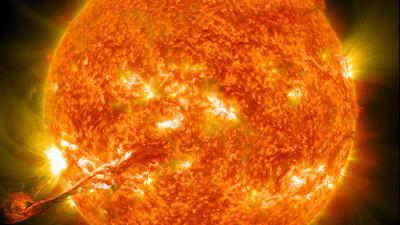
Aditya-L1 set to observe Sun’s maximum in 2026
The Sun, the star at the center of our solar system, is a dynamic and ever-changing entity. Its activity waxes and wanes over an 11-year cycle, with periods of high activity followed by periods of relative calm. In 2026, the Sun is expected to reach its solar maximum, a period of heightened activity characterized by intense magnetic storms, frequent coronal mass ejections, and rapid changes in magnetic activity. To study this phenomenon in unprecedented detail, India’s first dedicated solar observatory, Aditya-L1, is set to closely monitor the Sun’s behavior during this peak phase.
The Aditya-L1 mission, launched by the Indian Space Research Organisation (ISRO), is designed to study the Sun’s corona, the outer atmosphere that extends millions of kilometers into space. The corona is much hotter than the Sun’s surface, and its behavior has a significant impact on the solar system, including Earth’s magnetic field and upper atmosphere. By studying the corona and its interactions with the solar wind, scientists hope to gain a deeper understanding of the Sun’s internal dynamics and its impact on the space environment.
The solar maximum, which occurs when the Sun’s magnetic poles flip, is a critical phase in the Sun’s 11-year cycle. During this period, the Sun’s magnetic field undergoes a significant transformation, leading to an increase in solar flares, coronal mass ejections, and other forms of magnetic activity. These events can have a profound impact on Earth’s magnetic field, causing geomagnetic storms that can disrupt communication and navigation systems, as well as posing a risk to satellites and other space-based infrastructure.
Aditya-L1 is equipped with a range of advanced instruments, including a coronagraph, a solar wind monitor, and a magnetometer, which will allow scientists to study the Sun’s corona and its interactions with the solar wind in unprecedented detail. The observatory will provide high-resolution images of the corona, as well as measurements of the solar wind’s speed, temperature, and composition. By analyzing these data, scientists will be able to gain a deeper understanding of the Sun’s internal dynamics and its impact on the space environment.
One of the key areas of focus for Aditya-L1 will be the study of coronal mass ejections (CMEs), which are massive bursts of plasma and magnetic field that are ejected from the Sun’s corona during periods of high activity. CMEs can have a significant impact on Earth’s magnetic field, causing geomagnetic storms that can disrupt communication and navigation systems. By studying CMEs in detail, scientists hope to improve their understanding of these events and develop more accurate predictive models.
In addition to its scientific objectives, the Aditya-L1 mission is also expected to have significant practical applications. By improving our understanding of the Sun’s behavior and its impact on the space environment, scientists can develop more effective strategies for mitigating the effects of space weather on Earth’s technological systems. This could include the development of more robust communication and navigation systems, as well as improved forecasting and warning systems for geomagnetic storms.
The Aditya-L1 mission is a significant milestone in India’s space program, demonstrating the country’s capabilities in space exploration and its commitment to advancing our understanding of the universe. The mission is also a testament to the importance of international cooperation in space research, with scientists from around the world collaborating on the project.
In conclusion, the Aditya-L1 mission is set to play a critical role in our understanding of the Sun’s behavior during its solar maximum in 2026. By providing high-resolution images and measurements of the Sun’s corona and its interactions with the solar wind, the observatory will offer valuable insights into the Sun’s internal dynamics and its impact on the space environment. As we look to the future, it is clear that the Aditya-L1 mission will be an important step forward in our understanding of the universe and our place within it.
About the Author