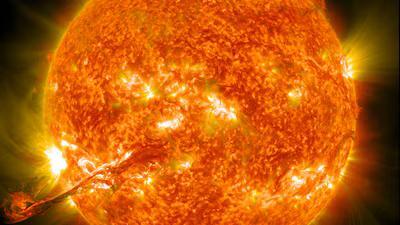
Aditya-L1 set to observe Sun’s maximum in 2026
The year 2026 is expected to be a significant one for space weather enthusiasts and scientists alike, as the Sun reaches its solar maximum. This peak phase in the Sun’s 11-year cycle is characterized by heightened solar storms, frequent coronal mass ejections, and rapid magnetic activity changes. To closely monitor this phenomenon, India’s first dedicated solar observatory, Aditya-L1, is all set to play a crucial role. In this blog post, we will delve into the details of Aditya-L1 and its mission to observe the Sun’s maximum activity in 2026.
What is Aditya-L1?
Aditya-L1 is a spacecraft designed and developed by the Indian Space Research Organisation (ISRO) to study the Sun’s corona, the outer atmosphere of the Sun. The spacecraft is equipped with a suite of instruments to observe the Sun’s magnetic field, solar wind, and coronal mass ejections. Aditya-L1 is India’s first dedicated solar observatory, and it is expected to provide valuable insights into the Sun’s behavior and its impact on the Earth’s magnetic field and upper atmosphere.
The Sun’s 11-year cycle
The Sun’s activity follows an 11-year cycle, known as the solar cycle. During this cycle, the Sun’s magnetic field undergoes a significant change, resulting in a shift from a quiet phase to an intense phase. The solar maximum, which occurs at the peak of the cycle, is characterized by an increase in sunspots, solar flares, and coronal mass ejections. These events can have a significant impact on the Earth’s magnetic field, causing geomagnetic storms that can disrupt communication and navigation systems.
What to expect in 2026
In 2026, the Sun is expected to reach its solar maximum, marking the peak of its 11-year cycle. During this phase, scientists expect to observe heightened solar storms, frequent coronal mass ejections, and rapid magnetic activity changes. These events will provide a unique opportunity for scientists to study the Sun’s behavior and its impact on the Earth’s magnetic field and upper atmosphere.
Aditya-L1’s mission
Aditya-L1 is designed to closely monitor the Sun’s activity during its solar maximum. The spacecraft will observe the Sun’s magnetic field, solar wind, and coronal mass ejections, providing valuable insights into the Sun’s behavior. The data collected by Aditya-L1 will help scientists to better understand the Sun’s impact on the Earth’s magnetic field and upper atmosphere, enabling them to predict and mitigate the effects of geomagnetic storms.
Instruments on board Aditya-L1
Aditya-L1 is equipped with a suite of instruments to observe the Sun’s corona, magnetic field, and solar wind. Some of the key instruments on board the spacecraft include:
- The Solar Ultraviolet Imaging Telescope (SUIT), which will observe the Sun’s corona in the ultraviolet wavelength range.
- The X-ray Solar Monitor (XSM), which will monitor the Sun’s X-ray emissions.
- The Plasma Analyser Package (PAP), which will study the solar wind and its interaction with the Earth’s magnetic field.
- The Magnetic Field Experiment (MFE), which will measure the Sun’s magnetic field.
Significance of Aditya-L1’s mission
Aditya-L1’s mission to observe the Sun’s solar maximum is significant for several reasons. Firstly, it will provide valuable insights into the Sun’s behavior and its impact on the Earth’s magnetic field and upper atmosphere. Secondly, it will enable scientists to predict and mitigate the effects of geomagnetic storms, which can disrupt communication and navigation systems. Finally, it will demonstrate India’s capabilities in space exploration and its commitment to advancing our understanding of the universe.
Conclusion
In conclusion, Aditya-L1 is all set to observe the Sun’s solar maximum in 2026, providing valuable insights into the Sun’s behavior and its impact on the Earth’s magnetic field and upper atmosphere. The spacecraft’s mission is significant, as it will enable scientists to better understand the Sun’s impact on our planet and predict and mitigate the effects of geomagnetic storms. As we look forward to the Sun’s solar maximum in 2026, Aditya-L1 is poised to play a crucial role in advancing our understanding of the universe.
About the Author