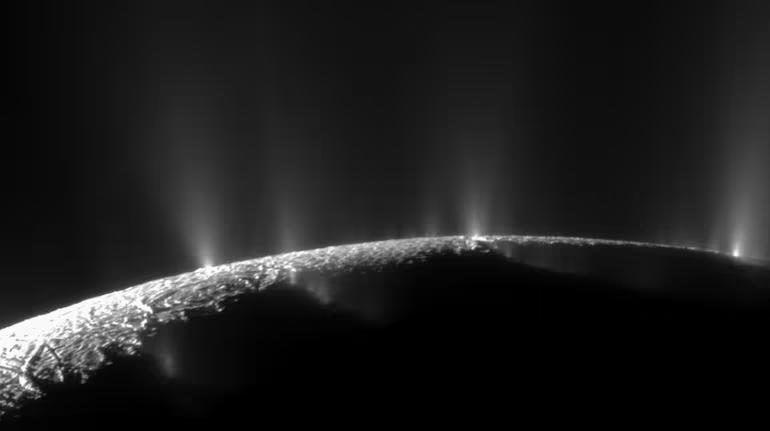
Cassini finds fresh organic molecules on Saturn’s Moon
In a groundbreaking discovery, NASA’s Cassini mission has detected fresh, complex organic molecules erupting from the subsurface ocean of Saturn’s moon Enceladus. This finding has significant implications for the search for life beyond Earth and provides new evidence that Enceladus could be a habitable world. The Cassini spacecraft, which flew just 13 miles above the surface of Enceladus, sampled ice grains in active plumes and found a wide range of organic compounds, including aliphatic, cyclic, nitrogen- and oxygen-bearing molecules, as well as double-bonded molecules.
The discovery was made possible by Cassini’s Cosmic Dust Analyzer (CDA) and Ion and Neutral Mass Spectrometer (INMS) instruments, which were able to detect and analyze the composition of the ice grains and gas in the plumes. The CDA instrument used a technique called time-of-flight mass spectrometry to identify the molecular composition of the ice grains, while the INMS instrument used a quadrupole mass spectrometer to analyze the gas composition of the plumes.
The organic molecules detected by Cassini are the building blocks of life, and their presence in the plumes of Enceladus suggests that the moon’s subsurface ocean may have the necessary conditions to support life. The discovery of these molecules is significant because it provides evidence that the chemical reactions that occur in the subsurface ocean of Enceladus are capable of producing complex organic compounds, which are the precursors to life.
The Cassini mission has been studying Saturn and its moons since 2004, and has made numerous groundbreaking discoveries about the Saturnian system. However, the discovery of organic molecules on Enceladus is one of the most significant findings of the mission to date. The discovery provides new insights into the chemistry of the Enceladus subsurface ocean and suggests that the moon may have a habitable environment.
Enceladus is a small, icy moon that orbits Saturn at a distance of about 178,000 miles. The moon has a diameter of approximately 313 miles and is thought to have a subsurface ocean that is in contact with rock, which could provide the necessary energy and nutrients for life to exist. The subsurface ocean of Enceladus is thought to be similar to the oceans found on Earth, with a mixture of water, salts, and organic compounds.
The discovery of organic molecules on Enceladus is not the first time that NASA’s Cassini mission has detected signs of life beyond Earth. In 2015, the mission detected a large plume of water vapor and organic compounds erupting from the south pole of Enceladus, which suggested that the moon may have a subsurface ocean that is in contact with rock. The discovery of organic molecules in the plumes of Enceladus provides further evidence that the moon may have a habitable environment and increases the likelihood that life may exist elsewhere in our solar system.
The implications of this discovery are significant and far-reaching. The detection of organic molecules on Enceladus suggests that the moon may have a habitable environment and increases the likelihood that life may exist elsewhere in our solar system. The discovery also provides new insights into the chemistry of the Enceladus subsurface ocean and suggests that the moon may have a complex geochemical system that is capable of supporting life.
The Cassini mission has been a groundbreaking success, and the discovery of organic molecules on Enceladus is a testament to the mission’s ability to make significant scientific discoveries. The mission has been extended several times, and it is expected to continue operating until 2017, when it will finally run out of fuel and crash into the atmosphere of Saturn.
In conclusion, the discovery of fresh organic molecules on Saturn’s moon Enceladus is a significant finding that has major implications for the search for life beyond Earth. The detection of these molecules provides evidence that the subsurface ocean of Enceladus may have the necessary conditions to support life and increases the likelihood that life may exist elsewhere in our solar system. The Cassini mission has been a groundbreaking success, and the discovery of organic molecules on Enceladus is a testament to the mission’s ability to make significant scientific discoveries.
About the Author