Cassini finds fresh organic molecules on Saturn’s Moon
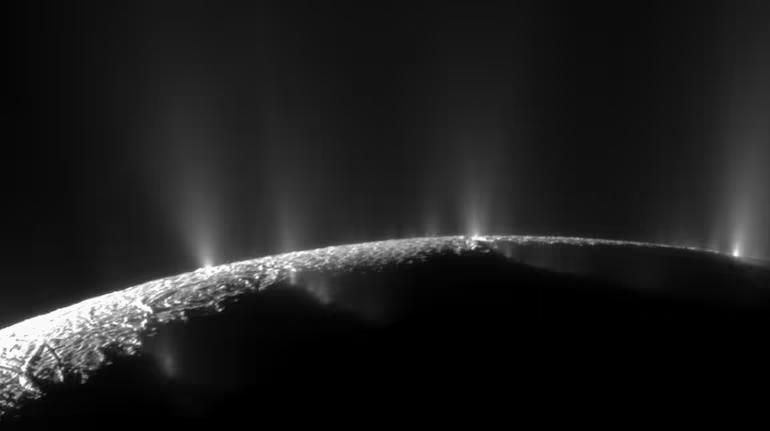
In a groundbreaking discovery, NASA’s Cassini mission has detected fresh, complex organic molecules erupting from the subsurface ocean of Saturn’s moon Enceladus. The spacecraft, flying just 13 miles above the surface, sampled ice grains in active plumes and found aliphatic, cyclic, nitrogen- and oxygen-bearing compounds, including double-bonded molecules. This finding has significant implications for the search for life beyond Earth and supports evidence that Enceladus could be habitable.
The Cassini mission, which was launched in 1997 and concluded in 2017, was designed to study the Saturnian system, including its rings, moons, and magnetic field. During its 13-year orbit around Saturn, Cassini made numerous flybys of Enceladus, a small, icy moon that orbits the planet. The spacecraft’s instruments were able to detect the presence of a subsurface ocean beneath the moon’s frozen surface, which is thought to be in contact with rock and could potentially support life.
The discovery of fresh organic molecules on Enceladus is a major breakthrough, as it suggests that the moon’s subsurface ocean is capable of producing complex chemical compounds. These compounds are the building blocks of life, and their presence on Enceladus increases the likelihood that the moon could support life. The fact that the molecules are fresh and have not been degraded by radiation or other processes suggests that they are being continuously produced, which is a strong indication of biological activity.
The Cassini spacecraft used its Cosmic Dust Analyzer (CDA) and Ion and Neutral Mass Spectrometer (INMS) instruments to sample the ice grains in the plumes erupting from Enceladus’s surface. The CDA instrument was able to detect the presence of large, complex organic molecules, while the INMS instrument was able to identify the specific types of molecules present. The data from these instruments revealed a diverse range of organic compounds, including aliphatic, cyclic, nitrogen- and oxygen-bearing compounds, as well as double-bonded molecules.
The presence of these complex organic molecules on Enceladus is a significant finding, as it suggests that the moon’s subsurface ocean is capable of supporting life. The discovery of life on Enceladus would be a major breakthrough, as it would provide evidence that life can exist elsewhere in the universe. The search for life beyond Earth is an active area of research, with scientists using a variety of methods to search for signs of life on other planets and moons.
The discovery of organic molecules on Enceladus also has implications for the search for life on other planets and moons. The presence of these molecules suggests that the conditions on Enceladus are suitable for life, and that similar conditions may exist on other planets and moons. This discovery could provide a new target for future missions, such as the Europa Clipper mission, which is scheduled to launch in the mid-2020s and will explore Jupiter’s moon Europa, which is thought to have a similar subsurface ocean.
The Cassini mission has provided a wealth of information about the Saturnian system, including the discovery of geysers on Enceladus and the presence of a subsurface ocean on the moon. The mission has also provided insights into the composition of the moon’s surface and the processes that shape it. The discovery of organic molecules on Enceladus is a major breakthrough, and it highlights the importance of continued exploration of the Saturnian system.
In conclusion, the discovery of fresh organic molecules on Enceladus is a significant finding that has major implications for the search for life beyond Earth. The presence of these complex molecules suggests that the moon’s subsurface ocean is capable of supporting life, and that similar conditions may exist on other planets and moons. The Cassini mission has provided a wealth of information about the Saturnian system, and its discovery of organic molecules on Enceladus is a major breakthrough that highlights the importance of continued exploration of our solar system.
For more information on this discovery, please visit: https://www.moneycontrol.com/science/nasa-s-cassini-detects-fresh-organic-molecules-from-saturn-s-moon-article-13703089.html/amp
About the Author