Cassini finds fresh organic molecules on Saturn’s Moon
The search for life beyond Earth has been a longstanding quest for scientists and astronomers. While we have yet to find definitive proof of extraterrestrial life, recent discoveries have brought us closer to understanding the possibility of life existing elsewhere in our solar system. One such discovery was made by NASA’s Cassini mission, which has been exploring the Saturn system since 2004. In a groundbreaking finding, the Cassini spacecraft has detected fresh, complex organic molecules erupting from the subsurface ocean of Saturn’s moon Enceladus.
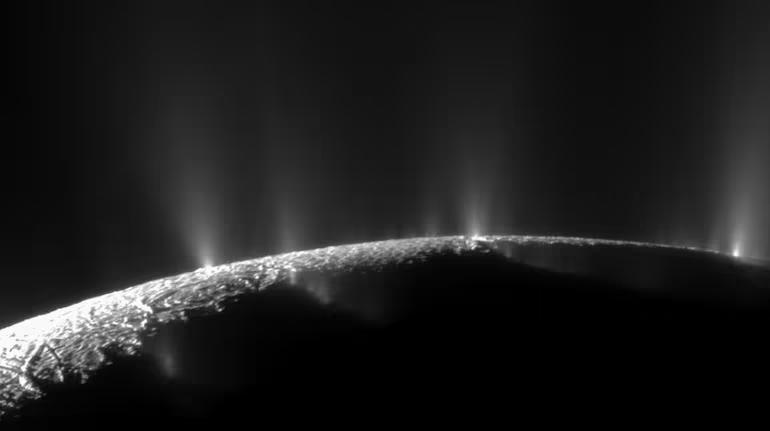
The discovery was made when the Cassini spacecraft flew just 13 miles above the surface of Enceladus, sampling ice grains in the active plumes that emanate from the moon’s subsurface ocean. The plumes, which are thought to be fueled by geysers of water vapor and organic compounds, are a key feature of Enceladus’ geological activity. By analyzing the ice grains, the Cassini team was able to identify a range of complex organic molecules, including aliphatic, cyclic, nitrogen- and oxygen-bearing compounds, as well as double-bonded molecules.
The presence of these complex organic molecules is significant, as they are the building blocks of life. On Earth, organic molecules are the foundation of all living organisms, from simple bacteria to complex plants and animals. The fact that similar molecules have been found on Enceladus suggests that the moon may have the necessary ingredients for life to exist. Furthermore, the discovery of fresh, complex organic molecules erupting from the subsurface ocean of Enceladus provides strong evidence that the moon’s hydrothermal system is capable of producing the raw materials necessary for life.
The Cassini mission has been instrumental in our understanding of the Saturn system, and the discovery of organic molecules on Enceladus is just one of many significant findings. Previous discoveries have included the presence of a subsurface ocean, geysers of water vapor, and a possible energy source for life. The combination of these factors makes Enceladus a prime target in the search for life beyond Earth.
The discovery of organic molecules on Enceladus also has implications for our understanding of the moon’s geological history. The presence of complex organic molecules suggests that the moon’s subsurface ocean has been in contact with rock, which is necessary for the formation of these molecules. This, in turn, suggests that Enceladus has undergone significant geological activity in the past, which could have provided the necessary energy for life to emerge.
The Cassini mission has been a groundbreaking success, and the discovery of organic molecules on Enceladus is a testament to the spacecraft’s capabilities. The mission has been extended several times, allowing scientists to continue exploring the Saturn system and making new discoveries. While the Cassini mission is scheduled to come to an end in the near future, the discoveries made by the spacecraft will continue to shape our understanding of the Saturn system and the search for life beyond Earth.
In conclusion, the discovery of fresh, complex organic molecules on Enceladus is a significant finding that supports the possibility of life existing on the moon. The presence of these molecules, combined with the moon’s subsurface ocean and geological activity, makes Enceladus a prime target in the search for life beyond Earth. As we continue to explore the Saturn system and the rest of our solar system, we may uncover even more evidence of the possibility of life existing elsewhere. The search for life beyond Earth is an ongoing quest, and discoveries like this one bring us closer to understanding the possibility of life existing elsewhere in the universe.
The discovery of organic molecules on Enceladus is a reminder that the search for life beyond Earth is a complex and ongoing process. While we have yet to find definitive proof of extraterrestrial life, discoveries like this one bring us closer to understanding the possibility of life existing elsewhere in our solar system. As we continue to explore the Saturn system and the rest of our solar system, we may uncover even more evidence of the possibility of life existing elsewhere. The search for life beyond Earth is an exciting and ongoing quest, and discoveries like this one are an important step towards understanding the possibility of life existing elsewhere in the universe.
About the Author