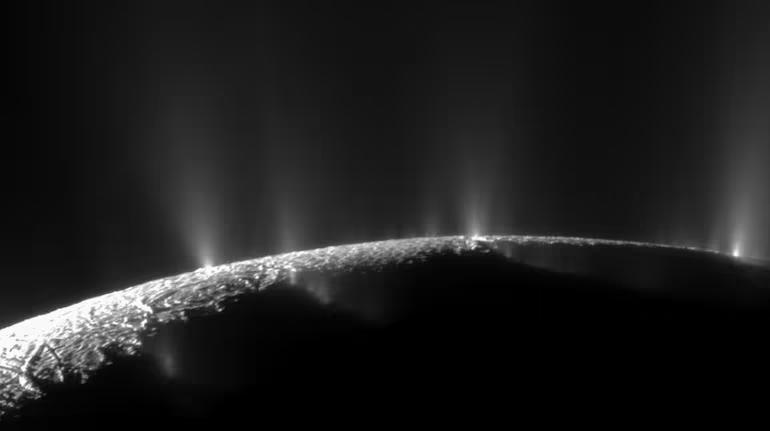
Cassini finds fresh organic molecules on Saturn’s Moon
The search for life beyond Earth has been a longstanding quest for scientists and space enthusiasts alike. While we have yet to find definitive evidence of extraterrestrial life, recent discoveries have brought us closer to understanding the possibility of life existing elsewhere in our solar system. One such discovery was made by NASA’s Cassini mission, which has detected fresh, complex organic molecules erupting from the subsurface ocean of Saturn’s moon Enceladus. This finding has significant implications for the search for life beyond Earth and sheds new light on the potential habitability of Enceladus.
The Cassini spacecraft, which orbited Saturn from 2004 to 2017, was equipped with a suite of instruments designed to study the planet and its moons. On October 28, 2015, Cassini flew just 13 miles above the surface of Enceladus, sampling ice grains in the active plumes that erupt from the moon’s subsurface ocean. The spacecraft’s Cosmic Dust Analyzer and Ion and Neutral Mass Spectrometer instruments were used to analyze the composition of the ice grains, and the results were nothing short of remarkable.
The analysis revealed the presence of aliphatic, cyclic, nitrogen- and oxygen-bearing compounds, including double-bonded molecules. These complex organic molecules are the building blocks of life and are found in all living organisms on Earth. The fact that they were detected in the plumes of Enceladus suggests that the moon’s subsurface ocean may have the necessary ingredients for life to exist.
The discovery of organic molecules on Enceladus is not entirely unexpected. Previous studies have shown that the moon’s subsurface ocean is in contact with rock, which could provide the necessary energy and nutrients for life to thrive. The presence of organic molecules, however, provides strong evidence that the conditions on Enceladus are suitable for life to exist.
The implications of this discovery are profound. If life can exist on Enceladus, it would suggest that the moon is habitable, and that the conditions necessary for life to thrive are not unique to Earth. This would have significant implications for the search for life beyond our solar system and would provide a new target for future missions designed to search for life.
The detection of organic molecules on Enceladus also raises questions about the moon’s potential for supporting life. The subsurface ocean on Enceladus is thought to be similar to those found on Earth, with temperatures ranging from -10 to 0 degrees Celsius. This temperature range is suitable for life as we know it, and the presence of organic molecules suggests that the necessary energy and nutrients are available.
The next step in the search for life on Enceladus will be to return to the moon with a new mission designed to study its subsurface ocean in more detail. The Enceladus Life Finder mission, proposed by NASA, would involve sending a spacecraft to Enceladus to study its subsurface ocean and search for signs of life. The mission would involve sampling the plumes of Enceladus and analyzing the composition of the ice grains to determine if they contain any biosignatures.
In conclusion, the detection of fresh, complex organic molecules on Enceladus is a significant discovery that has implications for the search for life beyond Earth. The presence of these molecules suggests that the moon’s subsurface ocean may have the necessary ingredients for life to exist, and that the conditions on Enceladus are suitable for life to thrive. As we continue to explore our solar system and search for life beyond Earth, the discovery on Enceladus serves as a reminder that the possibility of life existing elsewhere in the universe is very real.
The search for life beyond Earth is an ongoing quest that has captivated human imagination for centuries. While we have yet to find definitive evidence of extraterrestrial life, discoveries like the one on Enceladus bring us closer to understanding the possibility of life existing elsewhere in our solar system. As we continue to explore and study the moons of Saturn, we may uncover even more evidence that suggests the possibility of life existing beyond Earth.
The discovery of organic molecules on Enceladus is a testament to the power of human curiosity and the importance of continued exploration and research. As we push the boundaries of what we know about our solar system, we may uncover even more secrets that challenge our understanding of the universe and our place within it.
For now, the discovery on Enceladus serves as a reminder that the search for life beyond Earth is an ongoing and exciting quest that has the potential to reveal new and unexpected discoveries. As we continue to explore and study the moons of Saturn, we may uncover even more evidence that suggests the possibility of life existing beyond Earth.
About the Author