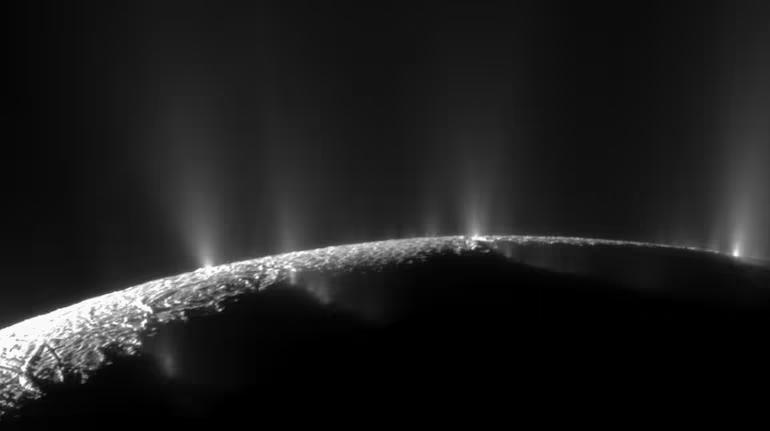
Cassini finds fresh organic molecules on Saturn’s Moon
The search for life beyond Earth has been a longstanding quest for scientists and astronomers. While we have not yet found definitive evidence of extraterrestrial life, recent discoveries have brought us closer to understanding the potential for life to exist elsewhere in our solar system. One such discovery was made by NASA’s Cassini mission, which detected fresh, complex organic molecules erupting from the subsurface ocean of Saturn’s moon Enceladus. This finding has significant implications for the search for life beyond Earth and provides new insights into the chemistry of Enceladus’s subsurface ocean.
The Cassini spacecraft, which orbited Saturn from 2004 to 2017, was designed to study the planet and its moons in unprecedented detail. One of its key objectives was to explore Enceladus, a small, icy moon that orbits Saturn. Enceladus is of particular interest to scientists because it has a subsurface ocean, which is thought to be in contact with rock, making it a potential habitat for life. The moon’s subsurface ocean is also believed to be warmed by tidal heating, a process that occurs when the moon’s interior is flexed by Saturn’s gravitational pull, generating heat through friction.
In 2015, the Cassini spacecraft flew just 13 miles above the surface of Enceladus, sampling ice grains in the active plumes that erupt from the moon’s southern pole. The plumes are thought to originate from the subsurface ocean, and by analyzing the ice grains, scientists were able to gain insights into the chemistry of the ocean. The findings, which were published in a recent study, revealed the presence of aliphatic, cyclic, nitrogen- and oxygen-bearing compounds, including double-bonded molecules. These complex organic molecules are the building blocks of life and are found in all living organisms on Earth.
The discovery of fresh, complex organic molecules on Enceladus is significant because it suggests that the moon’s subsurface ocean has the necessary chemistry to support life. The presence of these molecules also implies that the ocean is in contact with rock, which is a key ingredient for life as we know it. The rock-ocean interface is thought to provide the necessary energy and nutrients for life to emerge and thrive. The fact that the molecules are fresh and not contaminated with older, more degraded material suggests that they are being produced continuously, which is consistent with the idea that Enceladus’s subsurface ocean is a dynamic, habitable environment.
The findings also have implications for our understanding of the origins of life on Earth. The discovery of complex organic molecules on Enceladus suggests that the raw materials for life are widespread in the solar system and that the emergence of life may be more likely than previously thought. This is because the conditions that exist on Enceladus, such as the presence of liquid water, energy, and organic molecules, are similar to those that existed on Earth billions of years ago, when life is thought to have emerged.
The Cassini mission has been instrumental in our understanding of Enceladus and its potential for life. The mission has provided a wealth of information about the moon’s subsurface ocean, including its composition, temperature, and potential for habitability. While the mission ended in 2017, when the spacecraft deliberately plunged into Saturn’s atmosphere, its legacy lives on, and its findings continue to inspire new research and exploration.
In the future, scientists hope to return to Enceladus with a new mission that will be designed to specifically search for signs of life. The Enceladus Life Finder mission, which is currently in the concept phase, would involve sending a spacecraft to Enceladus to sample the plumes and search for biosignatures, such as the presence of oxygen, methane, or other biomarkers. The mission would also involve studying the moon’s subsurface ocean and searching for evidence of hydrothermal activity, which is thought to be a key ingredient for life.
In conclusion, the discovery of fresh, complex organic molecules on Enceladus is a significant finding that has implications for the search for life beyond Earth. The presence of these molecules suggests that Enceladus’s subsurface ocean has the necessary chemistry to support life and that the moon may be a habitable world. The findings also have implications for our understanding of the origins of life on Earth and suggest that the raw materials for life are widespread in the solar system. As we continue to explore our solar system and search for signs of life, the discovery of organic molecules on Enceladus is a reminder that the possibility of life existing elsewhere in the universe is very real.
About the Author