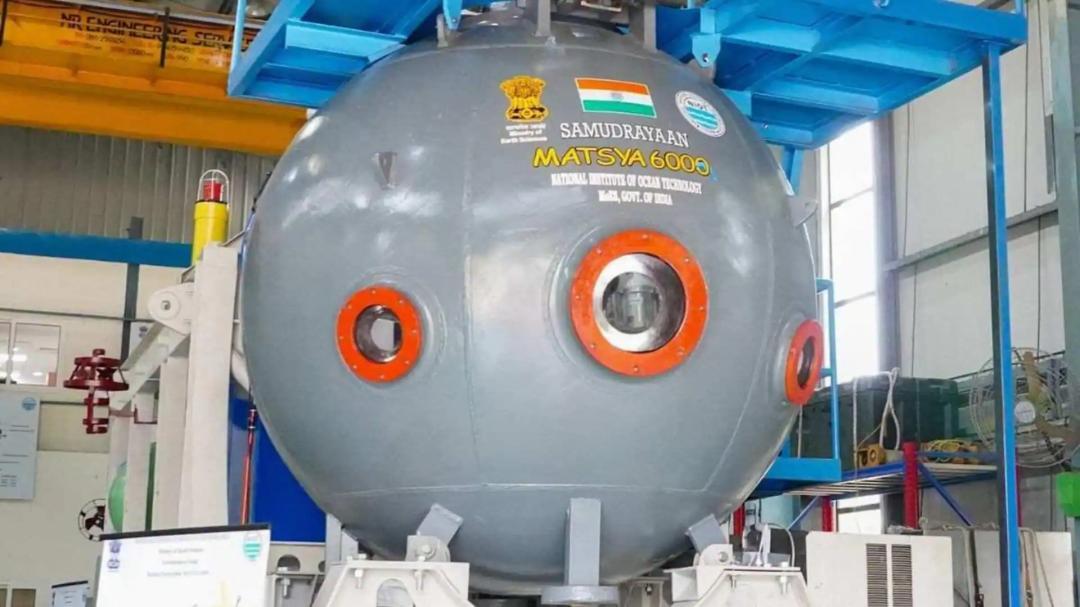
What is causing the delay in India’s Samudrayaan mission?
India’s ambitious Samudrayaan mission, which aims to send a manned submersible to a depth of 6,000 meters underwater, has been delayed due to unforeseen circumstances. The project, led by the National Institute of Ocean Technology (NIOT), has been facing a setback due to the late delivery of a crucial component from France. The syntactic foam cladding, which is vital for the submersible’s buoyancy, has been delayed, pushing back the testing schedule to April next year.
The Samudrayaan mission is a significant undertaking by the Indian government, with the objective of exploring the ocean floor, collecting samples, and paving the way for deep-sea mining. The mission is expected to provide valuable insights into the uncharted territories of the ocean and unlock new opportunities for scientific research and economic development. However, the delay in the delivery of the syntactic foam cladding has thrown a spanner in the works, forcing the researchers to revise their timeline.
The syntactic foam cladding is a critical component of the submersible, as it provides the necessary buoyancy to maintain the vessel’s stability and balance underwater. The foam cladding is designed to withstand the immense pressure of the deep sea, and its late delivery has left the researchers with no choice but to postpone the testing schedule. The NIOT team had initially planned to conduct the tests earlier this year, but the delay in the delivery of the foam cladding has forced them to push back the schedule to April next year.
The Samudrayaan mission is a complex and challenging project that requires meticulous planning and execution. The submersible will be designed to withstand the harsh conditions of the deep sea, including extreme pressure, near-freezing temperatures, and total darkness. The vessel will be equipped with state-of-the-art technology, including advanced sensors, cameras, and sampling equipment, to collect data and samples from the ocean floor.
The mission is expected to provide valuable insights into the geology, biology, and chemistry of the ocean floor, and will help scientists to better understand the complex ecosystems that exist in the deep sea. The data collected during the mission will also be used to identify potential sites for deep-sea mining, which could provide a new source of revenue for the Indian economy.
Despite the delay, the NIOT team remains optimistic about the mission’s prospects and is working tirelessly to ensure that the project gets back on track. The team is collaborating with international partners, including French companies, to overcome the technical challenges and ensure the success of the mission.
The delay in the Samudrayaan mission is a reminder of the complexities and challenges involved in deep-sea exploration. The project requires careful planning, precise execution, and collaboration with international partners to overcome the technical and logistical challenges. However, the potential rewards of the mission are significant, and the Indian government is committed to supporting the project and ensuring its success.
In conclusion, the delay in the Samudrayaan mission is a setback, but it is not a roadblock. The NIOT team is working hard to overcome the challenges and ensure that the project gets back on track. The mission is expected to provide valuable insights into the ocean floor and unlock new opportunities for scientific research and economic development. As the project moves forward, it will be interesting to see how the team overcomes the challenges and achieves its objectives.
The Samudrayaan mission is a significant undertaking by the Indian government, and its success will depend on the collaboration and cooperation of international partners. The project has the potential to unlock new opportunities for deep-sea mining, scientific research, and economic development, and it is essential that the government and the research team work together to ensure its success.
As the world looks to the oceans for new opportunities and challenges, the Samudrayaan mission is a beacon of hope and innovation. The project has the potential to inspire a new generation of scientists, engineers, and explorers, and to pave the way for a new era of deep-sea exploration and discovery.
News Source: https://www.newsbytesapp.com/news/science/samudrayaan-mission-delayed-due-to-late-delivery-of-french-foam/story
About the Author