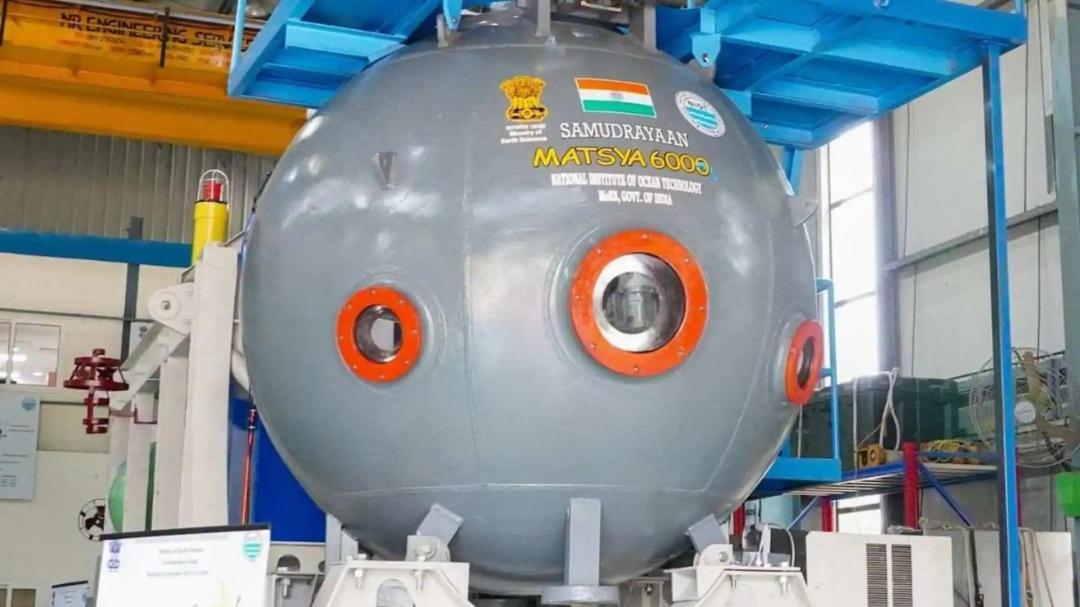
What is causing the delay in India’s Samudrayaan mission?
India’s ambitious Samudrayaan mission, aimed at sending a manned submersible to a depth of 6,000 meters underwater, has hit a roadblock. The mission, led by the National Institute of Ocean Technology (NIOT), has been delayed due to the late delivery of a critical component – syntactic foam cladding – from France. This vital component is essential for the submersible’s buoyancy, and its delayed arrival has pushed back the mission’s timeline.
The Samudrayaan mission is a significant undertaking for India, as it seeks to explore the ocean floor, collect samples, and pave the way for deep-sea mining. The mission’s success would not only enhance our understanding of the ocean’s depths but also unlock new opportunities for extracting valuable resources from the seabed. However, the delay in the delivery of the syntactic foam cladding has thrown a spanner in the works, and the mission’s timeline has been revised.
The syntactic foam cladding is a critical component of the submersible’s design, as it provides the necessary buoyancy to withstand the immense pressure of the deep ocean. The foam cladding is made up of a mixture of hollow glass microspheres and a polymer resin, which provides the required strength and durability to resist the crushing pressure of the deep sea. Without this component, the submersible would not be able to maintain its buoyancy, making it impossible to reach the desired depth.
The delay in the delivery of the syntactic foam cladding has been attributed to unforeseen circumstances, and the NIOT team is working closely with the French supplier to expedite the delivery. The team is now expecting the component to arrive by April next year, which would allow them to conduct the necessary tests and prepare the submersible for the mission.
The Samudrayaan mission is a complex undertaking that requires meticulous planning and execution. The mission involves a range of activities, including the design and development of the submersible, the training of the crew, and the deployment of the submersible to the desired depth. The mission’s success would depend on the precise execution of each of these activities, and the delay in the delivery of the syntactic foam cladding has added an extra layer of complexity to the mission.
Despite the delay, the NIOT team remains optimistic about the mission’s prospects. The team has been working tirelessly to develop the submersible and prepare it for the mission, and they are confident that the delay would not affect the mission’s overall objective. The team is now focusing on conducting a range of tests, including pressure hull tests, life support system tests, and propulsion system tests, to ensure that the submersible is ready for the mission.
The Samudrayaan mission is not only significant for India but also for the global scientific community. The mission’s success would provide valuable insights into the ocean’s depths, which would help us better understand the Earth’s ecosystem. The mission would also pave the way for deep-sea mining, which could provide a new source of revenue for countries with access to the ocean.
In conclusion, the delay in the delivery of the syntactic foam cladding has caused a setback for India’s Samudrayaan mission. However, the NIOT team remains committed to the mission’s success, and they are working closely with the French supplier to expedite the delivery of the component. The mission’s success would depend on the precise execution of each activity, and the team is now focusing on conducting a range of tests to ensure that the submersible is ready for the mission. As we wait for the mission to take off, we can only hope that the delay would not affect the mission’s overall objective and that the team would be able to overcome the challenges and achieve success.
News Source: https://www.newsbytesapp.com/news/science/samudrayaan-mission-delayed-due-to-late-delivery-of-french-foam/story
About the Author