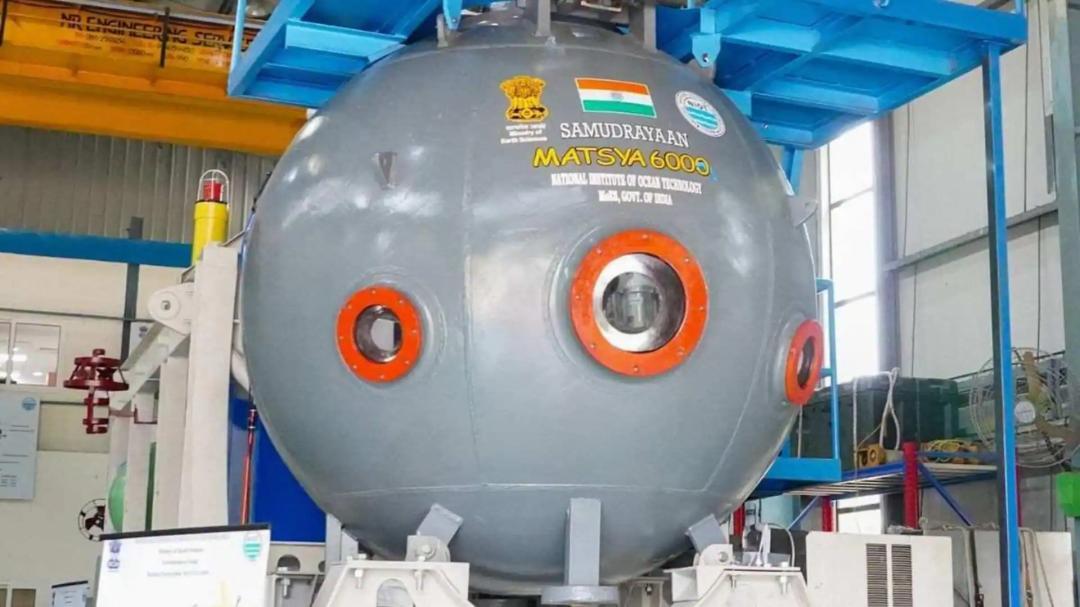
What is causing the delay in India’s Samudrayaan mission?
India’s ambitious Samudrayaan mission, aimed at sending a manned submersible to a depth of 6,000 meters underwater, has hit a roadblock. The mission, led by the National Institute of Ocean Technology (NIOT), has been delayed due to the late delivery of a critical component from France. The component in question is syntactic foam cladding, which is vital for the submersible’s buoyancy. The delay has pushed back the testing schedule, with the new expected timeline set for April next year.
The Samudrayaan mission is a significant undertaking for India, with the objective of exploring the ocean floor, collecting samples, and paving the way for deep-sea mining. The mission is expected to provide valuable insights into the ocean’s ecosystem, geology, and potential mineral resources. The submersible, designed to withstand the immense pressure of the deep sea, will be capable of carrying a crew of three to the ocean floor, where they will conduct scientific experiments and collect data.
The syntactic foam cladding, which is being sourced from France, is a critical component of the submersible’s design. The foam cladding provides the necessary buoyancy to the submersible, allowing it to maintain its stability and balance underwater. Without this component, the submersible would be unable to operate safely and efficiently.
The delay in the delivery of the syntactic foam cladding has had a ripple effect on the entire mission schedule. The testing phase, which was initially expected to commence earlier this year, has now been pushed back to April next year. The delay has also affected the overall timeline of the mission, with the crew training and preparation phases also being rescheduled.
Despite the delay, the NIOT team remains optimistic about the mission’s prospects. The team has been working tirelessly to ensure that all other components of the submersible are ready and in place. The submersible’s design and engineering have been completed, and the crew training program is ongoing.
The Samudrayaan mission is not just significant for India but also has global implications. The mission is expected to contribute to the international community’s understanding of the ocean’s ecosystem and its potential resources. The mission’s success will also demonstrate India’s capabilities in deep-sea exploration and technology, placing the country among the league of nations that have achieved this feat.
The delay in the Samudrayaan mission highlights the complexities and challenges involved in deep-sea exploration. The development of technologies and components required for such missions is a time-consuming and labor-intensive process. The reliance on international suppliers for critical components also adds to the complexity, as seen in the case of the syntactic foam cladding.
As India awaits the delivery of the syntactic foam cladding, the NIOT team continues to work on other aspects of the mission. The team is conducting rigorous tests and simulations to ensure that the submersible is ready for the challenges of the deep sea. The crew training program is also ongoing, with the selected crew members undergoing rigorous training to prepare them for the mission.
In conclusion, the delay in the Samudrayaan mission is a setback, but it is not a setback that will derail the entire mission. The NIOT team is working diligently to ensure that the mission stays on track, and the delay has provided an opportunity to review and refine the mission’s plans. As India looks to explore the ocean floor and unlock its secrets, the Samudrayaan mission remains a vital component of the country’s scientific and technological endeavors.
News Source: https://www.newsbytesapp.com/news/science/samudrayaan-mission-delayed-due-to-late-delivery-of-french-foam/story
About the Author