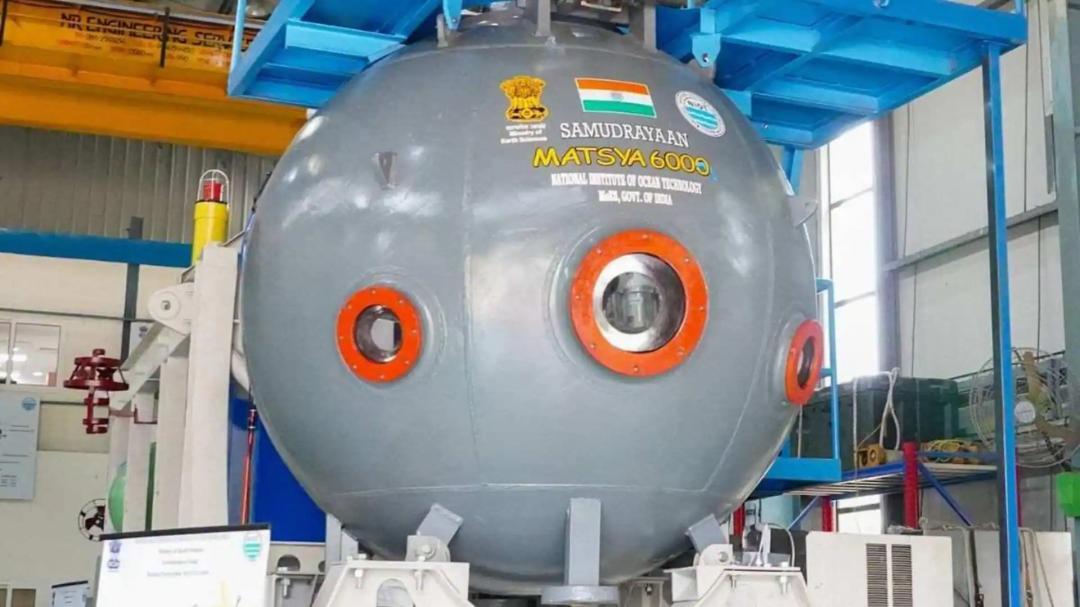
What is causing the delay in India’s Samudrayaan mission?
India’s ambitious Samudrayaan mission, aimed at sending a manned submersible to a depth of 6,000 meters underwater, has hit a roadblock. The mission, led by the National Institute of Ocean Technology (NIOT), has been delayed due to the late delivery of a critical component from France. The component in question is syntactic foam cladding, a vital material for the submersible’s buoyancy. The delay has pushed back the testing schedule, with trials now expected to commence by April next year.
The Samudrayaan mission is a significant undertaking for India, with the objective of exploring the ocean floor, collecting samples, and paving the way for deep-sea mining. The mission is expected to provide valuable insights into the Earth’s oceans, which cover over 70% of the planet’s surface. The data collected during the mission will help scientists better understand the ocean’s ecosystem, geology, and potential resources.
The manned submersible, designed to withstand the immense pressure at depths of 6,000 meters, is a complex piece of equipment. The syntactic foam cladding, which is being imported from France, plays a crucial role in maintaining the submersible’s buoyancy. The foam cladding is a specialized material that provides the necessary lift to counteract the weight of the submersible, allowing it to descend to great depths and return to the surface safely.
The delay in the delivery of the syntactic foam cladding has significant implications for the mission. The NIOT had initially planned to conduct the tests earlier this year, but the late arrival of the critical component has forced the team to revise the schedule. The delay has also raised concerns about the mission’s overall timeline and the potential impact on the project’s budget.
Despite the setback, the NIOT team remains optimistic about the mission’s prospects. The team has been working tirelessly to design and develop the submersible, and the delay has provided an opportunity to fine-tune the equipment and conduct additional tests. The mission’s success will depend on the precise functioning of the submersible, and the team is determined to ensure that every aspect of the equipment is thoroughly tested and validated.
The Samudrayaan mission is not just about exploring the ocean floor; it also has significant economic implications. The mission is expected to pave the way for deep-sea mining, which could provide access to valuable resources such as minerals and metals. The ocean floor is believed to be rich in resources, including copper, zinc, and gold, and the mission could help India tap into these resources.
The delay in the Samudrayaan mission is a reminder of the complexities and challenges involved in deep-sea exploration. The mission requires the development of specialized equipment, including the manned submersible, and the coordination of multiple stakeholders, including scientists, engineers, and policymakers. The success of the mission will depend on the ability of the NIOT team to overcome the technical and logistical challenges and to work together to achieve the mission’s objectives.
In conclusion, the delay in the Samudrayaan mission is a setback, but it is not a insurmountable obstacle. The NIOT team is working hard to overcome the challenges, and the mission remains on track to achieve its objectives. The success of the mission will depend on the precise functioning of the submersible, and the team is determined to ensure that every aspect of the equipment is thoroughly tested and validated. The Samudrayaan mission is a significant undertaking for India, and its success will have far-reaching implications for the country’s scientific and economic development.
The mission’s delay has also highlighted the importance of international cooperation in deep-sea exploration. The import of syntactic foam cladding from France is a testament to the global nature of the mission, and the need for collaboration between countries to achieve common goals. The Samudrayaan mission is a reminder that deep-sea exploration is a complex and challenging endeavor, requiring the coordination of multiple stakeholders and the development of specialized equipment.
As the NIOT team works to overcome the challenges and achieve the mission’s objectives, the country remains hopeful about the prospects of the Samudrayaan mission. The mission has the potential to unlock new resources, advance our understanding of the ocean’s ecosystem, and pave the way for future deep-sea exploration. The delay may have pushed back the testing schedule, but it has not dampened the enthusiasm and excitement surrounding the mission.
The Samudrayaan mission is a significant step forward for India’s scientific community, and its success will have far-reaching implications for the country’s development. The mission is a testament to India’s growing capabilities in deep-sea exploration and its determination to become a major player in the field. As the country looks to the future, the Samudrayaan mission is a reminder of the importance of investing in science and technology, and the need to push the boundaries of human knowledge and exploration.
News Source: https://www.newsbytesapp.com/news/science/samudrayaan-mission-delayed-due-to-late-delivery-of-french-foam/story
About the Author