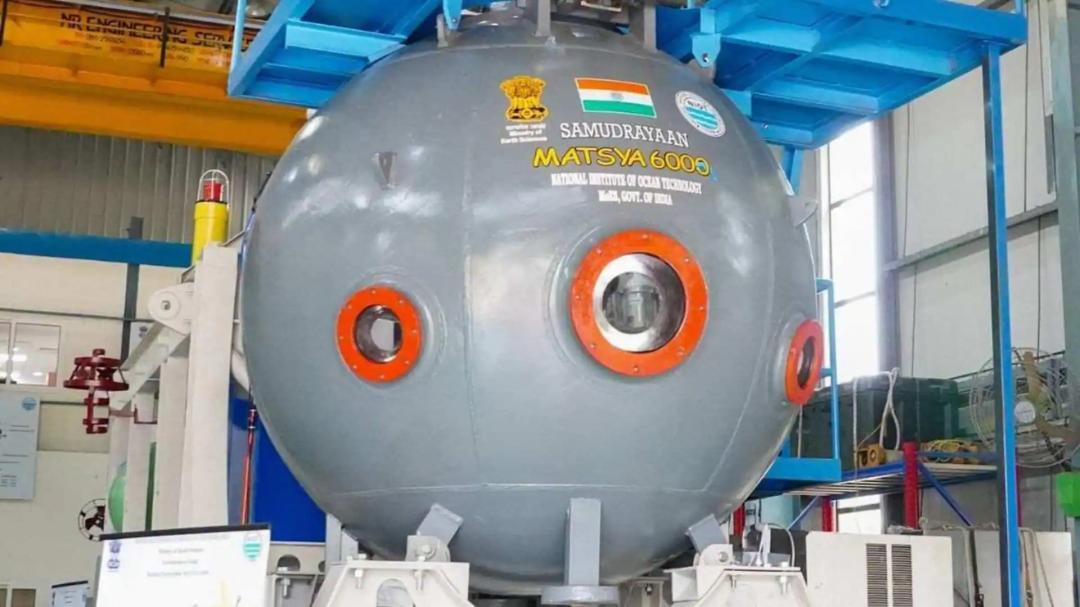
What is causing the delay in India’s Samudrayaan mission?
India’s ambitious Samudrayaan mission, which aims to send a manned submersible to a depth of 6,000 meters underwater, has hit a roadblock. The mission, led by the National Institute of Ocean Technology (NIOT), has been delayed due to the late delivery of a critical component from France. The component in question is syntactic foam cladding, a vital material that provides buoyancy to the submersible. Without it, the submersible cannot operate safely and efficiently.
The Samudrayaan mission is a significant undertaking for India, as it seeks to explore the ocean floor, collect samples, and pave the way for deep-sea mining. The mission is expected to provide valuable insights into the ocean’s ecosystem, geology, and potential mineral resources. However, the delay in the delivery of the syntactic foam cladding has pushed back the timeline for the mission.
According to reports, the syntactic foam cladding was supposed to be delivered from France several months ago. However, due to unforeseen circumstances, the delivery has been delayed, and the Indian team is now expecting to receive the component by the end of this year. Once the component is received, the team will begin integrating it into the submersible, followed by a series of tests to ensure its safety and functionality.
The tests are now expected to be conducted by April next year, which means that the mission will be delayed by several months. While the delay is unfortunate, it is essential to ensure that the submersible is safe and functional before it is deployed. The Indian team is working closely with the French supplier to expedite the delivery of the syntactic foam cladding and get the mission back on track.
The Samudrayaan mission is a complex and challenging undertaking that requires careful planning, precise engineering, and rigorous testing. The mission involves sending a manned submersible to a depth of 6,000 meters, which is an unprecedented feat in Indian oceanography. The submersible will be equipped with state-of-the-art technology, including advanced life support systems, communication equipment, and sampling gear.
The mission is expected to provide valuable insights into the ocean’s ecosystem, including the distribution of marine life, the geology of the ocean floor, and the potential for deep-sea mining. The ocean floor is thought to be rich in mineral resources, including copper, zinc, and gold, which could be exploited to meet India’s growing energy needs. However, the exploration and exploitation of these resources require careful planning and management to ensure that they are done sustainably and with minimal environmental impact.
The delay in the Samudrayaan mission is a setback, but it is not a significant one. The Indian team is working diligently to get the mission back on track, and the delay will provide an opportunity to review and refine the mission plan. The mission is expected to be a significant milestone in Indian oceanography, and it will pave the way for future explorations of the ocean floor.
In conclusion, the delay in the Samudrayaan mission is a temporary setback, but it is essential to ensure that the submersible is safe and functional before it is deployed. The Indian team is working closely with the French supplier to expedite the delivery of the syntactic foam cladding, and the tests are expected to be conducted by April next year. The mission is a significant undertaking that will provide valuable insights into the ocean’s ecosystem and pave the way for deep-sea mining. With careful planning, precise engineering, and rigorous testing, the Samudrayaan mission is expected to be a success and a significant milestone in Indian oceanography.
News source: https://www.newsbytesapp.com/news/science/samudrayaan-mission-delayed-due-to-late-delivery-of-french-foam/story
About the Author