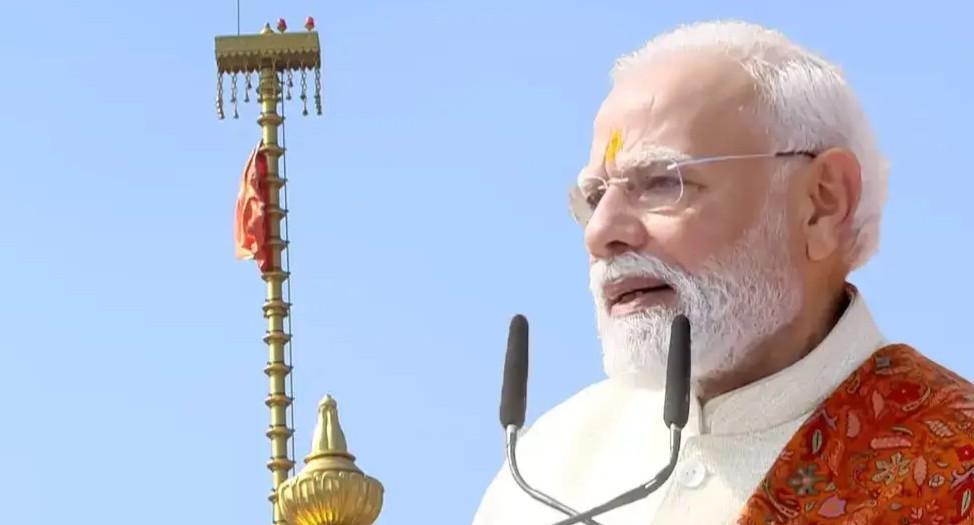
Our Ram Unites Through Emotion, Not Division: PM at Ram Temple
In a momentous occasion, Prime Minister Narendra Modi attended the flag-hoisting ceremony at Ayodhya’s Ram Temple, where he emphasized the unifying power of Lord Ram. Speaking to a gathering of devotees and dignitaries, the Prime Minister said, “Our Ram unites through emotion, not division.” This statement resonated deeply with the audience, as it underscored the importance of unity and inclusivity in the face of diversity.
The Prime Minister’s remarks were significant, as they highlighted the need to move beyond divisions and focus on the commonalities that bind us together. He emphasized that the development of India must be a collective effort, where every individual, regardless of their background or socio-economic status, has a stake. “With this thought, we have kept women, farmers, Dalits, backward classes, and tribals at the centre of development,” he added, stressing the importance of inclusive growth.
The Prime Minister’s vision for India’s development is closely tied to the ideals embodied by Lord Ram. He noted that if India is to become a developed nation by the year 2047, it must walk the path shown by Ram. This path is characterized by values such as compassion, empathy, and selflessness, which are essential for building a harmonious and equitable society.
The idea of Ram as a unifying figure is not new. Throughout Indian history, Lord Ram has been revered as a symbol of righteousness, courage, and wisdom. His story, as depicted in the Ramayana, has inspired countless generations of Indians, transcending regional and linguistic boundaries. The Prime Minister’s reference to Ram as a unifying force, therefore, resonates deeply with the cultural and spiritual heritage of India.
The Prime Minister’s speech also underscored the importance of women’s empowerment and their role in India’s development. By placing women at the centre of development, the government aims to unlock their full potential and create a more equitable society. This is a crucial step towards achieving the Sustainable Development Goals (SDGs) and ensuring that no one is left behind.
Similarly, the Prime Minister’s emphasis on farmers, Dalits, backward classes, and tribals is a recognition of the critical role they play in India’s development. These groups have historically been marginalized and excluded from the mainstream, but they possess a wealth of knowledge, skills, and experience that can be leveraged to drive growth and prosperity.
The Prime Minister’s vision for India’s development is ambitious and far-reaching. It requires a fundamental transformation of the country’s economy, society, and politics. However, by placing the ideals of Ram at the centre of this vision, the Prime Minister is emphasizing the importance of values such as compassion, empathy, and selflessness. These values are essential for building a harmonious and equitable society, where every individual has access to opportunities and resources.
In conclusion, the Prime Minister’s speech at the Ram Temple flag-hoisting ceremony was a powerful reminder of the unifying power of Lord Ram. By emphasizing the importance of unity, inclusivity, and compassion, the Prime Minister is charting a new course for India’s development, one that prioritizes the well-being and dignity of all citizens. As India strives to become a developed nation by 2047, it must walk the path shown by Ram, a path that is characterized by values such as empathy, selflessness, and righteousness.
The Prime Minister’s remarks have significant implications for India’s development trajectory. By placing women, farmers, Dalits, backward classes, and tribals at the centre of development, the government is recognizing the critical role they play in driving growth and prosperity. This is a crucial step towards achieving the SDGs and ensuring that no one is left behind.
As India moves forward on its development journey, it must remain true to the ideals of Ram. This requires a fundamental transformation of the country’s economy, society, and politics, one that prioritizes the well-being and dignity of all citizens. By walking the path shown by Ram, India can become a beacon of hope and prosperity, a nation that is just, equitable, and compassionate.
Source: https://x.com/PTI_News/status/1993214277654921477
About the Author