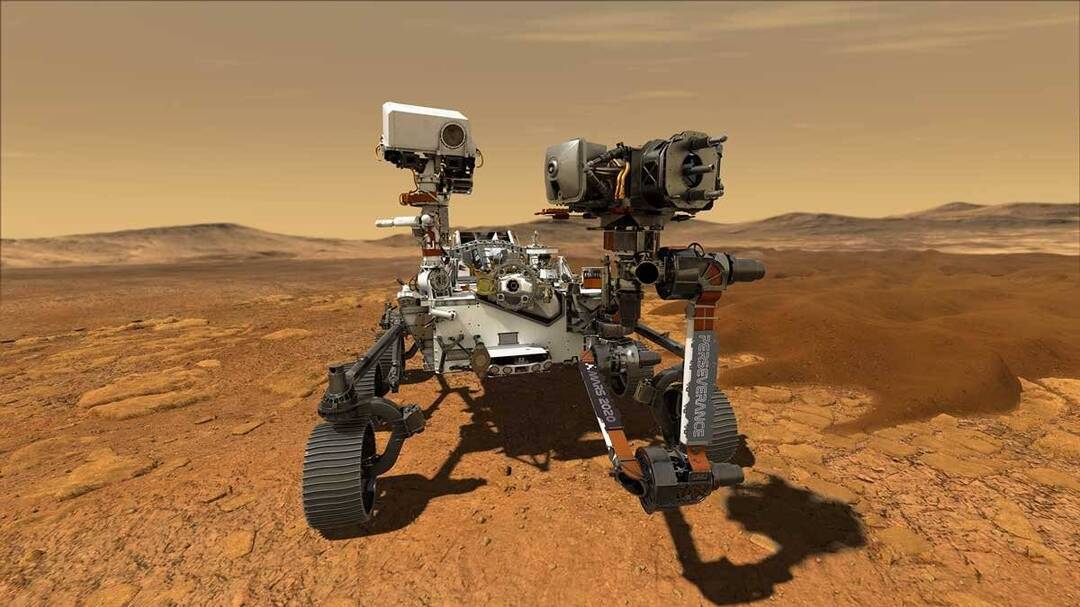
NASA’s Perseverance rover completes 1st AI-planned drive on Mars
In a groundbreaking achievement, NASA’s Perseverance rover has completed its first drive on Mars that was planned by artificial intelligence. The demonstration, which took place on December 8 and 10, was led by NASA’s Jet Propulsion Laboratory in Southern California. This milestone marks a significant step forward in the use of AI in space exploration, and it has the potential to revolutionize the way we explore other worlds.
According to NASA, the AI-planned drive was a complex process that involved the use of advanced algorithms and machine learning techniques. The rover’s onboard computer system used data from its various sensors and instruments to plan a route across the Martian terrain, taking into account obstacles, terrain difficulty, and other factors. The AI system then executed the planned drive, navigating the rover through the chosen route with precision and accuracy.
“This demonstration shows how far our capabilities have advanced and broadens how we will explore other worlds,” said NASA Administrator Jared Isaacman. “The use of AI in space exploration has the potential to greatly enhance our ability to explore and understand the universe, and we are excited to see where this technology will take us in the future.”
The Perseverance rover, which landed on Mars in February 2021, is equipped with a range of advanced instruments and technologies, including a robotic arm, a rock coring system, and a suite of scientific instruments. The rover’s primary mission is to explore Jezero crater, a former lake bed that is believed to have once been home to a thriving ecosystem. The rover’s findings have already provided valuable insights into the geology and climate of Mars, and have helped scientists to better understand the planet’s history and potential for supporting life.
The use of AI in space exploration is not new, but the Perseverance rover’s AI-planned drive marks a significant step forward in the use of this technology. In the past, AI has been used in space missions to perform tasks such as data analysis, image processing, and autonomous navigation. However, the use of AI to plan and execute a drive on another planet is a major breakthrough, and it has the potential to greatly enhance the efficiency and effectiveness of future space missions.
One of the key benefits of using AI in space exploration is its ability to process large amounts of data quickly and accurately. Space missions often generate vast amounts of data, which can be difficult and time-consuming for human operators to analyze. AI systems, on the other hand, can process this data in real-time, identifying patterns and anomalies that may be missed by human operators. This can help to improve the safety and efficiency of space missions, and can also enable scientists to gain new insights into the data that is being collected.
Another benefit of using AI in space exploration is its ability to adapt to changing circumstances. Space missions are often complex and unpredictable, and they can be affected by a range of factors, including weather, terrain, and equipment failures. AI systems can help to mitigate these risks by adapting to changing circumstances in real-time, and by making decisions that are based on the latest available data.
The Perseverance rover’s AI-planned drive is just one example of the many ways in which AI is being used in space exploration. Other examples include the use of AI to control spacecraft systems, to navigate through asteroid fields, and to communicate with Earth. As the use of AI in space exploration continues to evolve, we can expect to see even more innovative applications of this technology in the future.
In conclusion, the Perseverance rover’s completion of its first AI-planned drive on Mars is a significant achievement that marks a major step forward in the use of AI in space exploration. The use of AI has the potential to greatly enhance our ability to explore and understand the universe, and it will play an increasingly important role in future space missions. As we continue to push the boundaries of what is possible with AI, we can expect to see even more exciting developments in the field of space exploration.
About the Author