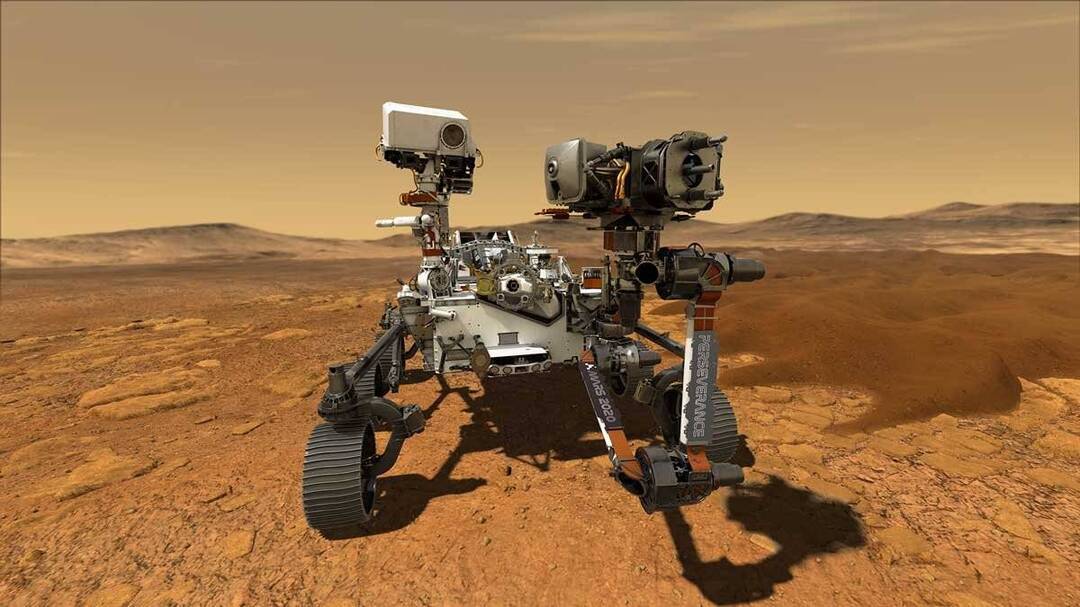
NASA’s Perseverance rover completes 1st AI-planned drive on Mars
In a groundbreaking achievement, NASA’s Perseverance rover has successfully completed its first drive on Mars that was planned by artificial intelligence. The demonstration, which took place on December 8 and 10, was led by NASA’s Jet Propulsion Laboratory in Southern California. This milestone marks a significant step forward in the use of AI in space exploration, showcasing the capabilities of autonomous systems in navigating complex and unforgiving environments like the Martian surface.
According to NASA, the AI-planned drive was a demonstration of the rover’s ability to navigate through challenging terrain using advanced algorithms and machine learning techniques. The drive was planned and executed by the rover’s onboard computer system, which used data from the rover’s various sensors and instruments to map out a safe and efficient route. The demonstration was a resounding success, with the rover completing the drive without any issues or interventions from human operators.
“This demonstration shows how far our capabilities have advanced and broadens how we will explore other worlds,” NASA Administrator Jared Isaacman said. “The use of AI in space exploration has the potential to revolutionize the way we explore the solar system, enabling us to cover more ground, gather more data, and make new discoveries that would be impossible for human operators to achieve alone.”
The Perseverance rover, which landed on Mars in February 2021, is equipped with a suite of advanced instruments and sensors designed to study the Martian geology, search for signs of past or present life, and assess the habitability of the planet. The rover’s AI system is designed to work in conjunction with these instruments, using data from the rover’s cameras, spectrometers, and other sensors to build detailed maps of the Martian terrain and identify areas of interest for further study.
The use of AI in space exploration has been a key area of research and development for NASA in recent years. By leveraging advanced machine learning algorithms and autonomous systems, NASA hopes to enable its spacecraft and rovers to operate more independently, making decisions in real-time based on changing conditions and new data. This has the potential to greatly enhance the efficiency and effectiveness of space missions, allowing scientists to gather more data, cover more ground, and make new discoveries that would be impossible for human operators to achieve alone.
The success of the AI-planned drive on Mars is a significant step forward in this effort, demonstrating the potential for autonomous systems to play a major role in future space missions. As NASA looks to the future, with plans to return humans to the Moon and send the first humans to Mars, the use of AI and autonomous systems will be critical in enabling these missions to succeed.
“The ability to plan and execute drives using AI is a major breakthrough for NASA,” said Jennifer Trosper, deputy project manager for the Perseverance rover at NASA’s Jet Propulsion Laboratory. “This technology has the potential to greatly enhance our ability to explore the Martian surface, and we’re excited to see where it will take us in the future.”
The AI-planned drive on Mars is just the latest in a series of achievements for the Perseverance rover, which has been operating on the Martian surface for over a year. During that time, the rover has made numerous groundbreaking discoveries, including the detection of organic molecules and the discovery of a lake bed that once existed on the Martian surface. The rover has also been instrumental in testing technologies that will be used in future Mars missions, including the use of helicopters and sample collection systems.
As NASA continues to push the boundaries of space exploration, the use of AI and autonomous systems will play an increasingly important role. With the success of the AI-planned drive on Mars, the agency has taken a major step forward in demonstrating the potential of these technologies, and paving the way for even more ambitious missions in the future.
In conclusion, the completion of the first AI-planned drive on Mars by the Perseverance rover is a significant achievement that marks a major milestone in the use of artificial intelligence in space exploration. The demonstration shows how far NASA’s capabilities have advanced and broadens how the agency will explore other worlds. As NASA looks to the future, the use of AI and autonomous systems will be critical in enabling the agency to achieve its goals and make new discoveries that will help us better understand the universe.
About the Author