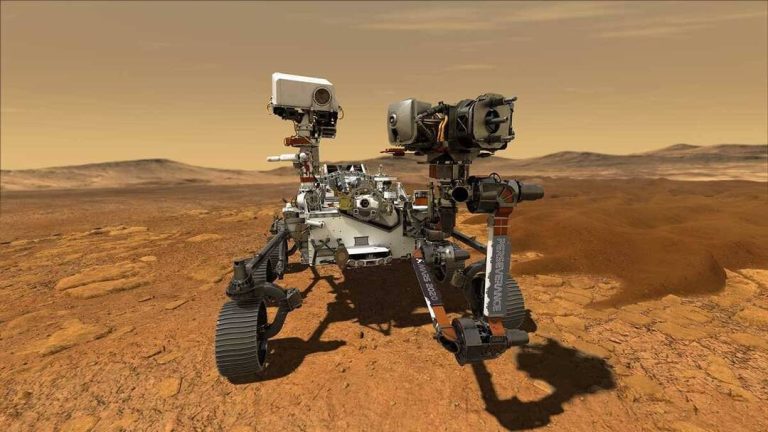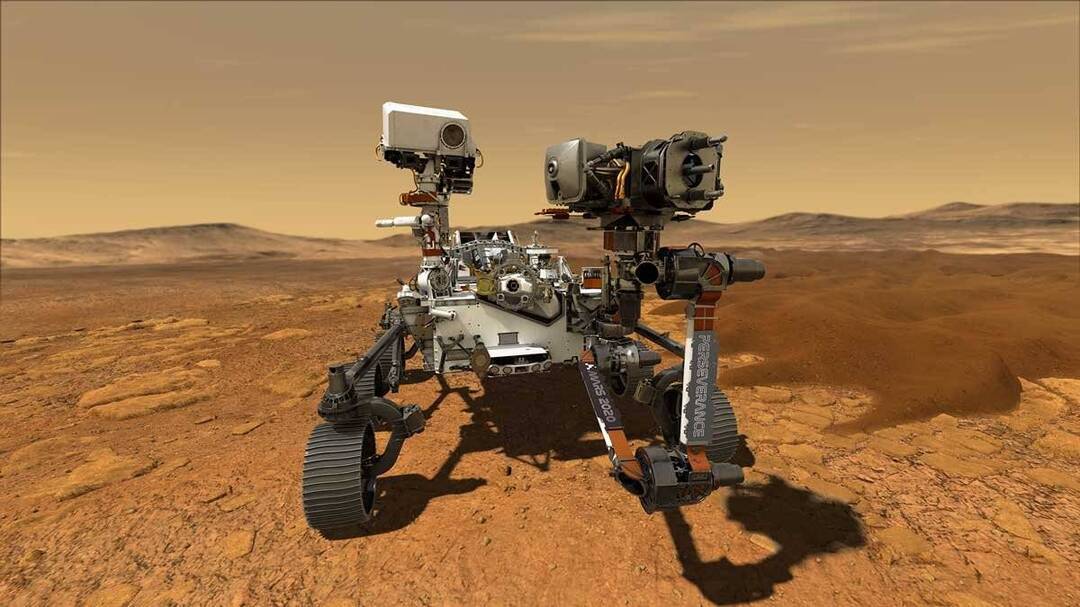
NASA’s Perseverance rover completes 1st AI-planned drive on Mars
In a groundbreaking achievement, NASA’s Perseverance rover has successfully completed its first drive on Mars that was planned by artificial intelligence. This significant milestone marks a major step forward in the use of AI in space exploration, demonstrating the potential for autonomous systems to play a key role in future missions.
According to NASA, the demonstration took place on December 8 and 10 and was led by its Jet Propulsion Laboratory in Southern California. The Perseverance rover, which landed on Mars in February 2021, has been conducting extensive research and exploration on the Red Planet, including searching for signs of past or present life.
The AI-planned drive was a complex operation that required the rover to navigate through a challenging terrain, avoiding obstacles and selecting the most efficient route to its destination. The AI system used a combination of data from the rover’s instruments, including its cameras, lidar, and radar, to plan the drive and make adjustments in real-time.
“This demonstration shows how far our capabilities have advanced and broadens how we will explore other worlds,” NASA Administrator Jared Isaacman said. “The use of AI in space exploration has the potential to revolutionize the way we conduct missions, allowing us to be more efficient, effective, and autonomous.”
The Perseverance rover is equipped with a range of advanced instruments, including a rock-corning drill, a radar system, and a suite of cameras. The rover is designed to study the geology and climate of Mars, as well as search for signs of past or present life. The AI-planned drive is a significant step forward in the rover’s mission, demonstrating its ability to operate autonomously and make decisions based on real-time data.
The use of AI in space exploration has been gaining momentum in recent years, with NASA and other space agencies investing heavily in the development of autonomous systems. AI has the potential to play a key role in future missions, from navigating complex terrain to selecting the most promising targets for scientific study.
One of the key benefits of using AI in space exploration is its ability to process large amounts of data quickly and efficiently. The Perseverance rover generates vast amounts of data every day, from images and videos to sensor readings and telemetry data. AI systems can analyze this data in real-time, identifying patterns and anomalies that may not be apparent to human operators.
Another benefit of AI is its ability to adapt to changing circumstances. The Martian environment is notoriously unpredictable, with sudden changes in weather and terrain that can pose significant challenges to the rover. AI systems can respond quickly to these changes, adjusting the rover’s plan and ensuring that it stays on track.
The success of the AI-planned drive on Mars is a significant achievement for NASA and the space community as a whole. It demonstrates the potential for AI to play a key role in future missions, from exploring the surface of Mars to searching for life beyond our solar system.
As NASA continues to push the boundaries of space exploration, the use of AI is likely to become increasingly important. The agency is already planning to use AI in a range of future missions, from the Artemis program to return humans to the Moon to the Europa Clipper mission to explore Jupiter’s icy moon.
In conclusion, the completion of the first AI-planned drive on Mars is a significant milestone in the use of artificial intelligence in space exploration. It demonstrates the potential for AI to play a key role in future missions, from navigating complex terrain to selecting the most promising targets for scientific study. As NASA continues to push the boundaries of space exploration, the use of AI is likely to become increasingly important, enabling the agency to conduct more efficient, effective, and autonomous missions.
About the Author