When you meet an Indian and a snake, kill the Indian first: Norway leader in Epstein files email
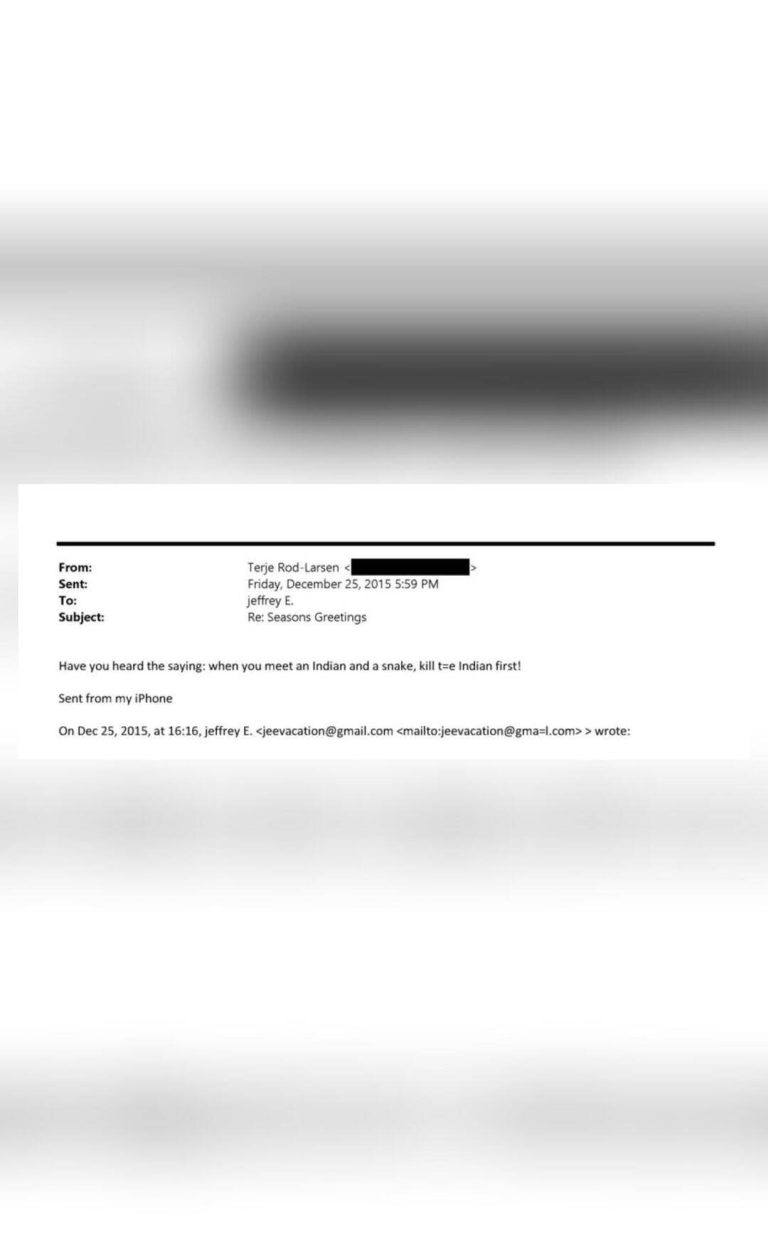
A shocking email has surfaced as part of the Epstein files, revealing a derogatory remark made by Norwegian diplomat Terje Rod-Larsen about Indians. The email, sent to convicted sex offender Jeffrey Epstein, contains a racist saying that has sparked widespread outrage on social media. The saying, “Have you heard the saying: when you meet an Indian and a snake, kill the Indian first,” is a disturbing example of the racist attitudes that still persist in some parts of the world.
The email, which was released as part of the Epstein files, has been widely criticized on social media, with many users expressing their outrage and disgust at the diplomat’s remark. One user wrote, “Aah Norwegians, the famously racist white lot,” highlighting the perceived hypocrisy of Norway, a country often seen as a bastion of tolerance and equality. The fact that a high-ranking diplomat such as Terje Rod-Larsen would make such a comment is particularly disturbing, as it suggests that racist attitudes may be more prevalent in positions of power than we might like to think.
The saying itself is a disturbing example of the kind of racist stereotypes that have been used to dehumanize and marginalize indigenous communities for centuries. The idea that an Indian person is more dangerous than a snake is a ridiculous and offensive notion, and it is appalling that a diplomat would repeat such a saying, let alone in an email to a convicted sex offender. The fact that Epstein, who was known for his predatory behavior towards young women, would be the recipient of such an email is also noteworthy, as it suggests that Rod-Larsen may have been trying to curry favor with the wealthy and influential financier.
The reaction to the email on social media has been swift and decisive, with many users calling for Rod-Larsen to be held accountable for his remarks. Some have pointed out that the diplomat’s comment is not just a personal opinion, but also a reflection of the broader attitudes towards indigenous communities that exist in some parts of the world. Others have noted that the email is a reminder of the systemic racism that still exists in many institutions, including governments and diplomatic corps.
The Norwegian government has yet to comment on the email, but it is likely that the diplomat will face some kind of disciplinary action in the coming days. In the meantime, the email has sparked a wider conversation about racism and tolerance, and the need for greater awareness and understanding of the experiences of indigenous communities. As one user wrote, “This is not just about one diplomat’s racist comment, it’s about the systemic racism that exists in our society and the need for us to do better.”
The Epstein files, which were released as part of a larger investigation into the financier’s sex trafficking ring, have shed light on a number of disturbing and previously unknown facts about Epstein’s associates and acquaintances. The files have also raised questions about the relationships between powerful individuals and the ways in which they use their influence to protect and enable each other. In the case of Rod-Larsen, the email suggests that the diplomat may have been trying to ingratiate himself with Epstein, who was known for his wealth and influence.
The fact that Epstein was able to cultivate relationships with so many powerful and influential people, despite his well-documented history of predatory behavior, is a disturbing commentary on the ways in which power and privilege can be used to silence and enable abuse. The Epstein files have also highlighted the need for greater transparency and accountability in positions of power, and the importance of holding individuals accountable for their actions, regardless of their status or influence.
In conclusion, the email sent by Norwegian diplomat Terje Rod-Larsen to Jeffrey Epstein is a disturbing example of the racist attitudes that still exist in some parts of the world. The saying, “Have you heard the saying: when you meet an Indian and a snake, kill the Indian first,” is a ridiculous and offensive notion that has no place in modern society. The fact that a high-ranking diplomat would repeat such a saying, let alone in an email to a convicted sex offender, is a reminder of the systemic racism that still exists in many institutions, including governments and diplomatic corps. As we move forward, it is essential that we prioritize greater awareness and understanding of the experiences of indigenous communities, and work to create a more just and equitable society for all.
About the Author