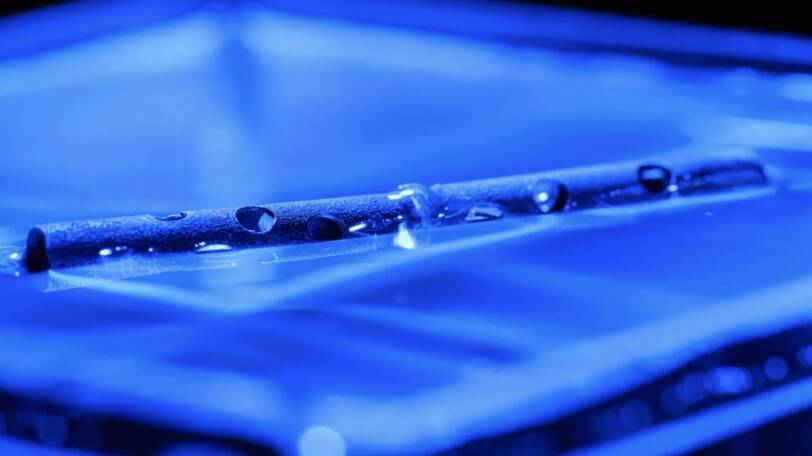
Scientists develop metal tubes that could enable unsinkable ships
Imagine a ship that can withstand even the most treacherous of seas, remaining afloat even when damaged or submerged for extended periods. This may seem like the stuff of science fiction, but thanks to a groundbreaking new development, it could soon become a reality. Scientists have recently made a significant breakthrough in materials science, creating a highly buoyant metal tube structure that can float even when damaged or submerged for long periods. This innovative technology has the potential to revolutionize the maritime industry, enabling the construction of “unsinkable ships” that could save countless lives and reduce the risk of maritime disasters.
The key to this remarkable development lies in the processing of aluminium, a metal that is already widely used in shipbuilding due to its strength, durability, and resistance to corrosion. However, aluminium is not typically known for its buoyancy, which is why scientists had to think outside the box to create a metal tube structure that could defy the laws of gravity. By adding nanometer-scale grooves to aluminium tubes, researchers were able to make them superhydrophobic, meaning they repel water and can stably maintain air bubbles on their inner surface.
This superhydrophobic property is crucial in creating a buoyant metal tube structure. When the tubes are submerged in water, the air bubbles that form on their inner surface help to reduce the weight of the metal, allowing it to float. Even when the tubes are damaged with holes, the air bubbles can still be maintained, ensuring that the structure remains buoyant. This is a significant improvement over traditional metal tubes, which would typically sink if damaged or submerged for extended periods.
The implications of this technology are vast and far-reaching. For starters, it could enable the construction of unsinkable ships that could withstand even the most extreme weather conditions. This would be a major breakthrough for the maritime industry, where sinkings and accidents are still a major concern. According to the International Maritime Organization (IMO), there were over 1,000 reported ship sinkings between 2010 and 2020, resulting in significant loss of life and property.
The potential applications of this technology extend beyond shipbuilding, however. It could also be used in the construction of offshore platforms, buoyant bridges, and even floating cities. The possibilities are endless, and scientists are already exploring new ways to utilize this innovative material.
One of the most significant advantages of this technology is its potential to improve safety at sea. Unsinkable ships would be able to withstand even the most extreme weather conditions, reducing the risk of accidents and sinkings. This would be a major breakthrough for the maritime industry, where safety is always a top concern. Additionally, the use of superhydrophobic metal tubes could also reduce the risk of environmental damage, as ships would be less likely to leak oil or other hazardous materials into the water.
The development of this technology is also a testament to the power of scientific innovation. By pushing the boundaries of materials science and exploring new ways to manipulate and process metals, researchers have been able to create something truly remarkable. This breakthrough is a reminder that even the most seemingly insurmountable challenges can be overcome with determination, creativity, and a willingness to think outside the box.
In conclusion, the development of metal tubes that can enable unsinkable ships is a groundbreaking achievement that has the potential to revolutionize the maritime industry. By creating a highly buoyant metal tube structure that can float even when damaged or submerged for long periods, scientists have opened up new possibilities for shipbuilding and beyond. As this technology continues to evolve and improve, we can expect to see significant advances in safety, sustainability, and innovation at sea.
For more information on this breakthrough, visit: https://www.sciencedaily.com/releases/2026/01/260130041105.htm
News Source: https://www.sciencedaily.com/releases/2026/01/260130041105.htm
About the Author