Scientists develop metal tubes that could enable unsinkable ships
The concept of an “unsinkable ship” has long been a topic of fascination and debate among shipbuilders, engineers, and scientists. While the idea of a ship that can withstand any amount of damage or flooding may seem like the stuff of science fiction, researchers have made a groundbreaking discovery that could bring this vision closer to reality. By developing a highly buoyant metal tube structure through a novel processing technique, scientists have created a material that can float even when submerged for long periods or damaged with holes. This innovative technology has the potential to revolutionize the maritime industry and pave the way for the creation of “unsinkable ships.”
The breakthrough was achieved by a team of researchers who set out to create a metal tube structure that could maintain its buoyancy even in the face of damage or prolonged submersion. To achieve this, they turned to aluminium, a lightweight and versatile metal that is commonly used in a wide range of applications, from aerospace to construction. However, aluminium on its own is not sufficient to create a buoyant structure, as it is prone to becoming waterlogged and losing its buoyancy when submerged.
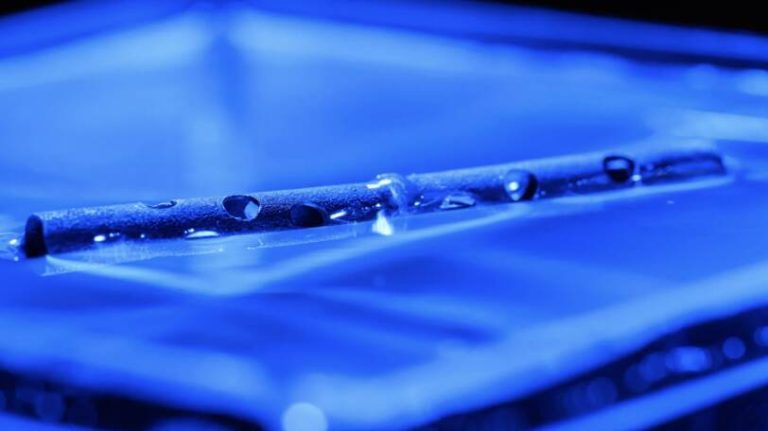
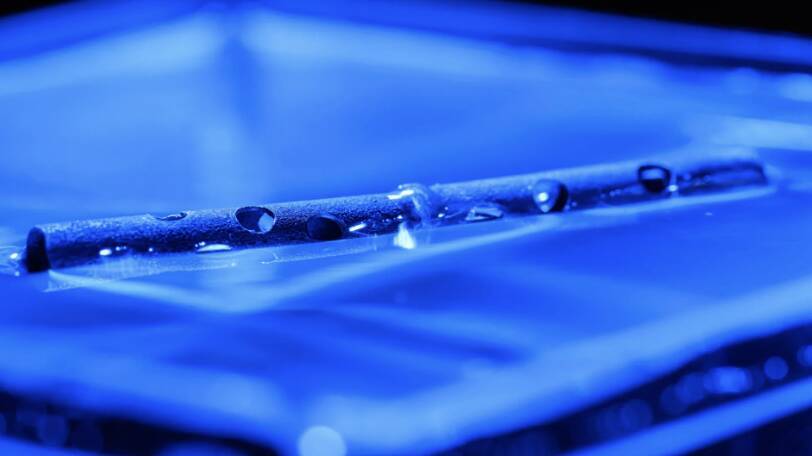
To overcome this limitation, the researchers employed a novel technique that involved adding nanometer-scale grooves to the surface of the aluminium tubes. This process, known as nanostructuring, creates a unique surface topology that makes the metal superhydrophobic, or extremely water-repellent. By creating these tiny grooves, the researchers were able to trap air bubbles on the inner surface of the tubes, which in turn enabled the structure to maintain its buoyancy even when submerged.
The resulting metal tube structure is not only highly buoyant but also remarkably stable. When subjected to damage or holes, the structure is able to maintain its air bubbles and continue to float, even in the face of significant water pressure. This is in stark contrast to traditional metal tubes, which would typically become waterlogged and sink in such circumstances.
The implications of this discovery are far-reaching and exciting. By using this novel metal tube structure, shipbuilders could potentially create vessels that are resistant to sinking, even in the event of catastrophic damage. This could have a major impact on maritime safety, as it would significantly reduce the risk of accidents and fatalities at sea. Additionally, the technology could also be used to create more efficient and stable offshore platforms, such as oil rigs and wind turbines.
The potential applications of this technology extend beyond the maritime industry, however. The superhydrophobic properties of the metal tube structure could also be used in a wide range of other fields, from aerospace to biomedical engineering. For example, the technology could be used to create more efficient heat exchangers, or to develop new types of medical implants that are resistant to water and other fluids.
While the development of unsinkable ships is still in its infancy, the discovery of this novel metal tube structure represents a major breakthrough in the field. As researchers continue to refine and develop this technology, we can expect to see significant advances in maritime safety and efficiency. Whether it’s used to create unsinkable ships, stable offshore platforms, or innovative new products, this technology has the potential to make a major impact on a wide range of industries and applications.
In conclusion, the development of metal tubes that can float even when submerged for long periods or damaged with holes is a groundbreaking discovery that could revolutionize the maritime industry. By creating a superhydrophobic surface on aluminium tubes, researchers have been able to create a highly buoyant structure that can maintain its air bubbles and continue to float, even in the face of significant water pressure. As this technology continues to evolve and develop, we can expect to see significant advances in maritime safety and efficiency, and potentially even the creation of “unsinkable ships.”
News source: https://www.sciencedaily.com/releases/2026/01/260130041105.htm
About the Author