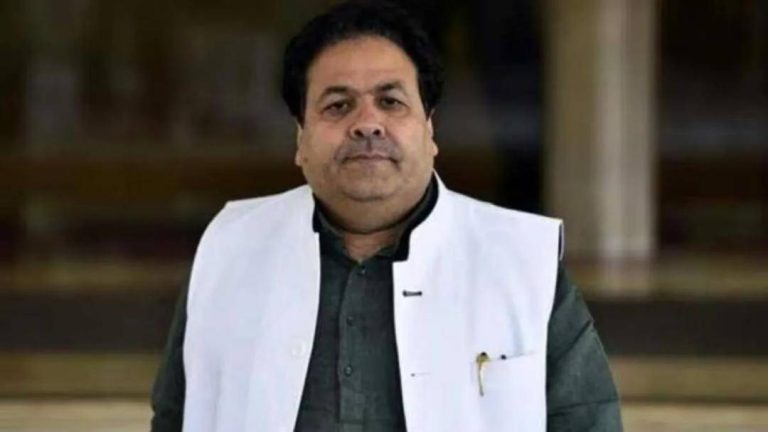
CMs meeting CMs in Switzerland to sign deals, criminal waste of money: Rajiv Shukla
The World Economic Forum (WEF) in Davos, Switzerland, has long been a platform for global leaders to converge and discuss pressing economic issues. However, this year’s edition has sparked controversy, with Rajya Sabha MP Rajeev Shukla criticizing the participation of Indian Chief Ministers in the event. According to Shukla, the presence of Indian CMs at the WEF is a “criminal waste of money” as they are essentially meeting with other Indians and signing agreements with Indian companies in a foreign land.
Shukla’s remarks have ignited a debate about the efficacy of Indian leaders attending international events, where they often end up interacting with their own countrymen rather than forging meaningful connections with global leaders. “It’s strange…Indians are going to Davos to meet Indians,” Shukla said, highlighting the absurdity of the situation. “State governments are signing agreements with Indian companies in Switzerland, which they could’ve done in India,” he added, questioning the logic behind such decisions.
The WEF is an annual gathering of the world’s most influential people, including heads of state, business leaders, and thought leaders. While it provides a unique opportunity for networking and deal-making, Shukla’s criticism raises important questions about the value proposition of Indian leaders attending the event. If the primary objective is to sign agreements with Indian companies, it is indeed puzzling why this cannot be done within the country.
Furthermore, the cost of attending the WEF is substantial, with estimates suggesting that the Indian government spends millions of dollars on travel, accommodation, and other expenses for its delegations. In an era of fiscal austerity, such extravagance is difficult to justify, especially when the benefits of attending the event are not clearly evident. Shukla’s characterization of the situation as a “criminal waste of money” may be hyperbolic, but it underscores the need for a more nuanced approach to international engagement.
Another aspect of Shukla’s criticism is the phenomenon of “CMs meeting CMs” in Davos. This phrase suggests that Indian Chief Ministers are using the WEF as a platform to network with their counterparts from other states, rather than engaging with global leaders. While such interactions may be useful for exchanging best practices and discussing regional issues, they do not necessarily justify the expense and effort of traveling to Switzerland.
In recent years, the Indian government has been keen to promote the country as a destination for foreign investment, with initiatives like “Make in India” and “Digital India” aimed at attracting international businesses. However, if Indian leaders are signing agreements with Indian companies in Switzerland, it sends a mixed signal about the country’s commitment to promoting domestic investment.
Shukla’s comments have sparked a lively debate on social media, with some defending the participation of Indian leaders in the WEF as essential for promoting the country’s interests abroad. Others have echoed Shukla’s criticism, arguing that the expense and effort of attending the event could be better spent on domestic development initiatives.
As the WEF continues to attract global leaders and celebrities, it is essential to evaluate the benefits and drawbacks of Indian participation in the event. While there may be some advantages to attending the WEF, such as networking opportunities and access to global thought leaders, these must be weighed against the significant costs involved. If the primary outcome of Indian leaders attending the WEF is to sign agreements with Indian companies or meet with other Indian leaders, it is indeed a “criminal waste of money.”
In conclusion, Rajeev Shukla’s criticism of Indian Chief Ministers attending the World Economic Forum in Davos has highlighted the need for a more critical evaluation of international engagement. While the WEF may provide a platform for global leaders to converge and discuss pressing issues, the benefits of Indian participation must be carefully weighed against the costs. As the country seeks to promote domestic investment and development, it is essential to prioritize initiatives that deliver tangible benefits, rather than indulging in expensive and potentially futile exercises in international diplomacy.
News source: https://x.com/ShuklaRajiv/status/2013664724563726652
About the Author