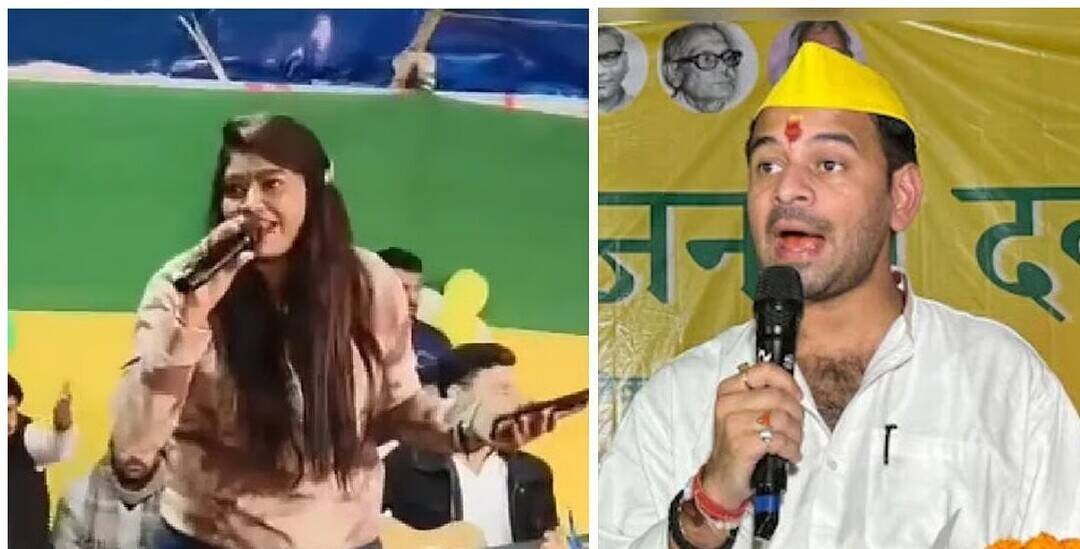
Tej Pratap asks singer to not sing ‘vulgar’ songs at Patna event
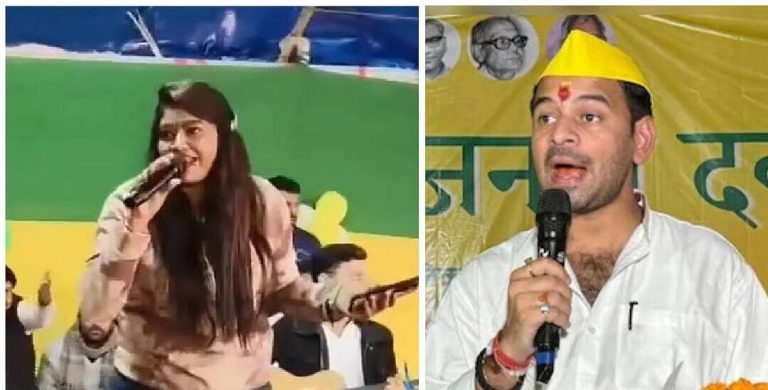
In a bizarre incident, JJD chief Tej Pratap Yadav was seen interrupting a Bhojpuri singer in the middle of her performance at a Makar Sankranti event in Patna. The video of the incident has gone viral on social media, sparking a debate about the role of politicians in shaping cultural norms. According to reports, Yadav stopped the singer and asked her to refrain from singing “vulgar” songs, instead urging her to sing devotional songs.
The video, which has been widely shared on social media platforms, shows Yadav walking up to the stage and asking the singer to stop performing. He is heard saying, “Krishna ji wala bhajan gaao (sing hymns of Lord Krishna).” The singer, taken aback by the sudden interruption, is seen trying to explain herself, but Yadav is firm in his request. He tells her that the event is a cultural program and that she should sing songs that are more suitable for the occasion.
The incident has sparked a mixed reaction on social media, with some praising Yadav for his efforts to promote cultural values, while others have criticized him for interfering with the singer’s performance. Some have also questioned the definition of “vulgar” and who has the right to decide what is acceptable and what is not.
The issue of censorship and moral policing has been a contentious one in India, with many arguing that it is a form of cultural oppression. The fact that a politician felt the need to intervene in a cultural event and dictate what kind of music is acceptable has raised concerns about the role of politics in shaping cultural norms.
On the other hand, some have argued that Yadav’s actions were necessary to maintain the cultural integrity of the event. They argue that the singer’s performance was not in line with the values and traditions of the occasion, and that Yadav was right to intervene.
The incident has also highlighted the complexities of cultural identity and the challenges of navigating different cultural norms and values. The fact that the singer was performing in a Bhojpuri language, which is a dialect spoken in the region, adds another layer of complexity to the issue.
In recent years, there has been a growing trend of moral policing in India, with many incidents of artists and performers being targeted for their work. The incident involving Tej Pratap Yadav and the Bhojpuri singer is just the latest example of this trend, and it raises important questions about the role of politics and culture in shaping our society.
As the debate surrounding the incident continues, it is essential to consider the broader implications of such actions. While it is essential to promote cultural values and traditions, it is equally important to respect the rights of artists and performers to express themselves freely.
In conclusion, the incident involving Tej Pratap Yadav and the Bhojpuri singer has sparked an important debate about the role of politics and culture in shaping our society. While it is essential to promote cultural values and traditions, it is equally important to respect the rights of artists and performers to express themselves freely. As we navigate the complexities of cultural identity and moral policing, it is crucial to strike a balance between promoting cultural values and respecting individual rights.
About the Author