Tej Pratap asks singer to not sing ‘vulgar’ songs at Patna event
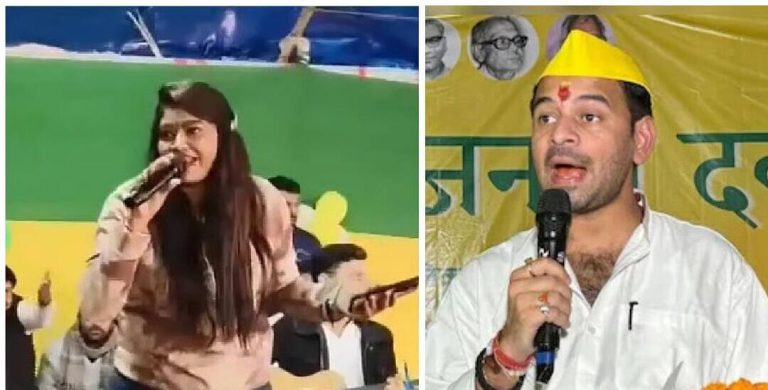
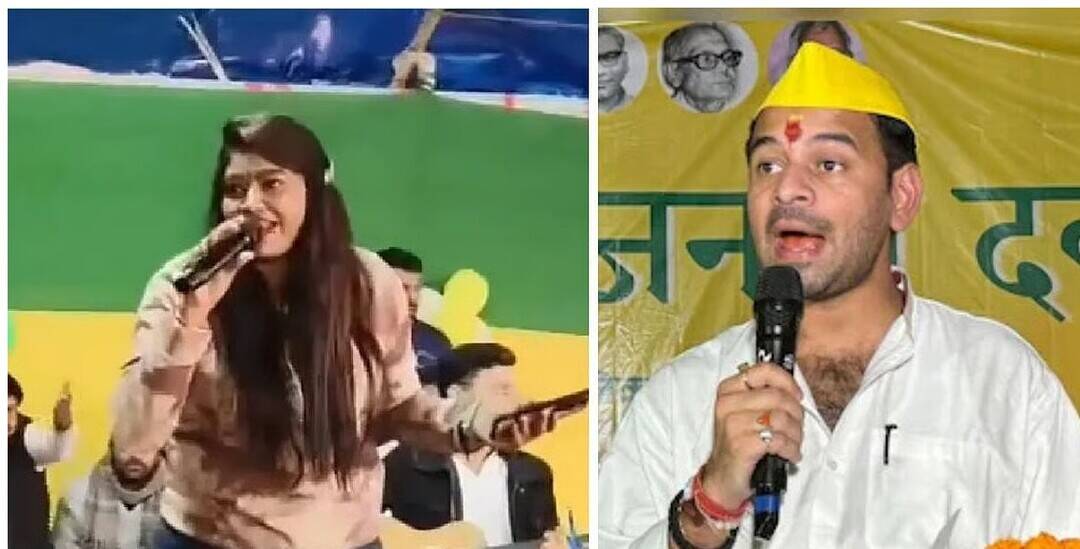
A recent incident at a Makar Sankranti event in Patna has sparked a heated debate on social media, with a video of Jan Adhikar Dal (JAD) chief Tej Pratap Yadav interrupting a Bhojpuri singer in the middle of her performance going viral. The video, which has been widely shared on various social media platforms, shows Yadav taking the stage and telling the singer to stop singing “vulgar” songs and instead sing devotional songs.
As can be seen in the video, Yadav, who is also the son of former Bihar Chief Minister Lalu Prasad Yadav, walks up to the stage where the singer is performing and requests her to stop singing. He is heard saying, “Vulgar gaana mat gaao, bhajan gaao (don’t sing vulgar songs, sing hymns)”. He further adds, “Krishna ji wala bhajan gaao (sing hymns of Lord Krishna)”. The singer, taken aback by the sudden interruption, tries to reason with Yadav, but he firmly tells her to change her song and sing something more devotional.
The incident has sparked a mixed reaction on social media, with some people praising Yadav for taking a stand against “vulgar” content, while others have criticized him for interfering with the singer’s performance. Some have even accused him of trying to impose his own moral code on others, and of being a “moral police”.
The issue of “vulgar” content in music and entertainment has been a contentious one in India, with many people arguing that it is a threat to traditional values and culture. However, others argue that it is a matter of personal choice and that artists should be free to express themselves as they see fit.
In recent years, there have been several instances of politicians and moral vigilantes trying to impose their own moral code on others, often with disastrous consequences. For example, in 2019, a group of right-wing activists in Uttar Pradesh tried to disrupt a concert by a popular singer, accusing her of singing “vulgar” songs. The incident sparked a huge controversy, with many people condemning the activists for trying to impose their own moral code on others.
Similarly, in 2018, a group of politicians in Tamil Nadu tried to ban a popular Tamil film, accusing it of containing “vulgar” content. The move was widely criticized by the film industry and civil society, with many people arguing that it was an attack on artistic freedom.
In the context of the recent incident in Patna, it is clear that Yadav’s actions have sparked a heated debate on social media. While some people have praised him for taking a stand against “vulgar” content, others have criticized him for interfering with the singer’s performance.
However, it is also important to consider the broader implications of such incidents. Do politicians and moral vigilantes have the right to impose their own moral code on others? Should artists be free to express themselves as they see fit, or should they be bound by traditional values and norms?
Ultimately, the answer to these questions will depend on one’s perspective on artistic freedom and moral values. However, it is clear that incidents like the one in Patna highlight the need for a nuanced and balanced approach to these issues. Rather than trying to impose our own moral code on others, we should strive to create a society that values diversity, tolerance, and artistic freedom.
In conclusion, the incident at the Makar Sankranti event in Patna has sparked a heated debate on social media, with many people praising or criticizing Yadav’s actions. While the issue of “vulgar” content in music and entertainment is a complex one, it is clear that incidents like this highlight the need for a nuanced and balanced approach to artistic freedom and moral values.
About the Author