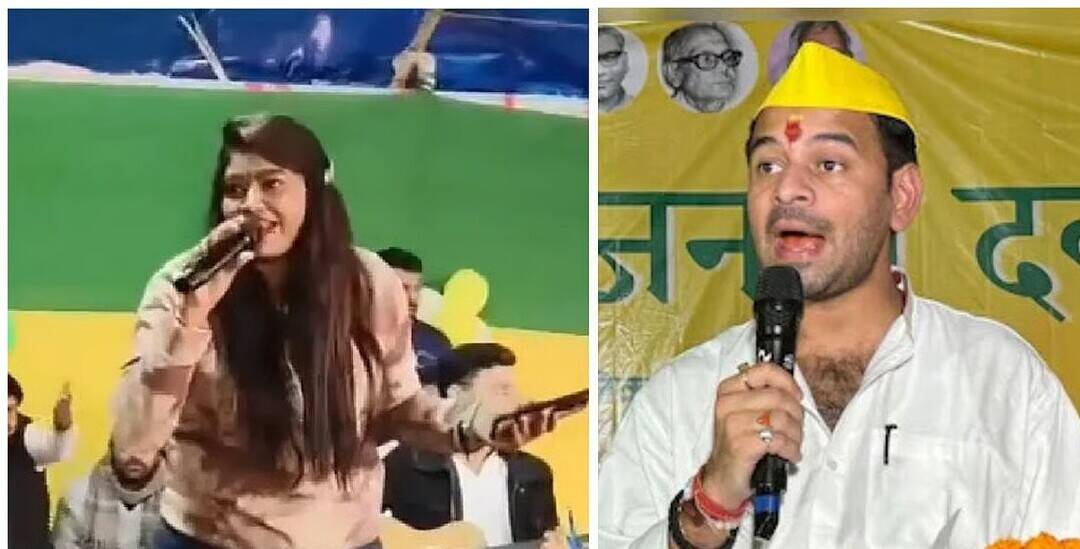
Tej Pratap asks singer to not sing ‘vulgar’ songs at Patna event
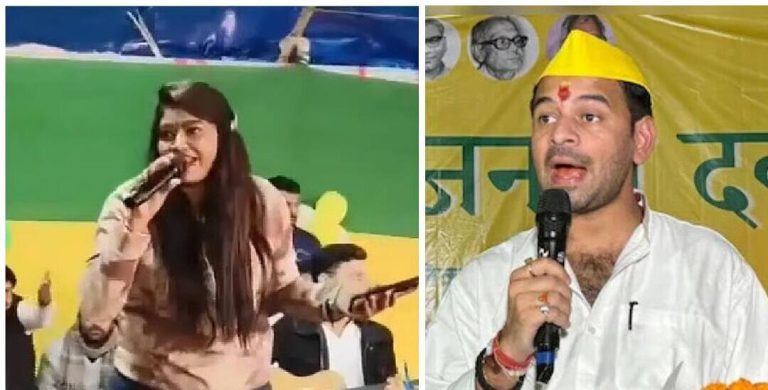
In a recent incident, Rashtriya Janata Dal (RJD) leader and Janata Jaladhar Dal (JJD) chief Tej Pratap Yadav made headlines when he interrupted a Bhojpuri singer in the middle of her performance at a Makar Sankranti event in Patna. The video of the incident has gone viral on social media, sparking a debate about the role of politicians in shaping cultural norms and the limits of artistic expression.
According to reports, Tej Pratap Yadav, who is also the son of former Bihar Chief Minister Lalu Prasad Yadav, was attending a Makar Sankranti event in Patna when he took the stage to address the crowd. As the Bhojpuri singer was performing, Yadav suddenly interrupted her, asking her to stop singing “vulgar” songs. Instead, he requested her to sing devotional songs, specifically hymns of Lord Krishna. “Krishna ji wala bhajan gaao (sing hymns of Lord Krishna),” he added.
The video of the incident shows Yadav walking up to the singer and whispering something in her ear, after which she stops singing and the music comes to a halt. The crowd seems taken aback by the sudden interruption, with some people cheering and others looking confused. The singer, however, quickly recovers and starts singing a devotional song, as requested by Yadav.
While some people have praised Yadav for taking a stand against “vulgar” content, others have criticized him for trying to impose his personal values on others. The incident has sparked a debate about the role of politicians in shaping cultural norms and the limits of artistic expression. Some have argued that politicians should not try to dictate what kind of music or art is acceptable, while others have welcomed Yadav’s move, saying that it is necessary to promote a more positive and respectful culture.
The incident has also raised questions about the definition of “vulgar” content and who gets to decide what is acceptable and what is not. In recent years, there has been a growing trend of politicians and self-appointed moral guardians trying to dictate what kind of music, films, and art are acceptable. This has led to a polarization of opinions, with some people arguing that such attempts are necessary to protect traditional values and others seeing them as an attack on artistic freedom.
In the context of Bhojpuri music, which is known for its earthy and often provocative lyrics, the issue of “vulgarity” is particularly complex. While some Bhojpuri songs do contain explicit language and suggestive themes, others are more nuanced and layered, exploring themes of love, longing, and social justice. The question of what constitutes “vulgar” content is therefore subjective and open to interpretation.
The incident has also highlighted the importance of respecting artistic freedom and the autonomy of artists to create and express themselves as they see fit. While it is understandable that some people may find certain types of music or art objectionable, it is not the role of politicians or anyone else to dictate what kind of art is acceptable. Instead, we should be promoting a culture of tolerance, respect, and open-mindedness, where artists are free to create and express themselves without fear of censorship or reprisal.
In conclusion, the incident involving Tej Pratap Yadav and the Bhojpuri singer has sparked an important debate about the role of politicians in shaping cultural norms and the limits of artistic expression. While some people have praised Yadav for taking a stand against “vulgar” content, others have criticized him for trying to impose his personal values on others. Ultimately, the incident highlights the importance of respecting artistic freedom and promoting a culture of tolerance, respect, and open-mindedness.
About the Author