Tej Pratap asks singer to not sing ‘vulgar’ songs at Patna event
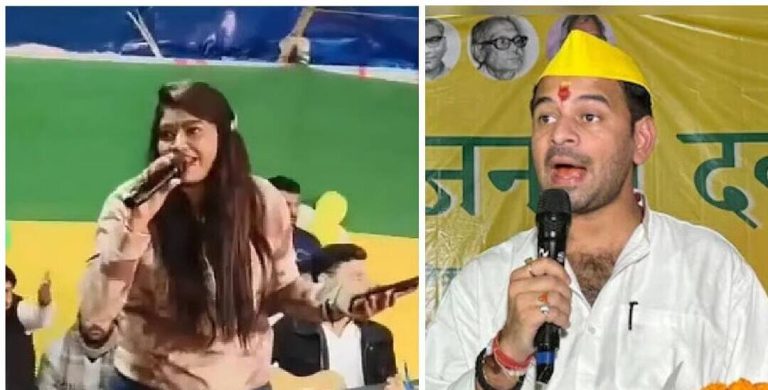
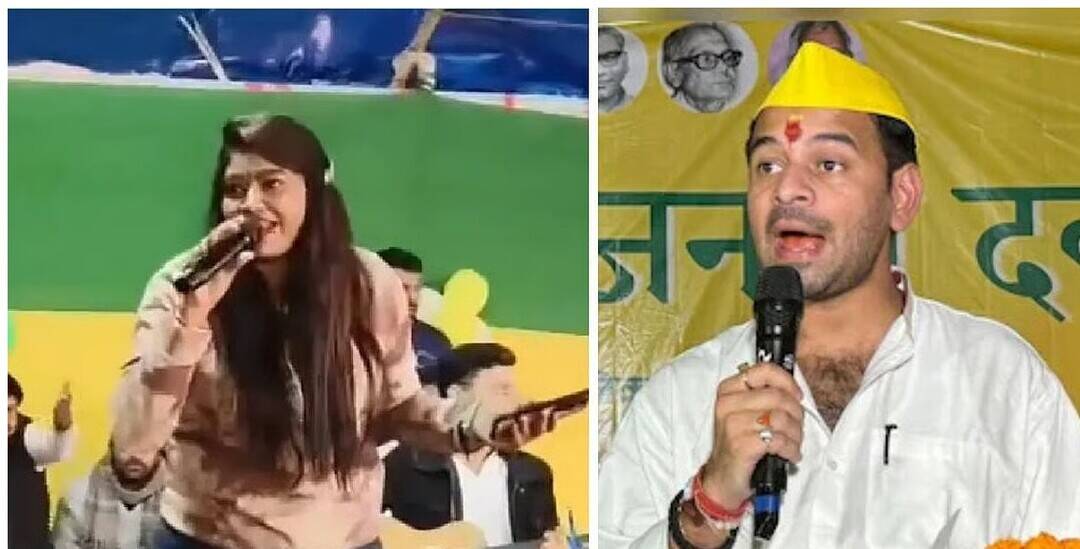
A recent incident at a Makar Sankranti event in Patna has sparked a heated debate on social media, with many weighing in on the role of politicians in policing artistic expression. The controversy began when a video surfaced of Jan Adhikar Party (JAP) chief Tej Pratap Yadav interrupting a Bhojpuri singer in the middle of her performance. The singer, whose identity has not been disclosed, was reportedly singing a popular Bhojpuri song when Yadav suddenly took the stage, objecting to the lyrics of the song.
According to eyewitnesses, Yadav approached the singer and told her to stop singing “vulgar” songs, suggesting that she instead sing devotional songs. “Krishna ji wala bhajan gaao (sing hymns of Lord Krishna),” he added, emphasizing his point. The video of the incident, which has gone viral on social media, shows Yadav gesturing to the singer and seemingly instructing her on what type of songs to sing.
The incident has raised several questions about the role of politicians in dictating what constitutes acceptable artistic expression. While some have praised Yadav for taking a stand against “vulgar” content, others have criticized him for overstepping his bounds and trying to impose his personal values on others.
The issue of “vulgar” content in music and art is a complex one, with different people having different opinions on what constitutes acceptable lyrical content. Some argue that songs with explicit lyrics or suggestive themes are inappropriate and should be banned, while others believe that artistic expression should be free from censorship and that individuals should be able to make their own choices about what they listen to.
In this context, Yadav’s actions at the Patna event have been seen as an attempt to impose his own moral code on the singer and the audience. While his intentions may have been to promote more “wholesome” content, his methods have been criticized as heavy-handed and dictatorial.
Moreover, the incident has also raised questions about the double standards of politicians when it comes to issues of morality and artistic expression. Many have pointed out that politicians often attend events and functions where “vulgar” content is on display, but only speak out against it when it suits their political interests.
The video of the incident has sparked a lively debate on social media, with many people weighing in on the issue. Some have praised Yadav for taking a stand against “vulgar” content, while others have criticized him for trying to impose his personal values on others.
One Twitter user wrote, “Tej Pratap Yadav is absolutely right in asking the singer to stop singing vulgar songs. We need more leaders like him who are willing to take a stand against indecency and promote good values.”
On the other hand, another user commented, “This is ridiculous. Who is Tej Pratap Yadav to decide what constitutes ‘vulgar’ content? Artistic expression should be free from censorship and politicians should not try to impose their personal values on others.”
The incident has also sparked a broader discussion about the role of politicians in shaping cultural narratives and promoting artistic expression. While some argue that politicians have a responsibility to promote “good” values and culture, others believe that they should stay out of artistic matters and focus on more pressing issues like governance and development.
In conclusion, the incident at the Patna event has highlighted the complexities of artistic expression and the role of politicians in policing cultural narratives. While Tej Pratap Yadav’s actions may have been well-intentioned, they have also sparked a lively debate about the limits of political intervention in artistic matters. As the debate continues, it remains to be seen how this incident will shape the broader conversation about artistic expression and cultural values in India.
About the Author